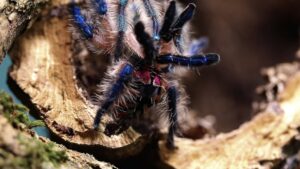
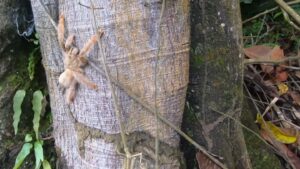
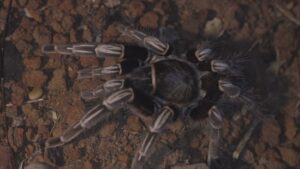
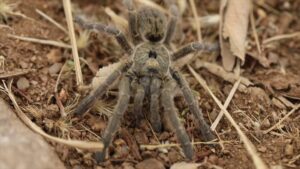
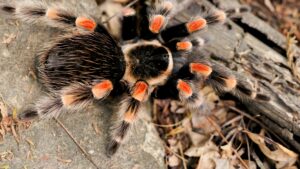
Antikuna is a genus of seven tarantula species, all recorded from Peru. I described it in 2021 with Kaderka, Ferretti, Lüddecke and West, and the name is Quechua for ‘Andes’.[1][2] The spiders live under rocks on high Andean slopes in central Peru, between 3,836 and 4,689 metres above sea level, and several species have blue or violet iridescence on the femora.[2] One of them, A. valladaresi, was reported in 2021 as a new altitude record for the whole tarantula family.[2]

What is Antikuna?
The genus belongs to the Theraphosinae, the New World subfamily that holds most of the large South American tarantulas. The World Spider Catalog lists the genus as Antikuna Kaderka, Ferretti, West, Lüddecke & Hüsser, 2021, with A. cernickai as the type species.[1] The spiders are medium sized, 18.9 to 31.9 millimetres in total length.[2] In the phylogenetic analysis of Ferretti and colleagues (2023), the Peruvian genus Chinchaysuyu came out as the sister group of Antikuna, and Hapalotremus as the sister of that pair.[4]
How to tell it from its neighbours
The authors name four features that separate Antikuna from other genera.[2]
- One central patch of type III urticating hairs on the abdomen. Bistriopelma has two lateral patches.
- In males, a palpal bulb with four keels, two of which end in a short tooth.
- In females, spermathecae made of two separate, divergent seminal receptacles. Hapalotremus has a single, undivided receptacle.
- In males, the leg order I, IV, II, III. Males of Homoeomma carry a basal nodule on the first metatarsus, and Antikuna males do not.
The spermathecae also set it apart from Thrixopelma, whose receptacles are short and swollen where Antikuna has long, flat ones.[2] None of this can be read from a photograph in the field. In practice the colour of the legs and the red abdominal hairs are what we notice first.
The seven species
The World Spider Catalog records all seven from Peru.[1] In the 2021 paper each one is known only from its type locality, and the species sit in three departments of central Peru: Junín, Huancavelica and Ayacucho.[2] The colour notes below come from the authors’ diagnoses.[2]
- Antikuna cernickai (Huancavelica) is the type species. Males have dark brown legs with darker femora that show violet iridescence. Females have black legs and a black abdomen without long reddish-brown hairs.
- Antikuna cimrmani (Huancavelica) was described from a female with dark grey legs and darker femora that show blue iridescence. Its type locality lies only 14 kilometres from that of A. cernickai. We cover it in its own field article.
- Antikuna cyanofemur (Junín) takes its name from the dark blue femora. Males have light brown legs with dark femora and blue iridescence. Females have black legs and a black abdomen covered with long reddish-brown hairs.
- Antikuna majkusi (Ayacucho) has uniformly dark brown legs in males. Females have black legs and a black abdomen with long reddish-brown hairs.
- Antikuna sapallanga (Junín) was described from a female with light brown legs, dark brown femora and a dark spot above the epigastric furrow.
- Antikuna urayrumi (Junín) means ‘under the rock’ in Quechua. Males have light brown legs with dark brown femora.
- Antikuna valladaresi (Junín) has males with light brown legs and black femora. This is the species behind the altitude record below.
So ‘blue-legged’ fits some of the seven and not all of them. The authors record iridescent femora in several species, in blue, violet or olive depending on species and sex: blue in A. cyanofemur males, A. cimrmani females and, weakly, A. sapallanga females, violet in A. cernickai males, and olive in A. majkusi males.[2]

Where Antikuna lives
The genus lives on the Andean slopes of central Peru above 3,800 metres.[2] The best habitat description in the paper is for A. urayrumi, found on open puna slopes with bunchgrass and sparse low shrubs. There the females sat in their own retreats or in abandoned rodent burrows beneath angular rocks, in burrows 20 to 25 centimetres long with a light silk lining. It was common to find several life stages under the same rock, each in its own burrow, and grazing sheep and farm plots occur across the area.[2]
The climate is cold. At the A. urayrumi site, at about 4,175 metres, the average in the coldest month is 10 degrees Celsius and nights can fall to 1 degree.[2] When the A. cyanofemur animals were collected, temperatures reached 10.5 degrees under cloud, and snow showers lasted until 11 a.m.[2] At the A. valladaresi site several females carried egg sacs about 10 millimetres across, and the authors found them at no particular time of year.[2]

The 4,689 metre record
The 2018 revision of Hapalotremus reported H. vilcanota at 4,524 metres as the highest record for a tarantula.[3] Three years later the Antikuna paper gave A. valladaresi at 4,689 metres and called it a new highest altitude record for the family.[2] That is the 2021 claim. We have not found a later paper that moves the figure, so 2021 is the date we can give for it.
What our films show
We filmed the genus in the field on our trips to Peru. Each film below already has a home on another page, so here we only point to the moments that matter.
- Why New Tarantula Species Keep Emerging (2022) is the film for A. cimrmani. From 1:36 we describe slightly silked, S-curved tunnels under rocks, two spiders under one rock with separate entrances, and more than 15 animals in an area of about 20 by 20 metres. At 2:38 we stand at the type site at around 4,000 metres. The full article is on the Antikuna cimrmani page.
- This Violet Tarantula Lives Among Trash (2024) follows a search at 3,500 to 4,300 metres. At 0:54 we mention a new locality with a potential eighth species, and at 5:57 we find at least one Antikuna under almost every rock on one hillside, with six or seven adult females. Later the film turns to rubbish and farmland that remove the rocks these spiders depend on. It is embedded on the Peru highlands hub.
- Why This Colorful Tarantula Will Surprise You (2024) is filmed in a dry valley and shows A. cyanofemur and an as yet undescribed Antikuna species. We find a first juvenile at 2:22, and we point out the purple-blue sheen and the red hairs where the carapace meets the abdomen. At 5:26 we explain why one animal does not match A. cyanofemur by locality or looks: it belongs to the undescribed species. Also on the Peru hub.
- I Explored the Andes and Found These Insane Tarantulas (2024) shows A. cyanofemur in the field. From 1:39 we check animals against the first description, and later the narration goes through the characters that separate Antikuna from Bistriopelma, Hapalotremus and Thrixopelma. At 7:49 we count about six larger animals and at least eight spiderlings under the rocks. It is embedded on what wild burrows show.
- Searching for Blue Tarantulas in South America (2024, Short) is a 26 second clip of a blue and red animal at altitude. It is also on the Peru hub.

In our own words from the 2024 films: highland tarantulas like Antikuna are unsuited for captivity, and their survival depends on being left alone in the wild.
More on Peruvian tarantulas
The Peru highlands hub puts Antikuna next to Hapalotremus and Bistriopelma. For the Argentine species named after Martin Gamache and me, see finding Hapalotremus martinorum. Where do tarantulas live places the Andes in a world picture, and the Theraphosidae overview covers the family.
References
- World Spider Catalog (2026), genus page for Antikuna. Natural History Museum Bern.
- Kaderka, R., Ferretti, N., Hüsser, M., Lüddecke, T. & West, R. (2021). Antikuna, a new genus with seven new species from Peru (Araneae: Theraphosidae: Theraphosinae) and the highest altitude record for the family. Journal of Natural History 55(21–22): 1335–1402. doi:10.1080/00222933.2021.1936680
- Ferretti, N., Cavallo, P., Chaparro, J. C., Ríos-Tamayo, D., Seimon, T. A. & West, R. (2018). The Neotropical genus Hapalotremus Simon, 1903 (Araneae: Theraphosidae), with the description of seven new species and the highest altitude record for the family. Journal of Natural History 52(29–30): 1927–1984. doi:10.1080/00222933.2018.1506521
- Ferretti, N., Chaparro, J. C., Ochoa, J. A. & West, R. (2023). A new tarantula (Mygalomorphae: Theraphosidae) genus endemic from Peru with a novel genitalic morphology among Theraphosinae and its phylogenetic placement. Zoologischer Anzeiger 302: 102–112. doi:10.1016/j.jcz.2022.11.011