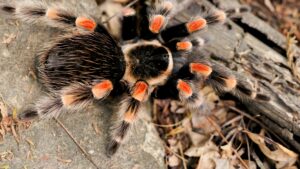
Arboreal tarantulas are the ones that live above the ground, on tree trunks, in bark holes and in silk tubes among leaves, instead of in a burrow. In the key Pérez-Miles gives for the New World, most species of Aviculariinae (the pink toes and their relatives) are arboreal, and the family as a whole includes burrowing, terrestrial and arboreal taxa.1 The World Spider Catalog counts 1,209 species in the family.2 Below are the arboreal genera I have filmed or photographed, with the catalog’s species count and what I actually saw: in the wild, or only in my collection.

Which tarantula genera are arboreal?
| Genus | Species in the catalog | What I have seen | My page |
|---|---|---|---|
| Avicularia | 122 | Field: two provisional A. hirschii records in Ecuador; captive: pink toes in my collection | A. hirschii, pink toe care |
| Caribena | 22 | Names and range of the Antilles pinktoe only | Caribena versicolor |
| Typhochlaena | 62 | Field: retreat lid of T. curumim in Paraíba (2010); Christian Andre’s field film of T. seladonia; captive: T. seladonia and T. costae | the genus, T. seladonia, T. costae |
| Ybyrapora | 32 | No film of my own; the page sorts out names and colour change | Ybyrapora diversipes |
| Psalmopoeus | 202 | Field: Psalmopoeus sp. in Panama (2011, first identified as P. reduncus), P. cambridgei in Trinidad, P. emeraldus in Colombia | P. cambridgei, P. emeraldus |
| Tapinauchenius | 112 | One reported drop from a tree into water; no film of my own | Tapinauchenius |
| Amazonius | 42 | No film. In 2018 I described a new arboreal genus from South America with A. burgessi (then Pseudoclamoris burgessi) and two new Tapinauchenius; the catalog now lists burgessi as a junior synonym of A. subcaeruleus4 | none yet |
| Poecilotheria | 152 | Field: P. subfusca in the Sri Lankan highlands | P. subfusca |
| Omothymus | 42 | Field: one Omothymus sp. on Langkawi, genus level only; captive adults | Omothymus |
| Heteroscodra, Stromatopelma | 2 and 62 | Captive only. I have not seen either in the wild | Heteroscodra maculata |
The species counts are those of version 27 of the catalog.2 Old World and New World are not the same animals in the hand, which is the subject of Old World vs New World tarantulas, and the wider sorting by burrow, ground and tree is on types of tarantulas.
What is a pink toe tarantula?
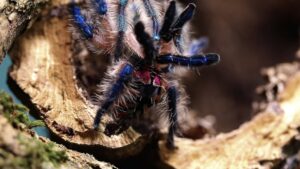
“Pink toe” is a hobby name, not a taxon. It covers Avicularia and its relatives, among them Caribena, the Antilles pinktoe. For more than a century Caribena versicolor was filed under Avicularia, and many people still search for the old name.3 The short below shows an Avicularia minatrix walking over a piece of wood, filmed against a dark backdrop.
Where do wild arboreal tarantulas hide?
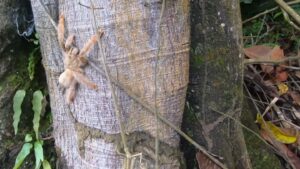
Mostly in silk, and the silk is often how I find them. In Panama in 2011, with Ray Gabriel and Reto, I found a silken retreat in a rotten stilt root of a walking palm on cattle land near Almirante. A leg showed in the beam of the torch. It was a juvenile Psalmopoeus with four legs missing, first identified as P. reduncus, although recent work gives P. pulcher and P. intermedius as the Panamanian records,6 and we put it back after a few photos (the full story). In Trinidad we found Psalmopoeus cambridgei about three metres up in a tall tree, in a metal pipe beside bamboo, as juveniles webbed into folded leaves, and once in a burrow in a roadside bank with no tree beside it (16:00). One spider in a bank does not change what the genus is, but it shows that “arboreal” describes where most of them live, not a rule they all follow.1
The most specialised tree retreat I know belongs to Typhochlaena. Christian Andre and I reported a strictly arboreal trapdoor lifestyle in T. seladonia in 2018: a flattened retreat on the trunk with a hinged, bark-coloured lid. Retreats sat from 10 centimetres up to 6 or 7 metres above the ground, and only 10 to 20 percent of them were inhabited.5 Christian’s field film shows a spider next to its retreat (2:00) and a finger lifting the lid (5:00). How silk, burrows and tree retreats compare is on do tarantulas make webs.

In Colombia the Psalmopoeus was a gift: a friend gave us the record, so I did not have to find it myself. Even so, I say in the film that arboreal species are not easy to find. The genus webs a lot, but most of the time you cannot tickle the spider out, and a village garden full of trees gave us no sign of another one (7:11). The name question around that animal is on Psalmopoeus emeraldus and the Panama blonde. In Malaysia, on an island, we found Omothymus spiderlings about four metres above the ground, which fits the arboreal placement of the genus, but I have not turned that into a rule for juveniles.
Are arboreal tarantulas fast?
Some are, and I would not make the guess from the word “arboreal”. When I filmed them I had Heteroscodra maculata and Stromatopelma calceatum in my collection, and I say in our film that they are extremely fast, much quicker than Poecilotheria, and more defensive (5:19). I would not give either to a beginner. Poecilotheria I find skittish, and the venom is something to respect. Every tarantula can bite, but the two African tree species are the ones where a little air from your mouth can put them in defence mode.
Which arboreal tarantula is best for a beginner?
That depends on the keeper, so this is my view and not a ranking. When I list my favourite arboreal tarantulas I put Avicularia high, because it is a good genus to start with and comes in many colours and sizes. I kept Poecilotheria early myself, as my second tarantula, and I think it can work as a second species. I would not start with Heteroscodra or Stromatopelma. Typhochlaena seladonia needs a cork bark where it can build its trapdoor, and I say in the film that it dies quickly without one. My enclosure method for pink toes, with cross ventilation, is on pink toe tarantula care.
References
- Pérez-Miles, F. (2020). Introduction to the Theraphosidae. In: Pérez-Miles, F. (ed.) New World Tarantulas, Chapter 1, pp. 1-23. Springer.
- World Spider Catalog (2026). Natural History Museum Bern, wsc.nmbe.ch, family list (Theraphosidae, version 27) and genus list; accessed 2 October 2026.
- Fukushima, C. S. & Bertani, R. (2017). Taxonomic revision and cladistic analysis of Avicularia, with description of three new aviculariine genera. ZooKeys 659: 1-185. doi:10.3897/zookeys.659.10717.
- Hüsser, M. (2018). A first phylogenetic analysis reveals a new arboreal tarantula genus from South America with description of a new species and two new species of Tapinauchenius Ausserer, 1871 (Araneae, Mygalomorphae, Theraphosidae). ZooKeys 784: 59-93. doi:10.3897/zookeys.784.26521.
- Andre, C. & Hüsser, M. (2018). About trapdoors and bridges: new insights in the little-known ecology and lifestyle of the genus Typhochlaena C. L. Koch, 1850. Journal of the British Tarantula Society 32(3): 3-29.
- Peñaherrera-R., P., León-E., R. J., Guerrero-Campoverde, A., Falcón-Reibán, J. M., Fajardo-Torres, J. D., Picón-Rentería, P., Gabriel, R., Sherwood, D. & Cisneros-Heredia, D. F. (2025). Novel insights on Psalmopoeinae Samm & Schmidt, 2010 (Araneae: Theraphosidae): new species, taxonomic restorations, and reversal of four erroneous synonymies. Arachnology 20(3): 491-508.