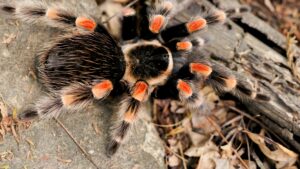
Some are, but very few tarantulas have ever been assessed. As of October 2026 the US Fish and Wildlife Service lists five Poecilotheria species from Sri Lanka as endangered, and CITES lists 38 tarantula species in its appendices, out of 1,209 described.1,2,4 I have found several of the listed ones in the wild, and in the field the trade rules and the state of the wild populations turned out to be two separate questions.
A 2019 review counted only 19 tarantula species on the IUCN Red List at that time.3 The legal status below is as of 2 October 2026; these registers change.
Which tarantulas are protected by law?
There are two kinds of protection. CITES controls international trade, and national laws can list a species as endangered. The CITES entries below come from the Species+ database on 2 October 2026.1
| Taxon | Names listed in Species+ | CITES listing | In force since |
|---|---|---|---|
| Brachypelma | 11 | Appendix II | 16 February 1995 (B. smithi alone since 1 August 1985) |
| Tliltocatl, Sericopelma, Aphonopelma pallidum | 7, 2 and 1 | Appendix II | 16 February 1995, listed under Brachypelma and carried over after the 2023 name changes |
| Poecilotheria | 15 | Appendix II | 26 November 2019 |
| Grammostola rosea | 1 | Appendix II | Adopted at CoP20 in December 2025; entry into effect delayed until 5 June 20278 |
| Caribena versicolor | 1 | Appendix III (listed by the EU) | 11 January 2023 |
That makes 38 names out of 1,209 valid tarantula species in the World Spider Catalog.1,4 For G. rosea, the rose hair tarantula, Species+ also lists G. porteri as a synonym. Canada, Liechtenstein and the United Kingdom entered reservations on the 2026 listing that were still current on 2 October 2026, and Switzerland entered one and withdrew it with effect from 1 May 2026.1 What the listing means for hobby animals is in our rose hair tarantula guide.
The US Endangered Species Act is a separate list. The Fish and Wildlife Service listed Poecilotheria fasciata, P. ornata, P. smithi, P. subfusca and P. vittata as endangered; the final rule was published on 31 July 2018 and took effect on 30 August 2018.2 It names five species, not the genus. The Service found that collection from the wild for trade is likely making other pressures worse, such as habitat loss, and wrote that Sri Lanka bans commercial collection and export of all Poecilotheria but enforces the ban weakly.2
The latest conference of the CITES parties, CoP20 in Samarkand in November and December 2025, also had tarantulas on the table. Argentina, Bolivia and Panama proposed the rose hair tarantula, Grammostola rosea, for Appendix II together with 14 look-alike tarantula species. The conference first rejected the proposal in a secret vote, then adopted an amended version that lists only G. rosea, by consensus.7 Separately, the US government’s December 2024 notice for CoP20 reported public recommendations to add Typhochlaena (five species) to Appendix I and to move B. baumgarteni, B. boehmei, B. hamorii and B. schroederi from Appendix II to Appendix I, and it placed all of them among the taxa for which the United States was unlikely to submit proposals. Typhochlaena appeared in that section of the notice for the 19th meeting in 2022 as well.5,6 On 2 October 2026 Species+ still shows the four Brachypelma species in Appendix II, and I found no Typhochlaena entry at all.1 For what we know about that genus see our pages on Typhochlaena and T. costae, and on how Typhochlaena builds its trapdoor.
What CITES does and does not do
Appendix II is for species that are not necessarily threatened with extinction now but may become so unless trade is closely controlled.3 It regulates trade between countries. CITES regulates trade. It does not stop logging, farms or housing developments, and a captive-bred rose hair in Germany does not clear any land (I talk about it at 4:51 in our Chile film).
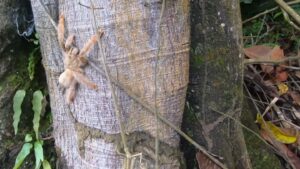
I saw the same gap in Sri Lanka. Poecilotheria subfusca occupies less than 500 square kilometres in two disjunct parts of the central highlands, and a survey found it at only 10 locations;2 in the highlands we measured 16 to 18 degrees Celsius inside a retreat in the morning, and that climate needs healthy vegetation. Appendix II does not protect that vegetation (4:22 in the film below). The listing proposal says the status of the wild populations is unknown because no field studies existed, and that hobby breeding cannot keep up with demand. I found that second claim uncited (3:09).

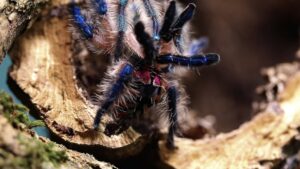
Our P. subfusca page has more on this species, and the film also covers the cobalt blue tarantula in its own post.
What the wild populations show
The best overview I know is a 2019 paper by Fukushima and colleagues. They assessed the 21 valid species then on CITES, mostly Brachypelma, with IUCN criteria. Only 16 had enough data on range, ecology and threats. For almost all of them the authors infer a shrinking range, mainly from deforestation, urban growth, agriculture and roads.3 They name harvesting for the illegal trade as the main cause of lost individuals, and say it is driving the decline of at least 14 Brachypelma species.3 Most of their information on illegal trade comes from grey literature and anecdotal reports, because consistent data do not exist.3
The legal trade records tell a different story. For B. baumgarteni the paper reports about 960 to 1,108 specimens traded internationally between 2006 and 2016, and none was declared as wild-caught.3 It is everywhere in the trade, “captive bred, supposedly”, and scientists can barely find it in the wild (0:00). The US Fish and Wildlife Service saw the same pattern for Poecilotheria: of 400 animals of the five Sri Lankan species legally traded in or out of the US from 2007 to 2012, 392 were declared captive-bred and 8 were wild-caught P. vittata. The Service still concluded that wild collection continues and that its extent is unknown.2
The rarest tarantulas I have seen alive
People who search for the rarest tarantula usually mean the most expensive one in the hobby. In the wild the question is different. A species can be in every shop and still be hard to find where it lives. Typhochlaena costae is the hobby kind of rare. It is not for sale in most countries and is among the most expensive tarantulas, and it has still been bred very successfully. More is in our portrait series.
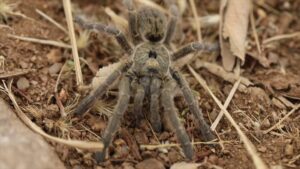
Brachypelma baumgarteni is the wild kind. It lives only in south-eastern Michoacán in the Sierra Madre del Sur, and the 2019 paper puts its extent of occurrence at about 2,727 square kilometres.3 We searched for days, hours each day, and found nothing in the burrows. Then a female presented herself in the open (5:27). The full story is on our B. baumgarteni page.
Brachypelma boehmei lives in one municipality in Guerrero. The paper gives it the smallest range of the species it assessed, under 500 square kilometres.3 Wild populations are the reference for everything we keep in captivity (16:11 in our Guerrero film). Our B. boehmei page has the details.

Brachypelma smithi, the real Mexican red knee, only lives in Guerrero. Acapulco keeps expanding into the foothills, and many wandering males are killed on the Pacific highway in every mating season (15:44). Smugglers still collect wild ones despite the CITES listing (16:22). The difference between B. smithi and B. hamorii is explained in Mexican red knee: smithi vs hamorii.

Is the pet trade the problem?
Sometimes, and sometimes it is the wrong thing to blame. After reading the publications from 2012 to 2020 on Typhochlaena costae, I thought in 2021 that pet trade demand and illegal extraction were not the main issue for that species. Stopping deforestation would help its population most (5:07). I also thought population data should come before a species goes on a list (6:40). The published review of the genus argues differently: Fukushima, Cardoso and Bertani (2020) describe Typhochlaena as range-restricted and in international demand, and suggest listing all Typhochlaena species in CITES Appendix I.9
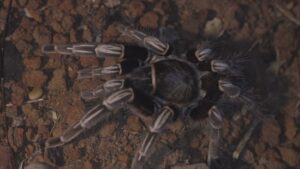
For the rose hair tarantula in Chile, legal does not mean harmless. Thousands and tens of thousands of adult females were exported legally over the decades, and I think that was not good for the wild populations (4:46). The illegal exports, on the other hand, had not damaged the populations we saw (5:43).

In Malaysia in 2018 the person I was with told me there had been many more Coremiocnemis hoggi in the hills a few years earlier, that the species had been heavily smuggled and still was (5:46). It lives close to a city, which makes it an easy target for collectors, and for souvenirs sold to tourists (6:32). Our Malaysia and Thailand page covers the area.

This is also why I do not publish exact localities of vulnerable species. For Pamphobeteus ornatus in Colombia the location is not public, and I cannot tell you where it lives because poaching is still going on and there is no money to pay the people who should protect the habitat (5:16). Our P. ornatus page has the rest.
What I tell buyers
Buy captive-bred. When you look at spiderlings or juveniles, ask where they come from, and if they are captive-bred, pay good money to support the breeder (4:52). For Brachypelma the same applies: make sure you get captive-bred ones (16:28). If you are buying Aphonopelma seemanni, see our page on that species.
Price is the first thing I look at. Watch for extremely cheap adult females and do not buy them. In 2021 wild-caught adult females of the cobalt blue tarantula were often sold for about 30 to 50 US dollars (2:19).
References
- UNEP-WCMC & CITES Secretariat. Species+: CITES listing records for Brachypelma, Poecilotheria, Grammostola rosea, Caribena versicolor and Theraphosidae. Accessed 2 October 2026.
- US Fish and Wildlife Service (2018). Endangered Species Status for Five Poecilotheria Tarantula Species From Sri Lanka. Federal Register 83 FR 36755, 31 July 2018, effective 30 August 2018.
- Fukushima, C. S., Mendoza, J. I., West, R. C., Longhorn, S. J., Rivera, E., Cooper, E. W. T., Hénaut, Y., Henriques, S. & Cardoso, P. (2019). Species conservation profiles of tarantula spiders (Araneae, Theraphosidae) listed on CITES. Biodiversity Data Journal 7: e39342. doi:10.3897/BDJ.7.e39342
- World Spider Catalog. Natural History Museum Bern. Families: Theraphosidae, 1,209 valid species (family record updated 27 November 2025). Accessed 2 October 2026.
- US Fish and Wildlife Service (2024). CITES Twentieth Regular Meeting: Taxa Being Considered for Amendments to the CITES Appendices. Federal Register 89 FR 105074, 26 December 2024.
- US Fish and Wildlife Service (2022). CITES Nineteenth Regular Meeting: Taxa Being Considered for Amendments to the CITES Appendices. Federal Register 87 FR 24577, 26 April 2022.
- Government of Canada. Outcomes of species proposals: 20th Conference of the Parties, Proposal 20.38, Chilean rose tarantula.
- US Fish and Wildlife Service, Office of Law Enforcement (2026). Public bulletin PB-26-001, CITES CoP20 amendments to Appendices I and II, 13 January 2026 (citing CITES Notification to the Parties No. 2026/005).
- Fukushima, C. S., Cardoso, P. & Bertani, R. (2020). Description of the male of the Critically Endangered tarantula Typhochlaena curumim Bertani, 2012 (Araneae, Theraphosidae), with comments on tarantula trade and conservation. ZooKeys 938: 125–136. doi:10.3897/zookeys.938.51442
Explore this site
For the wider picture, see Tarantulas of Mexico in the wild, what wild burrows show and the Theraphosidae overview.