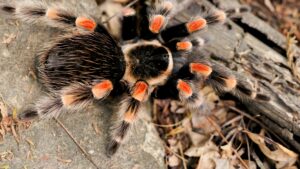
Are Tarantulas Poisonous? What Their Venom Actually Does
Tarantulas are venomous, not poisonous: a bite injects venom through the fangs. The venom of most species is not dangerous to humans, and the effect of a bite is usually compared to a wasp sting, with pain and swelling at the site.[1][12] Some bites cause severe muscle cramps that can last weeks.[8][9][12] In a review of 363 published bite reports, symptoms were mostly local and mild, but 12.7% of victims had pronounced cramps.[13] Many American tarantulas also have irritating hairs that can injure skin and eyes. “Venomous” describes the bite mechanism; it does not mean the spider is safe to touch or eat.
When should you actually seek medical help?
For a bite, Poison Control’s advice is straightforward: wash the area with soap and water, apply a cool compress or ice pack, and use an over-the-counter pain reliever such as acetaminophen or ibuprofen. For hairs embedded in skin, they recommend lifting them out with sticky tape; a topical corticosteroid or an oral antihistamine can help with lingering irritation, but on a clinician’s direction rather than as a routine first step. Eye exposure needs prompt assessment by an eye doctor, who may prescribe corticosteroid eye drops.[1] Severe or spreading muscle cramps after a bite also need medical assessment. Call emergency services immediately for breathing difficulty, sudden throat or tongue swelling, collapse, or inability to wake the person.[2][3] These are general emergency warning signs, not a claim that tarantula bites commonly cause anaphylaxis. Poison Control also recommends checking your tetanus immunization status with a healthcare provider after any bite, and notes that a poison control center (in the U.S., 1-800-222-1222, or the webPOISONCONTROL tool) can advise on any tarantula bite or hair exposure, tarantula-specific or not.[1]
Poisonous or venomous — which word is actually right?
Venomous is correct. A poisonous animal harms you passively, through contact or ingestion; a venomous animal injects its toxin, usually through a bite or sting. Tarantulas do the second: the toxin is made in venom glands inside the chelicerae and is delivered through the fangs when the spider bites.[15] Poison Control, the U.S. National Capital Poison Center, states it plainly: “Tarantulas are venomous, and a tarantula bite can result in the injection of venom.”[1] “Poisonous tarantula” is the phrase most people type into a search bar, but it describes the wrong mechanism — and venomous is not the same thing as safe.
What does tarantula venom actually do?
Tarantula venom can cause pain and swelling, and some bites cause muscle cramps. In the lab, the venom itself turns out to be a cocktail, not a single toxin, and the mix differs by genus: the 2015 description of the Colombian genus Aguapanela includes a short venom profile of A. arvi: HPLC showed a venom moderately rich in polar compounds, and gel electrophoresis showed many compounds below 14 kDa plus a strong band between 31 and 45 kDa that could correspond to enzymes, a profile that differs from most theraphosid venoms.[4] Biochemistry has even been used in species description: a 1999 paper titled as a biochemical identification described the Chinese tarantula Selenocosmia hainana (now Melopoeus hainanus) as new to science.[5] Both papers are laboratory work, not descriptions of what a bite does to a person — a separate, thinner body of evidence, covered next.
Video: milking tarantulas for venom research
Captive footage from a 2018 visit to venom researcher Dr. Volker Herzig, showing how tarantulas are milked for venom research.
What actually happens when a tarantula bites someone?
For the New World species most commonly kept and photographed — the American and South American genera such as Aphonopelma, Grammostola, and Pamphobeteus — Poison Control, which names no genera, says tarantulas native to the Americas cause milder symptoms than those found in other parts of the world, and describes a typical bite as pain at the site, throbbing that can last for hours, swelling, and, rarely, fever, nausea, or vomiting. There is no antidote.[1] A survey of 354 self-reported bites and stings from pet arachnids (not tarantulas alone) found 60.7% of symptoms local and 32.8% minor, with 1.1% severe.[14] But geography alone does not guarantee a mild outcome: a 2025 case report describes a woman bitten by a tarantula identified as a Chilean rose tarantula, Grammostola rosea, a species commonly sold as a calm beginner pet, who developed paroxysmal muscle cramping that spread from her feet up through her hips and face, persisting for four weeks despite hospitalization and treatment with benzodiazepines, baclofen, and other medication. In a later reply to arachnologists, the authors acknowledged that the spider may have been misidentified (Cole et al. 2026, doi:10.5811/cpcem.48543).[9]
Old World genera read differently in the older arachnological literature. Ronald Baxter’s guide to keeping tarantulas, first published in 1993 and revised in 2014, describes several African genera — Harpactira, Harpactirella, Stromatopelma, and Pterinochilus — as having bites that are “extremely painful,” causing swelling at the site and a general feeling of malaise, with severity varying from one person to the next. The same source states that similar bites are inflicted by certain Asian species, notably those of the genera Haplopelma and Cyriopagopus.[6] Haplopelma is still a valid genus in the World Spider Catalog, though several species once placed there — including the cobalt blue tarantula popular in the pet trade — now sit in the genus Melopoeus.[7]
Poecilotheria bites have their own, more recent documentation. Photographs of the genus are in the Poecilotheriinae gallery. A 2023 study in the journal Cells describes envenomation by the Indian ornamental tarantula, Poecilotheria regalis, as medically relevant to humans: symptoms develop over time from hot flushes to severe, generalized muscle cramps and aches in the limbs, with elevated creatine kinase levels indicating muscle damage. There is no specific antivenom; clinicians manage symptoms.[8] The same paper traces this pattern back to an earlier verified bite case and to a small case series covering bites from Poecilotheria, Pterinochilus, and Lampropelma.[8] Separately, injected mice showed substantial muscle damage at day five and regeneration by day twenty, with some abnormalities remaining — a laboratory result about tissue mechanism, not a description of a human bite.[8]
Baxter also describes the defensive display many Old World genera use: rearing onto their hind legs, spreading their front legs, baring their fangs, and flashing bright warning colours on the underside of the legs.[6] Tarantulas may bite defensively when threatened. A raised-leg display is a warning to leave them alone, but do not rely on receiving a warning before a bite: Poison Control notes a tarantula will “often” adopt this threat pose before biting, not always.[1] The King Baboon spider, Pelinobius muticus, filmed below hissing and standing its ground, is one of the more vocal examples of that display.
Urticating hairs: a common but not universal New World defense
Many New World tarantulas carry a second weapon that Old World species lack entirely: urticating setae, modified hairs on the abdomen (or, in one genus, the pedipalps) that the spider can flick or press into an attacker. Seven structurally distinct types are now recognized. Cooke and colleagues first defined types I through IV in 1972, including type II, which is exclusive to arboreal genera like Avicularia. A 2019 revision, based on 144 New World taxa, went back specifically to types I, III, and IV and redescribed them — refining their definitions and reclassifying some type-I variants as ontogenetic subtypes — while leaving type II’s original 1972 description essentially as it stood. Later work added three more types beyond Cooke’s original four: type V sits on the pedipalps of Ephebopus and is deployed by rubbing the palps against the chelicerae instead of kicking the legs; type VI is known only from the Mexican genus Hemirrhagus; and type VII, the most recently described, is exclusive to the Colombian genus Kankuamo. All seven types work the same basic way: barbed shafts that penetrate the skin or mucous membranes of an attacker and cause physical irritation.[10]
A 2019 phylogenomic study of the whole family adds the human side of that mechanism directly: urticating setae “have been known to induce painful symptoms in humans,” contact can cause skin or eye irritation because of the hairs’ harpoon-like structure, and inhaling them has been linked to respiratory problems.[11] Baxter’s account matches this on the ground: he describes the hairs as fine enough that thousands become airborne at once, and warns that discomfort is “certain to result” if they land in the eyes or nostrils. He also records that repeated exposure can sensitize a keeper, to the point that some people can no longer handle certain Theraphosinae genera without breaking out in a severe rash.[6]
The clip above shows this urticating-hair defense in Pamphobeteus solaris.
New World vs. Old World: what the sources actually document
| Trait | New World (e.g. Aphonopelma, Grammostola, Pamphobeteus) | Old World (e.g. Poecilotheria, Pterinochilus, Pelinobius, Haplopelma/Melopoeus) |
|---|---|---|
| Urticating hairs | Present in many species; seven types described across different groups | None |
| First-line defense | Kick hairs, retreat toward burrow | Rear up, bare fangs, flash warning colours |
| Documented bite effects | Often localized pain and swelling; severe reactions can occur | Extremely painful, with swelling and malaise; Poecilotheria bites documented with generalized muscle cramps and raised creatine kinase |
| Everyday hazard for keepers/photographers | Hairs in skin or eyes | The bite itself |
Sources: Poison Control[1], Baxter 1993/2014[6], Richards et al. 2023[8], Gooley et al. 2025[9], Kaderka et al. 2019[10]. Genus names current per World Spider Catalog, accessed 27 September 2026.[7]
For the full comparison of the two groups, including urticating hairs and what I saw in the field, see Old World vs New World Tarantulas.
Frequently asked questions
Do tarantulas attack without being provoked?
Tarantulas may bite defensively when threatened. A raised-leg display is a warning to leave them alone, but do not rely on receiving a warning before a bite.[1] A bite is a defensive response to feeling threatened, not an unprovoked attack, but the warning that usually precedes it is not guaranteed.
Can you become sensitized to tarantula hairs over time?
Baxter records exactly that in keepers who handle hair-flicking species repeatedly: sensitization can build up until further exposure causes a severe rash.[6] Repeated exposure can lead to sensitization, while irritating hairs can also cause injury on a first encounter.[1]
Is an Old World tarantula bite always worse than a New World one?
No. Geography alone cannot predict an individual bite’s severity. Baxter notes that even within the genera he describes as extremely painful, a bite “may affect one individual more severely than another,”[6] and a documented 2025 case shows a New World species, Grammostola rosea, causing weeks of severe muscle cramping.[9]
Do Poecilotheria bites really cause muscle cramps?
Documented cases say yes. A 2023 study describes envenomation by Poecilotheria regalis producing severe, generalized muscle cramps alongside elevated creatine kinase levels, a blood marker of muscle damage, tracing back to an earlier verified bite case and a small case series.[8] There is no specific antivenom; clinicians manage symptoms.
Why do headlines keep calling tarantulas “deadly poisonous”?
Sensational reporting predates the internet by decades. Baxter’s introduction quotes a provincial newspaper headline, “Deadly spider escapes,” for what turned out to be a Mexican red-knee tarantula, Brachypelma smithi, one of the calmest species in the hobby.[6] The label oversimplifies a real, variable risk in both directions: most bites are not deadly, but that is not the same as harmless.
Related reading on birdspiders.ch
- Theraphosidae: an overview on tarantula spiders
- Goliath birdeater: the world’s biggest tarantula
- Pink toe tarantula care: cross ventilation for Avicularia
- Grammostola iheringi: taxonomy, range, and venom research
- Omothymus spider: the Malaysian Earth Tiger explained
- Cobalt blue tarantula in Thailand: Melopoeus lividus
- Are tarantulas spiders? Legs, fangs and what sets them apart
References
- Poison Control (National Capital Poison Center). Are Tarantulas Dangerous? Accessed 27 September 2026.
- Poison Control (National Capital Poison Center). First Aid for Poisonings. Accessed 27 September 2026.
- NHS (National Health Service, UK). Anaphylaxis. Accessed 27 September 2026. Cited for general emergency warning signs and when to call emergency services, not for tarantula-specific anaphylaxis incidence.
- Perafán, C., Cifuentes, Y. & Estrada-Gómez, S. (2015). Aguapanela, a new tarantula genus from the Colombian Andes (Araneae, Theraphosidae). Zootaxa 4033(4): 529–542. doi:10.11646/zootaxa.4033.4.4
- Liang, S., Peng, X., Huang, R. & Chen, P. (1999). Biochemical identification of Selenocosmia hainana sp. nov. from South China (Araneae, Theraphosidae). Life Science Research 3(4): 299–303.
- Baxter, R. N. (1993; rev. ed. A. Smith, 2014). Baxter’s Bumper Book of Tarantulas. Fitzgerald Publishing, pp. 15, 19–22, 192.
- World Spider Catalog (2026). Natural History Museum Bern. wsc.nmbe.ch. Accessed 27 September 2026. Species records: Melopoeus hainanus, Melopoeus lividus, Melopoeus schmidti, all status ACCEPTED, transferred from Cyriopagopus per Smith, Daniel & Vignaud (2026), Journal of the British Tarantula Society 40(3): 15–28.
- Richards, N. J., Alqallaf, A., Mitchell, R. D., Parnell, A., Haidar, H. B., Almeida, J. R., Williams, J., Vijayakumar, P., Balogun, A., Matsakas, A., Trim, S. A., Patel, K. & Vaiyapuri, S. (2023). Indian ornamental tarantula (Poecilotheria regalis) venom affects myoblast function and causes skeletal muscle damage. Cells 12(16): 2074. doi:10.3390/cells12162074 (open access; the human case history is cited there from Fuchs et al. 2014, Toxicon 77:73–77, and Ahmed, Pinkham & Warrell 2009, QJM 102:851–857).
- Gooley, B., Hughes, K., Gooley, M., Keyler, D., Vetter, R. & Cole, J. (2025). A Case Report of Delayed, Severe, Paroxysmal Muscle Cramping After Chilean Rose Tarantula (Grammostola rosea) Envenomation. Clinical Practice and Cases in Emergency Medicine 9(3): 285–288. PMC12342680
- Kaderka, R., Bulantová, J., Heneberg, P. & Řezáč, M. (2019). Urticating setae of tarantulas (Araneae: Theraphosidae): Morphology, revision of typology and terminology and implications for taxonomy. PLoS ONE 14(11): e0224384. doi:10.1371/journal.pone.0224384
- Foley, S., Lüddecke, T., Cheng, D.-Q., Krehenwinkel, H., Künzel, S., Longhorn, S. J., Wendt, I., von Wirth, V., Tänzler, R., Vences, M. & Piel, W. H. (2019). Tarantula phylogenomics: a robust phylogeny of deep theraphosid clades inferred from transcriptome data sheds light on the prickly issue of urticating setae evolution. Molecular Phylogenetics and Evolution 140: 106573. doi:10.1016/j.ympev.2019.106573
- Pérez-Miles, F. (2020). Introduction to the Theraphosidae. In: Pérez-Miles, F. (ed.) New World Tarantulas. Zoological Monographs 6. Springer, pp. 1–23 (section 1.5, Venom). doi:10.1007/978-3-030-48644-0_1
- Hauke, T. J. & Herzig, V. (2021). Muscle spasms – a common symptom following theraphosid spider bites? Toxicon 192: 74–77. doi:10.1016/j.toxicon.2021.01.001
- Hauke, T. J. & Herzig, V. (2021). Love bites – do venomous arachnids make safe pets? Toxicon 190: 65–72. doi:10.1016/j.toxicon.2020.12.003
- Sebastian, P. A. & Peter, K. V. (eds.) (2009). Spiders of India. Universities Press, Hyderabad, pp. 8–9 (Introduction to Spiders, position of the venom gland).
- birdspidersCH. Tarantulas Makes Sound! King Baboon Tarantula Painful Venom.
- birdspidersCH. Tarantula Urticating Hairs as Defense Mechanism – “Pamphobeteus solaris”.