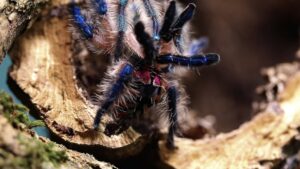
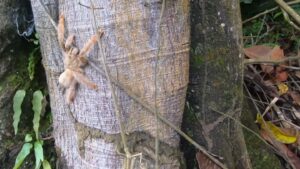
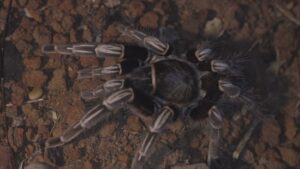
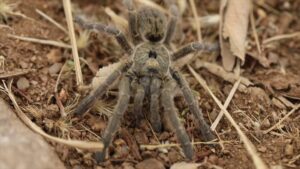
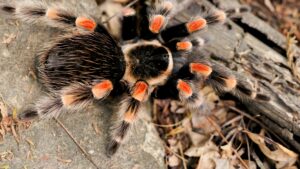
Yes. A tarantula is a spider: it has eight legs, two body parts, a pair of pedipalps, silk glands and fangs that inject venom, and it belongs to the spider order Araneae.1,2 Tarantulas are the family Theraphosidae, one of the mygalomorph families, and they are arachnids, not insects.1,2,3 What sets them apart from most other spiders is the direction of the fangs: they strike downward instead of pinching together.1,2
| Feature | In a tarantula |
|---|---|
| Legs | Eight walking legs in four pairs, like every spider2 |
| Pedipalps | One pair in front of the legs, used to handle food; one segment shorter than a leg; in adult males the tip is the sperm-transfer organ1,2 |
| Body parts | Two: the cephalothorax with eyes, mouthparts and legs, and the abdomen with the spinnerets and reproductive openings2 |
| Fangs | Chelicerae side by side, fangs striking downward. In most other spiders, about 90 percent of species, the chelicerae oppose each other1,2 |
| Silk | Silk glands and spinnerets like other spiders. Tarantulas line burrows and retreats with it, but they do not spin capture webs1,2 |
| Venom | Injected through the fangs to subdue prey. In most tarantulas the effect on a person is comparable to a wasp sting1,2 |
Are tarantulas true spiders?
You will read that tarantulas are “not true spiders”. The order Araneae is divided into three big branches: the Mesothelae, with a segmented abdomen, the Araneomorphae, which hold about 90 percent of all species, and the Mygalomorphae, the sister group of the Araneomorphae. The tarantula family sits in the Mygalomorphae.1 All three branches are spiders, so the sentence only makes sense as “tarantulas are not typical spiders”, and even that depends on which spider you picture.
The numbers show how small the tarantula corner is. The World Spider Catalog (version 27, checked on 2 October 2026) lists 54,145 species in 139 families.4 Theraphosidae has 1,209 of them in 192 genera, which is about 2 percent of all spiders.4 The family with the most species is Salticidae, the jumping spiders, with 6,985, and Theraphosidae is far smaller.4
The word itself is older than the family. “Tarantula” was first used for wolf spiders (Lycosidae), and Pérez-Miles notes that the name was later moved to Theraphosidae.1 In Latin America the same animals have other names, such as araña pollito or araña mono,1 and here “tarantula” means Theraphosidae only.
How many legs does a tarantula have? Are tarantulas insects?
A tarantula has eight legs, in four pairs. An insect has six legs, three body parts and a pair of antennae, and most adult insects have wings as well.3 A spider has eight legs and two body parts, so tarantulas are arachnids, in the same class as scorpions and mites, and not insects.2
If you counted ten, you counted the pedipalps. They sit in front of the first pair of legs and at a glance can pass for a short fifth pair, but they are a different organ: a palp has one segment less than a leg, it has mainly sensory functions, and in adult males it carries the bulb that transfers sperm.1 How a tarantula regrows a lost leg is on How tarantulas molt.

Tarantula vs spider: what is different?
The clearest difference is how the fangs work. In a tarantula the two chelicerae sit parallel and the fangs strike downward. Most other spiders have chelicerae that oppose each other, and the fangs pinch the prey from both sides.1,2 Pérez-Miles calls the tarantula type orthognath and lists two pairs of book lungs and no anterior spinnerets among the traits tarantulas share with other mygalomorphs.1
The feet are the next clue, because the family is defined by claw tufts together with dense scopulae under the tarantula’s feet, which are the adhesive hairs for climbing and for holding prey.1 Size and lifespan follow from the group, since Theraphosidae are mostly large, hairy spiders and include some of the largest spiders in the world.1 Females grow slowly, and a female Brachypelma is not mature before about nine or ten years old and can then live another 20 years or so (14:03 in our Guerrero film). Lifespan by species and sex is on How long do tarantulas live?
The bite and the hairs are separate questions. Details and the exceptions for venom are on Are tarantulas poisonous? Urticating hairs, the flicked defence of many American tarantulas, are on Urticating hairs.
Where do tarantulas sit in the spider tree?
Tarantulas are on the mygalomorph branch, and the oldest branch of all is the Mesothelae. It is a small group from Asia with a segmented abdomen.1 The World Spider Catalog lists 199 species in 8 genera for Liphistiidae.4 In Malaysia in 2018 we found a Liphistius burrow in the forest. Liphistius belongs to the Mesothelae, which are the sister group to all other spiders, and no other spider has a segmented abdomen5, as I explain in our Liphistius film. It is a spider, and it is not a tarantula. The burrow, the trip lines and how to tell a trapdoor spider from a trapdoor tarantula are on Trapdoor spiders and trapdoor tarantulas.
What is a genus, and why do the names change?
Answering “what is a tarantula” also means knowing how a tarantula is named. A genus is a group of species that share traits, which points to a possible common ancestor. I explain it with simple circles in a short film (3:15). When new work shows that a species does not share those traits, it moves to another genus or gets a new one. That is why a name in an older book can differ from the name in the World Spider Catalog today. The family and its genera are on Theraphosidae: an overview of tarantulas.
What I can show from the field
In the field the build shows up in how tarantulas live, because most tarantulas live in burrows, under stones or in silk retreats and wait for prey at the entrance.1 I look at the silk and at what burrows look like on Do tarantulas make webs?, and at where tarantulas live, from sea level up past 4,000 meters, on Where do tarantulas live?1 For the Old World and New World split, see Old World vs New World tarantulas.
Short answers
What is a tarantula? A large, hairy spider of the family Theraphosidae. There are 1,209 accepted species in 192 genera, found on every continent except Antarctica.1,4
Is a tarantula a spider? Yes. It has eight legs, two body parts and spinnerets, and it belongs to the order Araneae.1,2
Is a tarantula an insect or an arachnid? An arachnid. Insects have six legs and three body parts.2,3
Do tarantulas spin webs? They do not spin capture webs. They line their homes with silk.1
Are tarantulas venomous? Yes, like almost all spiders, but most tarantula species are not dangerous to people.1,2
References
- Pérez-Miles, F. (2020). Introduction to the Theraphosidae. In: Pérez-Miles, F. (ed.), New World Tarantulas, Zoological Monographs 6. Springer, Cham, pp. 1-23. doi:10.1007/978-3-030-48644-0_1
- Australian Museum. Spiders. australian.museum/learn/animals/spiders (read 2 October 2026).
- Australian Museum. Insects. australian.museum/learn/animals/insects (read 2 October 2026).
- World Spider Catalog (2026). Version 27 and the families list, Natural History Museum Bern. wsc.nmbe.ch/families (read 2 October 2026).
- Li, M., Chen, W.-T., Zhang, Q.-L., Liu, M., Xing, C.-W., Cao, Y., Luo, F.-Z. & Yuan, M.-L. (2022). Mitochondrial phylogenomics provides insights into the phylogeny and evolution of spiders (Arthropoda: Araneae). Zoological Research 43(4): 566–584. doi:10.24272/j.issn.2095-8137.2021.418
Explore this site
Species and genera are in the Theraphosidae overview. Where tarantulas live is in Where do tarantulas live?