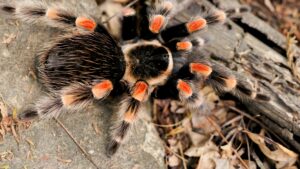
A baboon spider is a tarantula from Africa. The name belongs to the family Theraphosidae and is used most for the southern and eastern African genera such as Harpactira, Ceratogyrus and Pterinochilus, though the hobby also hangs it on the king baboon from East Africa and on a Socotra species.1,2,3 My own field find in this group is a single young Ceratogyrus under a rock in Namibia, and I keep Harpactira pulchripes and Pterinochilus murinus.

What is a baboon spider?
Midgley and Engelbrecht, in a paper on Angola, write “baboon spider specimens (Araneae: Theraphosidae)” for the tarantulas they collected there, among them Pterinochilus and Ceratogyrus.1 The African Snakebite Institute lists the “Baboon Spider” under the family Theraphosidae, gives the Afrikaans name bobbejaanspinnekop, and describes bulky, hairy spiders of up to about 15 centimeters with the legs, living in large silky burrows in the ground.4 A standard book on the group is titled Baboon spiders: Tarantulas of Africa and the Middle East (Smith, 1990).5
Are baboon spiders tarantulas?
Yes. Baboon spiders are theraphosids, the same family as every other tarantula, and the World Spider Catalog counts 1,209 species in 192 genera for the whole family (version 27, last family update 27 November 2025).2 What sets the African ones apart is where they live and which subfamilies they belong to. The 2018 molecular study by Lüddecke and colleagues places Harpactirinae in Central and Southern Africa, Eumenophorinae from West and East Africa to Madagascar and Yemen, and Stromatopelminae in West and Central Africa.3 How the Old World tarantulas differ from the New World ones is on Old World vs New World tarantulas.
Which tarantulas are called baboon spiders?
The name is a family habit, not a taxon. This is how the catalog counts the genera that carry it most often, with the page where I show them.
| Genus | Species in the catalog | Range given by the catalog | Where I show it |
|---|---|---|---|
| Harpactira (Harpactirinae) | 15 | South Africa for H. pulchripes2 | Harpactira pulchripes |
| Ceratogyrus (Harpactirinae) | 10 | Southern Africa for C. darlingi, Angola for C. attonitifer2 | Ceratogyrus |
| Pterinochilus (Harpactirinae) | 10 | DR Congo to South Africa for P. murinus2 | below |
| Pelinobius (Eumenophorinae) | 1 | Kenya and Tanzania for P. muticus2 | King baboon spider |
| Monocentropus (Eumenophorinae) | 2 | Yemen (Socotra) for M. balfouri2 | Monocentropus balfouri |
| Heteroscodra (Stromatopelminae) | 2 | West and Central Africa for the subfamily3 | Heteroscodra maculata |
What is the horned baboon tarantula?
Ceratogyrus carries a horn on the carapace, which is why the hobby calls the genus horned baboon tarantulas. The most extreme case is Ceratogyrus attonitifer, which Midgley and Engelbrecht described in 2019 from females dug out of open burrows in miombo woodland in south-eastern Angola.1 It has a long protuberance that extends out of the fovea and over the abdomen, and the authors write that no other spider has anything similar.1 It is soft, where the same structure is fully hardened in the other genera that have one, and what the horn is for is uncertain.1 The name comes from the Latin for astonishment, which is how the authors felt.1 I talked through the paper days after it appeared, in a film where my camera stopped recording and only the audio survived (full talk). More on the genus is on our Ceratogyrus page.
What did I find in Namibia?
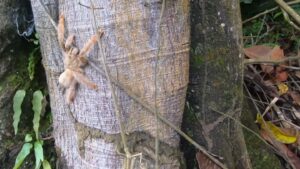
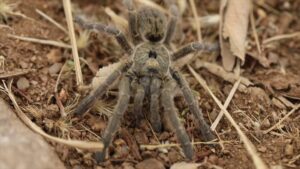
Little. On the day we filmed in the Waterberg area it was around 35 degrees, I had turned a lot of rocks and found only a few scorpion molds. The tarantula I show is one we found there the year before, under a rock, at a silk-lined burrow so deep and dry that we poured water down it to see a leg or a palp (5:04). The animal came up slowly, we guided it out with a small stick, and it was neither aggressive nor hungry, so there was no tickling and no cricket trick (5:47). It was about 2.5 centimeters in body length and pure luck (3:54). Finding these takes a lot of manpower. Richard Gallon and the South African team around Ian Engelbrecht do that work.

What does a baboon spider look like up close?
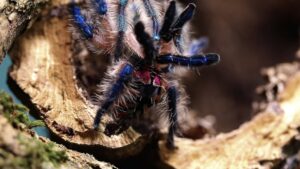
Harpactira pulchripes, the golden blue leg baboon, is one of the two I keep. The catalog credits Pocock, 1901 and gives South Africa.2 In the film where I paired a male with a female, the male drummed on her web with the first and second legs and his palps, and used his tibial hooks to hold her fangs away from him (2:09). Not all tarantulas have those hooks. I also point out that it is not the blue baboon of Socotra, Monocentropus balfouri (7:14), which shows how loosely the word baboon is used. The pair is in my collection, so this is captive footage.


Is the orange baboon tarantula a different species?
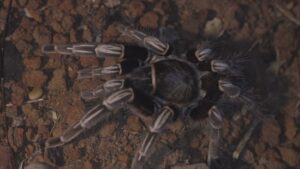
No, not in the catalog. “Orange baboon tarantula” is the hobby name of Pterinochilus murinus, Pocock, 1897, which the catalog gives for DR Congo, Burundi, Kenya, Tanzania, Angola, Zambia, Mozambique, Zimbabwe and South Africa.2 One of mine is the dark colour form, not the orange one; the species has several colour variants (11:13 in our feeding film). The same film is on what tarantulas eat.
Are baboon spiders dangerous?
The African Snakebite Institute calls the bite painful for a day or two but not medically important. It describes the spiders as generally docile, but they raise their front legs when disturbed and will bite at that stage.4 That is a general description from a snakebite organisation, not a medical study of baboon spider bites. For tarantulas as a family, emergency physicians write that case reports of bites commonly describe local tissue damage and pain, with muscle spasms rarer but documented, in one bite attributed to a Chilean rose tarantula (an identification the authors later called uncertain) as cramping that lasted four weeks.6 I have not been bitten by one. Venom across tarantulas is on are tarantulas poisonous, and the king baboon has its own page.
Where do baboon spiders live?
In Africa and, for the hobby name, in a corner of Yemen. Midgley and Engelbrecht describe the genus Ceratogyrus as known mainly from southern Africa south of the Cunene and Zambezi rivers, with six of the nine species then known in Zimbabwe.1 Monocentropus balfouri is a Socotra species.2 The one I found in Namibia sat in a silk-lined burrow under a rock, which fits the African Snakebite Institute description of silky burrows in the ground.4 For the wider picture of where tarantulas live, see where do tarantulas live.
References
- Midgley, J. M. & Engelbrecht, I. (2019). New collection records for Theraphosidae (Araneae, Mygalomorphae) in Angola, with the description of a remarkable new species of Ceratogyrus. African Invertebrates 60(1): 1-13. doi:10.3897/AfrInvertebr.60.32141
- World Spider Catalog (2026). Natural History Museum Bern, wsc.nmbe.ch, family list (Theraphosidae), genus lists and species pages for Harpactira, Ceratogyrus, Pterinochilus, Pelinobius, Monocentropus; accessed 2 October 2026.
- Lüddecke, T., Krehenwinkel, H., Canning, G., Glaw, F., Longhorn, S. J., Tänzler, R., Wendt, I. & Vences, M. (2018). Discovering the silk road: Nuclear and mitochondrial sequence data resolve the phylogenetic relationships among theraphosid spider subfamilies. Molecular Phylogenetics and Evolution 119: 63-70, Table 1.
- African Snakebite Institute, Baboon Spider (Theraphosidae), species page, africansnakebiteinstitute.com; accessed 2 October 2026.
- Smith, A. M. (1990). Baboon spiders: Tarantulas of Africa and the Middle East. Fitzgerald Publishing, London (title as cited in Gallon 2008, Bulletin of the British Arachnological Society 14(5): 232-246).
- Gooley, B., Hughes, K., Gooley, M., Keyler, D., Vetter, R. & Cole, J. (2025). A case report of delayed, severe, paroxysmal muscle cramping after Chilean rose tarantula (Grammostola rosea) envenomation. Clinical Practice and Cases in Emergency Medicine 9: 285-288. doi:10.5811/cpcem.24973