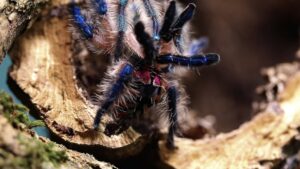
Birupes simoroxigorum Gabriel & Sherwood, 2019, sold as the Borneo neon blue leg tarantula, is a theraphosid from lowland rainforest in Sarawak, Malaysian Borneo. In the original description the adult female has iridescent blue legs and the adult male has black, non-iridescent legs. The paper does not describe juvenile colour. [1][2]

| Accepted name | Birupes simoroxigorum Gabriel & Sherwood, 2019, type species of Birupes [1] |
|---|---|
| Family | Theraphosidae. The catalogue gives no subfamily; the original description places Birupes in Selenocosmiinae [1][2] |
| Distribution | Malaysia (Borneo) [1]. Known from lowland rainforest at the type locality in Sarawak [2] |
| Type material | Male holotype and female paratype, Sarawak Museum Department, Kuching [1] |
| Colour | Female: iridescent blue legs, cream carapace, light brown abdomen. Male: black, non-iridescent leg setae [2] |
| Measured size | Male holotype 45.1 mm, female paratype 45.5 mm total length [2] |
| Hobby names | Borneo neon blue leg tarantula, blue-legged tarantula |
| Original description | Gabriel & Sherwood (2019), Journal of the British Tarantula Society 34(1): 19-34 [2] |
Why are the legs of Birupes simoroxigorum blue?
Part of the answer is in the genus name: Birupes combines the Malay word biru, blue, with the Latin pes, leg or foot, so it means blue leg. In life, the description records an adult female with distinctive iridescent blue legs, a cream carapace and a light brown abdomen, and an adult male with black, non-iridescent leg setae. Preserved in alcohol, the female’s blue legs turn iridescent green, then return to blue once the specimen is removed from the spirit. The describing authors noticed this on the paratype female. [2]
Tarantula blue is a structural colour, not a pigment. In the species Foelix, Erb and Wullschleger examined, it sits in fine hairs only 5 to 6 µm thick and comes from light interfering with thin cuticle layers, about 50 to 75 nm thick, that alternate with air spaces inside the hair wall. [4] Hsiung and colleagues found that blue reflectance is conserved across distantly related tarantulas even though different nanostructures produce it. [5] Foley and colleagues reconstructed blue as probably an ancestral condition in tarantulas that is lost more often than gained. [6] The original description of Birupes simoroxigorum does not report what produces the blue in this species, so no mechanism is claimed for it here.
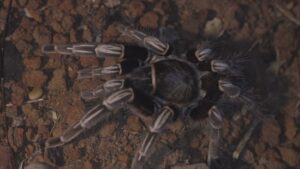
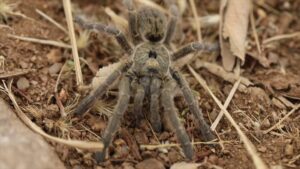
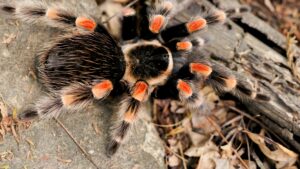
So a photo of a blue-legged tarantula says little until it states the sex and life stage of the animal.
Is this the tarantula people search for as the blue leg tarantula?
Partly. For the query “blue leg tarantula”, search results are mostly about a different animal, the golden blue leg baboon tarantula, Harpactira pulchripes, which belongs to another genus. Birupes simoroxigorum is the blue-legged tarantula from Borneo, sold as the Borneo neon blue leg. The scientific name keeps the two apart.
How big does Birupes simoroxigorum get?
In total length the holotype male measured 45.1 mm and the paratype female 45.5 mm, so the two sexes are close in size. Beyond these two specimens, the description gives no leg span and no size range. [2]
As a visual cue colour is useful, but it is not a diagnostic character: the describing authors separated Birupes from related genera by structures such as the maxillary lyra and the male palpal bulb. [2]
Where does Birupes simoroxigorum live?
At its type locality in Sarawak, Malaysian Borneo, the species is known only from lowland rainforest, where it burrows in the forest floor. No broader distribution has been published. As a country-level range the catalogue gives Malaysia (Borneo), which does not mean the species occurs elsewhere on the island. [1][2]
Why is the species tied to a collecting dispute?
In 2019 the description came out of a documented dispute about collection and export from Sarawak. The Malaysian Insight reported that the Forest Department of Sarawak said the collectors lacked permits to collect or export wildlife, while Sherwood said the researchers had received the specimens in good faith and had been told that the required paperwork existed. [3] According to the same report, the species name simoroxigorum incorporates the names of the three collectors’ children. [3]
Neither account is a legal finding, and neither establishes a current legal status for an individual animal or for later captive stock. A CITES appendix number or an IUCN category should not be inferred from hobby listings or from this dispute.
Where can I read more about related tarantulas?
Family-level context is in the Theraphosidae overview. Birupes belongs to the subfamily Selenocosmiinae. The Selenocosmiinae gallery and the wider Tarantula Gallery carry related species pages and photographs. Selenobrachys philippinus and Aspinochilus rufus from Java are other Southeast Asian descriptions with older hobby names in their history.
Notes from the field, by email
I send a short tarantula briefing by email, with field notes from our trips written for the newsletter when I have them, and once a month a roundup of new posts. It is free, and you can unsubscribe at any time.
Later, if you want to support the fieldwork and the films, I am also on Patreon.
References
- World Spider Catalog (accessed 2026-10-02). Birupes simoroxigorum species record and Birupes genus record. Natural History Museum Bern.
- Gabriel R & Sherwood D (2019). A new genus and species of theraphosid spider from Sarawak, Borneo (Araneae: Theraphosidae). Journal of the British Tarantula Society 34(1): 19–34.
- The Malaysian Insight (2019). Illegal trade of tarantulas from Sarawak comes to light.
- Foelix, R., Erb, B. & Wullschleger, B. (2009). Worauf beruht die Blaufärbung gewisser Vogelspinnenarten? Arachne 14(3): 4–12.
- Hsiung, B.-K., Deheyn, D. D., Shawkey, M. D. & Blackledge, T. A. (2015). Blue reflectance in tarantulas is evolutionarily conserved despite nanostructural diversity. Science Advances 1(10): e1500709.
- Foley, S., Saranathan, V. & Piel, W. H. (2020). The evolution of coloration and opsins in tarantulas. Proceedings of the Royal Society B 287: 20201688.