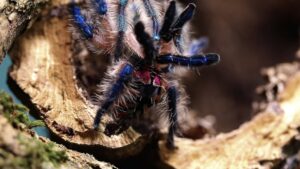
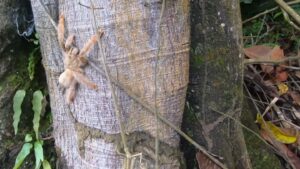
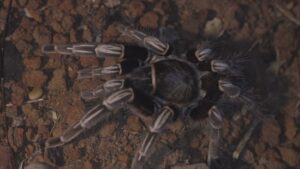
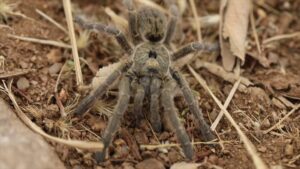
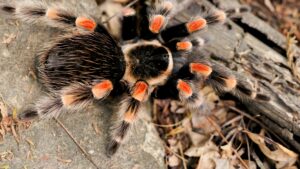
Brachypelma albiceps Pocock, 1903 is a Mexican tarantula that hobbyists call the Mexican golden red rump. Adults have a golden-brown carapace, a black abdomen with light orange to red hairs, and bluish-black legs without bands.[3] Central Mexico is its home: Morelos, part of Puebla, the State of Mexico and central Guerrero, the southern end of its range.[3] Below you will find its names, the century of changing genus assignments that followed its description, how to recognise it, where it lives and the films from our own search for it in Guerrero.
Which names does the Mexican golden red rump go by?
- Brachypelma albiceps Pocock, 1903: the accepted name in the World Spider Catalog, with Mexico as its distribution.[1]
- Mexican golden red rump, golden red rump tarantula: hobby names, not scientific ones. We use the first.
- Brachypelmides ruhnaui Schmidt, 1997: a junior synonym. The World Spider Catalog lists it under B. albiceps, and Mendoza and Francke credit Locht and colleagues (2005) with showing that the two are one species.[1][3]
- Brachypelma and Tliltocatl: in 2020 Mendoza and Francke divided the old genus Brachypelma in two. B. albiceps stays in Brachypelma in the strict sense, together with B. smithi, B. hamorii, B. auratum, B. boehmei, B. baumgarteni, B. emilia and B. klaasi. The species that went to Tliltocatl include T. vagans and T. albopilosum.[3]
Because of that split, “red rump” is a loose name here: Mendoza and Francke say that Brachypelma differs from Tliltocatl by red or orange on the legs or carapace, and that B. albiceps is the exception to that rule.[3]
How was Brachypelma albiceps described, and why the confusion?
In 1903 R. I. Pocock described the species from a female, and that specimen is the holotype, held in the Natural History Museum in London.[1][2][3] What followed was a list of changes of genus:
- Earlier, an author had illustrated a female under the name Eurypelma pallidum. Pocock treated that as a misidentification.[1]
- Smith removed the species from the synonymy of Aphonopelma pallidum, and for some years it was listed as Aphonopelma albiceps.[1]
- Schmidt described, in 1997, a male and a female from Mexico as a new species and a new genus combination, Brachypelmides ruhnaui.[1]
- Locht and colleagues returned, in 2005, the species to Brachypelma and treated ruhnaui as a synonym of it, after examining topotype material and museum specimens.[1][3]
How do you recognise Brachypelma albiceps?
Colour separates it from every other Brachypelma, according to Mendoza and Francke: brown carapace hairs and red hairs on the abdomen.[3] Living adults of both sexes have a brown carapace and a black abdomen with light orange hairs, their legs and palps are bluish black, and juveniles and subadults are paler.[3] Genitalia help as well: the male palpal bulb is sharp and tapered, and the female spermatheca is divided, with rounded receptacles.[3] That second feature is shared in this genus only with B. klaasi.[3]

One male measured about 38 mm and one female about 54 mm in body length, not counting chelicerae and spinnerets.[3] Those are single specimens, not a size range for the species.
Where does Brachypelma albiceps live in the wild?
Mendoza and Francke describe the species as known from central Mexico: Morelos, part of Puebla and the State of Mexico, to central Guerrero.[3] Together with B. auratum, it is one of two Brachypelma species that follow the Balsas Depression of central Mexico, while the genus as a whole is tied to the tropical Pacific coast region.[3] Across the genus, species are found between 10 and 1,600 m above sea level, and Mendoza reports that B. albiceps is occasionally found as high as 1,700 m.[3]

Burrows lie in dense thickets or dry thorn forest, under large rocks or tree roots, with no silk at the entrance and often several tunnels inside.[3] Breeding falls in the last part of the rainy season and the first part of the dry season, from August to January. Egg sacs are made through the drier winter months, and the young emerge and disperse in late spring, just before the early summer rains begin, which means the whole cycle is tied to the seasons of the dry forest.[3]
Is Brachypelma albiceps protected?
All Brachypelma species are listed in Appendix II of CITES, which regulates international trade, and the World Spider Catalog notes that trade in this species is restricted by CITES.[1][3]
Our films: looking for the Mexican golden red rump in Guerrero
In December 2025 we searched the Guerrero highlands for B. albiceps, and the search took three days. The films below cover it, and they are embedded on other pages of this site, so they are linked here and not repeated.
- The search that missed: in Tarantula Half Black – Half White with Diamond in Mexico we spend the first two days looking for the golden red rump in rocky, agricultural hillside country. We say plainly that a spider we hoped was B. albiceps turned out to be something else. Late in the film we find a moult that we identify as one. The film is on our Brachypelma auratum page.
- The find: on day three we find B. albiceps at its silk-free burrow in the film We Found the Tarantula Scientists Argued About for 100 Years. It is part of our Mexico field series.
- The short version: Golden Tarantula of Mexico is a one-minute Short on the golden carapace, the black legs and the red abdominal hairs. It also sits on the Mexico series page.
The films make the same point as the burrow description above, that nothing at the entrance gives a Brachypelma burrow away, so the search comes down to lifting rocks and looking inside.
More on Mexican Brachypelma
Brachypelma auratum, the other Balsas species, has its own page. Other pages cover Brachypelma boehmei, the Mexican fireleg, Brachypelma baumgarteni and smithi versus hamorii. The whole series is gathered in tarantulas of Mexico in the wild.
References
- World Spider Catalog (2026). Brachypelma albiceps Pocock, 1903. Natural History Museum Bern. Accessed 1 October 2026.
- Pocock, R. I. (1903). On some genera and species of South-American Aviculariidae. Annals and Magazine of Natural History (7) 11(61): 81–115. doi:10.1080/00222930308678729 (original description, as cited by the World Spider Catalog).
- Mendoza, J. & Francke, O. (2020). Systematic revision of Mexican threatened tarantulas Brachypelma (Araneae: Theraphosidae: Theraphosinae), with a description of a new genus, and implications on the conservation. Zoological Journal of the Linnean Society 188: 82–147. doi:10.1093/zoolinnean/zlz046