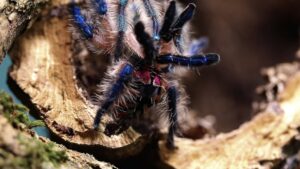
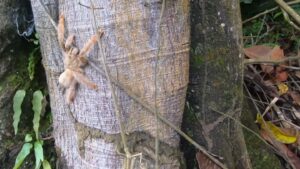
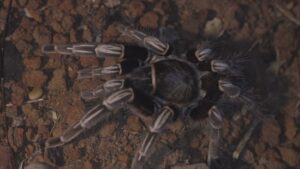
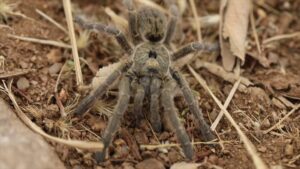
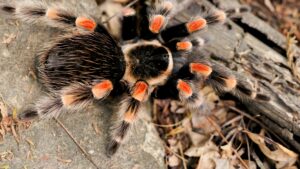
Brachypelma baumgarteni is a Mexican tarantula that hobbyists call the Mexican orange beauty. Adults have black bodies and legs with a deep orange, flame-shaped patch on the knee, and it is known only from Michoacán, on the Sierra Madre del Sur in Mexico.[3] Andrew Smith described it in 1993 from a single male collected by Marc Baumgarten, the German amateur arachnologist it is named after.[2] Our film below follows a field search for it and ends with a large adult female.
Which names does the Mexican orange beauty go by?
- Brachypelma baumgarteni Smith, 1993: the accepted name in the World Spider Catalog.[1]
- Mexican orange beauty, orange beauty tarantula: the hobby names. Neither is a scientific name.[4]
- Brachypelma and Tliltocatl: in 2020 Mendoza and Francke split the old genus Brachypelma in two. B. baumgarteni stays in Brachypelma in the strict sense, with the other red-kneed species. Species such as T. albopilosum, the dark-bodied ones, went to the new genus Tliltocatl.[1][3]
Marc Baumgarten, the collector, gave the species its name, and it is spelled baumgarteni in the original paper and in the catalog.
Who described Brachypelma baumgarteni, and from what?
Smith described it in 1993 in the Journal of the British Tarantula Society, from a male holotype held in the Natural History Museum in London. Collected by Baumgarten in the foothills of the Sierra Madre del Sur in Michoacán, the holotype is the name-bearing specimen.[2] Smith calls him a German amateur arachnologist who helped with specimens, habitat data and photographs, and the species is named after him.[2]
Several Brachypelma species described in the early 1990s, this one among them, came from animals collected for the pet trade.[3] Only the male was described then, and the World Spider Catalog lists the female as first described in the 2020 revision by Mendoza and Francke, who examined females collected in Michoacán in 2013. [1][3]
How do you recognise Brachypelma baumgarteni?
Mendoza and Francke separate it from every other Brachypelma by the legs: a deep orange flame-shaped patch on each patella with a yellowish area around it, and yellowish colour on the tibiae and metatarsi as well.[3] Both sexes also carry a yellowish line along the middle of the metatarsi, easiest to see on legs I and IV.[3] Femora are black.[3] The two sexes differ in body colour:

- Females: the carapace is black in the middle with a pink or tan border, in two patterns that differ in how far the pale colour reaches behind the fovea. Black with sparse rose-brown hairs, the abdomen is plainer.[3]
- Males: the carapace is a rust colour with a lighter border, and the abdomen is black with sparse light brown hairs.[3]
Mendoza and Francke measured one female at about 66 mm in body length, not counting chelicerae and spinnerets, and one male at about 50 mm.[3] Telling the species from its relatives with certainty also needs the genitalia: the shape of the male palpal bulb and of the female spermatheca.[3]
Where does Brachypelma baumgarteni live in the wild?
Mendoza and Francke report it only from Michoacán, on the Sierra Madre del Sur, in deciduous forest.[3] Fossorial by habit, the species uses burrows, modified or self-excavated, that lie between the roots of large trees, and they have no silk around the entrance.[3] For anyone searching, nothing at the opening gives a burrow away.

Smith, working from Baumgarten’s notes, gave a drier picture. Smith describes burrows on grassy hillsides, roughly 30 to 40 cm deep, in a more arid zone, further north and higher than the coastal woodland species he was comparing it with.[2] Different observers wrote the two accounts 27 years apart, so both are given here.
Is Brachypelma baumgarteni protected?
All Brachypelma species are listed in Appendix II of CITES, which controls international trade.[3] Mendoza and Francke also relay the finding of a 2017 action plan by the Commission for Environmental Cooperation: preliminary field studies indicated that B. baumgarteni, B. boehmei and B. hamorii have small ranges and are sensitive to habitat disruption, so these three should not be considered for direct capture and export until more is known about their viability.[3] Population data for Mexican tarantulas, they add, are insufficient, particularly for species with small ranges.[3]
Our film: searching for the orange beauty in Michoacán
Field footage from Michoacán, Mexico: we searched burrows for hours for B. baumgarteni, and the spider we found was not in one.[4]
- 1:02: we explain where we are, in the Sierra Madre del Sur in Michoacán, and what we are after.
- 1:45: we look for burrows between tree roots and note that they have no silk at the entrance. Gentle stimulation at the entrance is the method, to see whether anything comes up.
- 2:13: the first burrow holds a different tarantula, with striped legs. Not our target, we say plainly, and not something we can name without examining a male under a microscope.
- 3:30: hours of the same routine in dry-season deciduous forest, and no baumgarteni.
- 4:41: an adult female is sitting in the open in daylight, about five metres from the rock where we had put the other tarantula. Her identification rests on the flame on the knee, which is the feature we describe at 5:56.
- 5:56: her body is around 65 mm long. Next come the flame-shaped patella, the yellowish line on the metatarsi of legs I and IV and the dark carapace with a pink or orange border, plus a note that males have a mostly orange carapace.
- 8:46: we tell the story of the name and of Marc Baumgarten.
- 9:36: we photograph her and put her back where she was.
Her measurements and markings agree with the female described by Mendoza and Francke: about 66 mm in body length, an orange flame on the patella and a yellowish line on the metatarsi.[3] In the film we also say that Mexico runs its own breeding programme for Brachypelma and exports captive-bred animals, so nobody needs to take them from the wild.
More on Mexican Brachypelma
The series this film belongs to is collected in tarantulas of Mexico in the wild. Three neighbours have their own pages: how to identify Brachypelma auratum, the Mexican fireleg, Brachypelma boehmei and smithi versus hamorii.
References
- World Spider Catalog (2026), genus page Brachypelma. Natural History Museum Bern.
- Smith, A. M. (1993). A new mygalomorph spider from Mexico (Brachypelma, Theraphosidae, Arachnida): Brachypelma baumgarteni n. sp. Journal of the British Tarantula Society 8: 14–19.
- Mendoza, J. & Francke, O. (2020). Systematic revision of Mexican threatened tarantulas Brachypelma (Araneae: Theraphosidae: Theraphosinae), with a description of a new genus, and implications on the conservation. Zoological Journal of the Linnean Society 188: 82–147.
- birdspidersCH (2026). I Found a Tarantula That Scientists Can’t Find. YouTube.