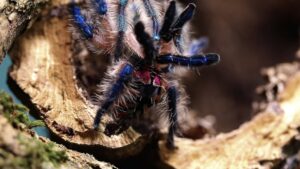
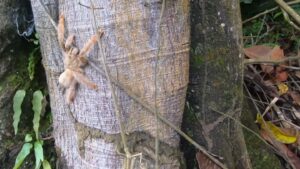
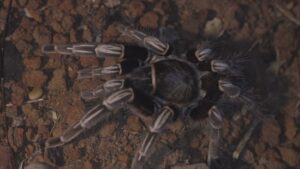
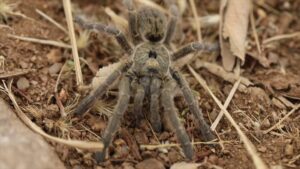
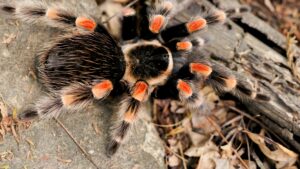
Brachypelma emilia (White, 1856) is the Mexican redleg tarantula, a burrowing species from the Pacific side of western Mexico. It is also the type species of Brachypelma, so every change to that genus is measured against it.[1][2] In 2019 our co-founder Reto went looking for it alone, dug down to a female on a dry roadside bank, and filmed the search.[3]
Which names does this tarantula go by?
- Brachypelma emilia (White, 1856): the accepted name in the World Spider Catalog, which lists Mexico as its distribution and marks the species as the type of the genus.[1]
- Mygale emilia White, 1856: the original name. Simon moved it to Brachypelma in 1891.[1]
- Mexican redleg, Mexican red leg tarantula: the common names. Several other Mexican tarantulas are sold as “red knee”, which is a different group of names (see below).
How do you recognise the Mexican redleg?
Colour does most of the work. Mendoza and Francke, who revised the genus in 2020, separate B. emilia from every other Brachypelma by an orange carapace with a black triangle over the eyes. The femora and patellae are black and the tibiae orange. The metatarsi of legs I to III are black and that of leg IV is orange.[2] Juveniles show the same pattern, only paler.[2]

It is a big spider. The female they describe in detail measured 61 millimetres in body length and the male 40, both single specimens.[2]
Where does Brachypelma emilia live?
It is the most northerly Brachypelma. Mendoza and Francke place it west of the Sierra Madre Occidental in southern Sonora, Sinaloa and Nayarit, and in a small area of north-western Jalisco, and say it could occur in Durango but that nobody has shown it yet.[2] White described it from Panama in 1856. Later authors consider that locality an error, because the collector, Berthold Seemann, travelled north along the Pacific coast and landed in Nayarit and Sinaloa.[2]
Within that range the habitat varies a lot, from dry coastal thorn scrub and grassland through palm forest to deciduous forest and, higher up, oak forest. The spider digs its own burrow or takes over an existing one, usually under a large rock, a dense thorn thicket or a big tree root, and some burrows sit close to houses.[2] In the south-west of Nayarit the species shares ground with a small population of B. klaasi.[2]
What changed in the 2020 revision?
Before 2020, Brachypelma held 18 species, from Mexico to Costa Rica.[2] Mendoza and Francke found that it was not one natural group and split it in two. Seven red-rump species, among them albopilosum and vagans, moved to a new genus, Tliltocatl. Brachypelma in the strict sense kept the “red leg” and “red knee” species: B. albiceps, B. auratum, B. baumgarteni, B. boehmei, B. emilia, B. hamorii, B. klaasi and B. smithi, which are the eight the catalog lists today.[1][2] Because B. emilia is the type species, the name Brachypelma stays with this group.
We have separate pages for four of its relatives: the smithi and hamorii red knees, the Mexican flame knee B. auratum, the Mexican fireleg B. boehmei and B. baumgarteni.
Looking for a Mexican redleg in the wild
These notes come from our film Finding a Wild Spider – The Mexican Red Leg Tarantula, shot in the field in western Mexico in late May, with the rains still to come. Reto lives in Mexico, had two days, and planned to find B. emilia himself.[3]

He searched road banks, which he calls the easiest place to look, scanning for burrow mouths. The first hole he dug was deep and he saw the spider’s legs, but he found only an old egg sac and then lost her, which he put down as bad luck (from 2:08). Next he found a brown tarantula sitting outside its hole, not a B. emilia, and sent it back into the cooler burrow.[3]
Further along he found large holes with silk across the mouth and took them for the species, but did not dig them out, because the soil was hard and most holes ran straight down. He also remarks on the fires that had swept the area, says it was almost June, and says the rains were late.[3]
The hole that worked did not go straight down like most of the others, which made it easy to dig, and he saw the spider before he reached her (from 6:31). At 9:31 he names her Brachypelma emilia. He then rebuilt the burrow so she would stay protected, and says nobody should leave a tarantula lying in the field in that sun, because she would die quickly.[3]
Is the Mexican redleg protected?
Yes. The whole genus is in Appendix II of CITES, which controls international trade, and the World Spider Catalog flags the species as trade-restricted.[1][2] Mendoza and Francke add that in Mexico the genus is also covered by the General Wildlife Law.[2]
Our film with this tarantula
- Finding a Wild Spider – The Mexican Red Leg Tarantula (2019): Reto’s first video, shot alone in the field. The first dig starts at 2:08, and he names the species at 9:31.
More on Mexican tarantulas
Our overview of what we found on the road is on tarantulas of Mexico in the wild. The family as a whole is in the Theraphosidae overview, and the tarantula gallery sorts pictures by subfamily.
References
- World Spider Catalog (2026), Brachypelma emilia and genus Brachypelma. Natural History Museum Bern.
- Mendoza, J. & Francke, O. (2020). Systematic revision of Mexican threatened tarantulas Brachypelma (Araneae: Theraphosidae: Theraphosinae), with a description of a new genus, and implications on the conservation. Zoological Journal of the Linnean Society 188(1): 82–147.
- birdspidersCH (2019). Finding a Wild Spider – The Mexican Red Leg Tarantula. YouTube.