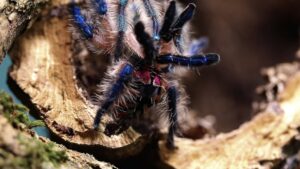
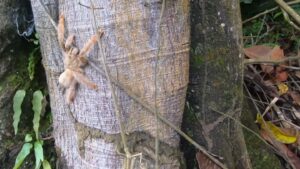
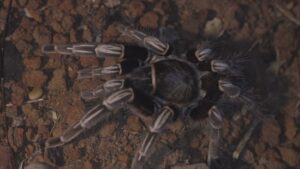
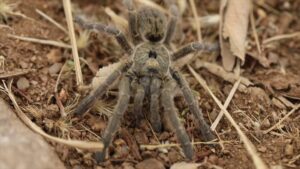
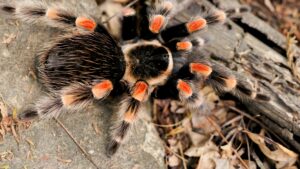
Brazilian jewel, black, salmon pink, white knee and red and white are hobby names, and each points at one species in the World Spider Catalog: Typhochlaena seladonia, Grammostola pulchra, Lasiodora parahybana, Acanthoscurria geniculata and Nhandu chromatus.1 The trade name is shorthand and the scientific name is the safe reference, because some of these species have changed genus since the old care sheets were written. This page matches each name to its current catalog entry, links my page for every species I cover, and says plainly which ones I have found in Brazil and which I only know from captivity.

Which Brazilian tarantula has which trade name?
The catalog gives the valid name and the range, but it does not record hobby names.1 The first column is the name sellers and keepers use. The third column is the range as the catalog states it on 2 October 2026.
| Trade name | Current name (World Spider Catalog) | Range in the catalog | My page |
|---|---|---|---|
| Brazilian jewel | Typhochlaena seladonia (C. L. Koch, 1841) | Brazil | Typhochlaena seladonia; the genus |
| Pink punk jewel | Typhochlaena costae Bertani, 2012 | Brazil | Typhochlaena costae; portrait series |
| Brazilian salmon pink, salmon pink birdeater | Lasiodora parahybana Mello-Leitão, 1917 | Brazil | none |
| Brazilian black | Grammostola pulchra Mello-Leitão, 1921 | Brazil | none |
| Brazilian whiteknee, giant white knee | Acanthoscurria geniculata (C. L. Koch, 1841) | Brazil | Acanthoscurria geniculata |
| Brazilian red and white | Nhandu chromatus Schmidt, 2004 (moved to Vitalius by Bertani in 2023, returned to Nhandu in 20265) | Brazil | Nhandu chromatus |
| Brazilian giant blonde | Nhandu tripepii (Dresco, 1984) (older name: Nhandu vulpinus) | Brazil | Nhandu tripepii |
| Brazilian blue | Lasiocyano sazimai (Bertani, Nagahama & Fukushima, 2011) (before 2023: Pterinopelma sazimai) | Brazil | Lasiocyano sazimai |
| no trade name I use | Ybyrapora diversipes (C. L. Koch, 1842) | Brazil | Ybyrapora diversipes |
| no trade name I use | Grammostola iheringi (Keyserling, 1891) | Brazil, Uruguay | Grammostola iheringi |
Hobby names move more slowly than the catalog. Nhandu chromatus is still listed as Vitalius chromatus in some shops, and the blue one was Pterinopelma sazimai until 2023, when it became the only species of its own genus, Lasiocyano.1 Searching with the old name finds the old advice.

Is the Brazilian jewel tarantula Typhochlaena seladonia?
Yes. The Brazilian jewel is T. seladonia, one of six Typhochlaena species in the catalog, all from Brazil.1 It lives in trees and shuts itself into a bark-coloured retreat with a hinged lid. Christian Andre searched for it in the field for twelve weeks, and in 2018 we reported that lifestyle together.3 The species has its own page, Typhochlaena seladonia: the Brazilian jewel tarantula, and the other five species are on Typhochlaena, Brazil’s jewel trapdoor tarantulas.
The “pink punk jewel” is a different animal. It is T. costae, which Bertani described from Tocantins, Maranhão and Piauí, drier country than the Atlantic forest of T. seladonia.4 I keep the two apart on the Typhochlaena costae page.
What is the Brazilian salmon pink birdeater?
It is Lasiodora parahybana Mello-Leitão, 1917, and the catalog records it from Brazil.1 The catalog accepts seven species of Lasiodora, three of them described by Bertani in 2023.1 I have not found L. parahybana in Brazil and I do not keep it, so there is no page of mine for it and nothing of my own to show. The Lasiodora I do know is L. klugi, a very old animal in my collection that I mention in my film on the genus Nhandu (9:17). For the salmon pink itself, the Wikipedia entry is a place to start.2
What is the Brazilian black tarantula?
It is Grammostola pulchra Mello-Leitão, 1921, recorded from Brazil.1 Other Grammostola species are easy to mix up with it. The catalog records G. pulchripes from Brazil, Paraguay and Argentina and G. iheringi from Brazil and Uruguay, and it places the common rose hair, G. rosea, in Bolivia, Chile and Argentina, not in Brazil.1 I have not found G. pulchra in the wild and I do not keep it. What I have on the genus is Grammostola iheringi and the rose hair tarantula.
Which Brazilian tarantulas have I found, and which do I only keep?
Very few, in the wild. In 2010 I travelled to Brazil, and a local colleague showed me a sub-adult male T. curumim that he had found in a mango tree in a small village in Paraíba. I photographed the animal and the lid of its retreat, and I could not see how the retreat sits in place, so it stays a lead (more on the genus page). In 2017 I turned a rock near Pedra Azul on a holiday and found a young tarantula that I could not name beyond the family, which is why that record stays short. In the field I can add one more: we found Iridopelma hirsutum Pocock, 1901 in Brazil a few years ago, a tree dweller that sits two to five meters above the ground.
Everything else on this page I know from captivity. T. seladonia and T. costae appear in our films as captive animals, the T. costae from friends’ breeding collections, and the only field footage of T. seladonia is Christian’s. I keep N. chromatus and N. tripepii myself. The first comes from the dry Caatinga and Cerrado, the second from the humid lowlands around Belém (2:17). The catalog counts six Nhandu species, five of them from Brazil, and I have not seen the other three Brazilian ones, N. carapoensis, N. cerradensis and N. coloratovillosus, in the wild (1:08).1

Is the Brazilian wandering spider a tarantula?
No. “Brazilian wandering spider” is the common name of Phoneutria, a genus of nine species that the catalog places in the family Ctenidae.1,2 Tarantulas are the Theraphosidae, and none of the species in the table above is a wandering spider. How the tarantula family is put together is on our overview of the Theraphosidae.
References
- World Spider Catalog (2026). Natural History Museum Bern, wsc.nmbe.ch, genus catalogs of Lasiodora, Grammostola, Nhandu, Acanthoscurria, Typhochlaena, Lasiocyano and Ybyrapora, and the Ctenidae genus list; accessed 2 October 2026.
- Wikipedia, Lasiodora parahybana and Phoneutria (for the use of the common names); accessed 2 October 2026.
- Andre, C. & Hüsser, M. (2018). About trapdoors and bridges: new insights in the little-known ecology and lifestyle of the genus Typhochlaena C. L. Koch, 1850. Journal of the British Tarantula Society 32(3): 3-29.
- Bertani, R. (2012). Revision, cladistic analysis and biogeography of Typhochlaena C. L. Koch, 1850, Pachistopelma Pocock, 1901 and Iridopelma Pocock, 1901 (Araneae, Theraphosidae, Aviculariinae). ZooKeys 230: 1-94. doi:10.3897/zookeys.230.3500.
- Sherwood, D., Gabriel, R., Peñaherrera-R., P., Brescovit, A. D. & Lucas, S. M. (2026). Redescription of Nhandu chromatus Schmidt, 2004 stat. rest. and revalidation of Nhandu sylviae Sherwood, Gabriel & Brescovit, 2023 stat. rest. (Araneae: Theraphosidae). Arachnology 20(4): 519–526. doi:10.13156/arac.2026.20.4.4.