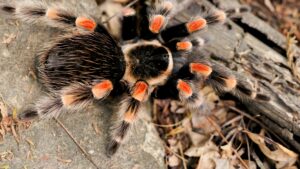
Caribena versicolor, the Antilles pinktoe, is a tree-dwelling tarantula found only on the Caribbean island of Martinique. For more than a century people filed it under Avicularia, and many still search for Avicularia versicolor. Since 2017 the species has belonged to Caribena, a genus of just two species. Walckenaer’s 1837 name survived only because a later team chose a new reference specimen. Below you will find the names, the range and the history of that name, plus the parts of our film that go with them.
| Accepted name | Caribena versicolor (Walckenaer, 1837)[1] |
|---|---|
| Common names | Antilles pinktoe, Martinique pinktoe, Martinique pink toe tarantula |
| Older name | Avicularia versicolor[1] |
| Family | Theraphosidae, subfamily Aviculariinae[2] |
| Range | Martinique[1][2] |
| Genus | Caribena Fukushima & Bertani, 2017: two species, C. versicolor and C. laeta[1] |
Which names does this tarantula go by?
- Caribena versicolor (Walckenaer, 1837): the accepted name in the World Spider Catalog. Walckenaer first published it as Mygale versicolor.[1]
- Avicularia versicolor: the name in use from Simon in 1892 until the 2017 revision moved the species to Caribena. Plenty of people still use it.[1]
- Avicularia rutilans Ausserer, 1875: a junior synonym. Its type specimen carried a label saying Colombia, but Fukushima and Bertani found it to be C. versicolor.[1][2]
- Antilles pinktoe, Martinique pinktoe, Martinique pink toe tarantula: the hobby names. Our film description adds Martinique tree tarantula, and matoutou falaise, the French name used on the island.[3]
What does it look like?
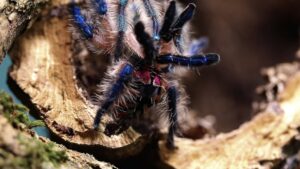
Colour changes completely between baby and adult, and that is what the name versicolor points to. In our film the young spiders are blue, and each moult adds more red hair on the abdomen until the adult is red over a green carapace.[3] The 2017 description agrees with the adult end of that story: brown carapace with short golden hairs and an intense green sheen, and vivid red guard hairs over short black ones on the top of the abdomen.[2] Juveniles show a dark stripe down the middle of the abdomen, joined to dark crossbars, and adults lose that pattern.[2] Two colour forms are known, one with bright red hairs on the legs and palps and one with darker hairs there.[2]
Where does it live?
Only on Martinique. The World Spider Catalog gives no other place, and the 2017 revision states that the species does not occur on Guadeloupe.[1][2] Walckenaer had described the female from Guadeloupe, and the authors suggest he recorded a Martinique specimen under the wrong island. Two other records are doubtful: three very old museum specimens labelled Cuba, and the Colombian label on A. rutilans. Fukushima and Bertani treat both as unconfirmed and know of no other record from the American mainland.[2]
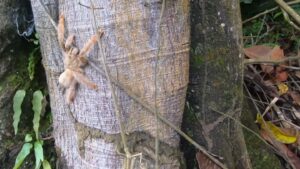
What we know about its habits comes from a population study on Martinique by Maréchal and colleagues, summarised in the 2017 revision. In that study the spider preferred mesophyll forest and built its silk retreat in bromeliad leaves, between tree branches, inside bamboo trunks, on tree trunks and in buildings. Life cycle: about two years, sexual maturity at around 18 months after about ten moults, a reproductive period in March and egg sacs hatching in May and June.[2] Maréchal and colleagues also suggested putting the species on the CITES list.[2]
Why are its hairs unusual?
Like other New World tarantulas, Caribena carries urticating hairs on the abdomen, but its hairs are unusual. They are type II hairs, the kind found in the Aviculariinae, yet long and slender: over a millimetre long and under 0.009 mm wide, in a conspicuous patch on the back of the abdomen.[2] In the female the authors measured, they ran 1.33 to 1.58 mm. Avicularia hairs are stouter, and that difference helps separate the two genera.[2]
Use differs as well. In Avicularia the hairs are passed on by direct contact when the spider is disturbed. Bertani and colleagues observed C. versicolor, under its old name, expelling them into the air the way terrestrial tarantulas do, which fits hairs thin enough to travel on air.[2] Our film covers the same point from 7:13.[3]
How did the name get sorted out?
The name versicolor has a messy history because Walckenaer described it from two spiders of different species: a female from Guadeloupe and a male from Brazil. The female matches what we now call C. versicolor. The male has a two-branched tibial apophysis and is a theraphosine from Brazil, a different subfamily.[2] Koch followed Walckenaer in 1842, extended the range to Brazil, and later moved the species to Lasiodora. Ausserer then built a new genus, Homoeomma, on Brazilian spiders he took for the same species. In 1892 Simon recognised that the name belonged to the very common Avicularia of the Lesser Antilles and used it that way.[2]
That left a name tied to a lost type series that mixed two species. In 2017 Fukushima and Bertani treated the original specimens as lost and designated a male from Martinique, held in the Paris museum, as the neotype, so the name would stay with the Antillean spider.[2] In the same paper they erected Caribena for two Caribbean species and named it from the Spanish caribeña, “from the Caribbean”. Type species of the genus is C. laeta, not C. versicolor. The catalog lists Puerto Rico, Cuba and the US Virgin Islands for that sister species.[1][2]
Our film, with timestamps
The full film, Have We Found the Antilles Pinktoe Tarantula in the Wild? (2021, 12 minutes), is embedded on the pink toe tarantula page. Footage comes from World of Spiders, with stock footage added.[3] Parts that go with this page:
- 1:32, a freshly hatched spider on the rocks, and from 2:00 in bromeliad leaves.
- 2:22, the colour change from blue to red.
- 3:23, the tangled naming history, from Walckenaer to the 2017 neotype.
- 7:13, the urticating hairs.
- 8:52, adults in the forest on Martinique.
More on pink toes
Caribena is one branch of the pink toe group. The Avicularia side is on our pink toe page, and the Beni, Bolivia label shows how easily locality and species names drift on pink toes. For the family as a whole, see the Theraphosidae overview.
References
- World Spider Catalog (2026), genus page Caribena. Natural History Museum Bern.
- Fukushima, C. S. & Bertani, R. (2017). Taxonomic revision and cladistic analysis of Avicularia Lamarck, 1818 (Araneae, Theraphosidae, Aviculariinae) with description of three new aviculariine genera. ZooKeys 659: 1–185 (Caribena gen. n. pp. 130–131; C. versicolor pp. 138–144; urticating hair behaviour p. 9). doi:10.3897/zookeys.659.10717
- birdspidersCH film Have We Found the Antilles Pinktoe Tarantula in the Wild? (2021), narration and video description.
Related Images: