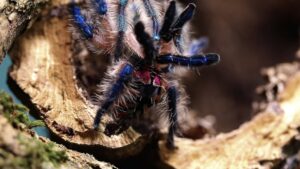
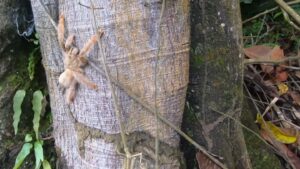
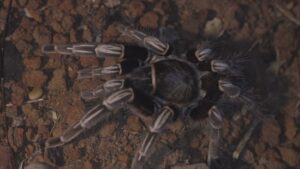
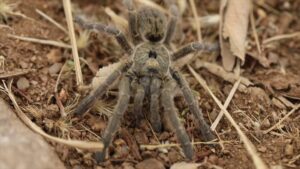
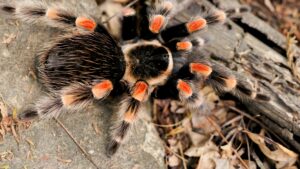
Ceratogyrus is a genus of baboon tarantulas from southern and south-central Africa, with ten accepted species from Angola and Namibia across to Mozambique and Malawi.[1] Hobbyists call them horned baboon tarantulas because many species carry a horn on the carapace, a protuberance that rises from the fovea, the pit in the middle of the back. It can be a low plug, a bump or a cone, and some species have none at all.[2][3] The two names you meet most often are Ceratogyrus darlingi, known in the hobby as the rear-horned baboon, and Ceratogyrus marshalli. What the horn is for has not been shown.[5] We searched for the genus in Namibia, and we made a film about the newest species, Ceratogyrus attonitifer from Angola, whose horn no other spider matches.
Which species belong to Ceratogyrus?
The World Spider Catalog accepts ten species, with countries as the catalog gives them.[1]
- Ceratogyrus attonitifer Engelbrecht, 2019: Angola.
- Ceratogyrus brachycephalus Hewitt, 1919: Botswana, Zimbabwe, South Africa.
- Ceratogyrus darlingi Pocock, 1897: southern Africa. The catalog gives no country list. Gallon names Botswana, Mozambique, Namibia, South Africa and Zimbabwe.[4] This is the type species of the genus.[1]
- Ceratogyrus dolichocephalus Hewitt, 1919: Zimbabwe.
- Ceratogyrus hillyardi (Smith, 1990): Malawi.
- Ceratogyrus marshalli Pocock, 1897: Zimbabwe, Mozambique.
- Ceratogyrus meridionalis (Hirst, 1907): Malawi, Mozambique.
- Ceratogyrus paulseni Gallon, 2005: South Africa.
- Ceratogyrus pillansi (Purcell, 1902): Zimbabwe, Mozambique.
- Ceratogyrus sanderi Strand, 1906: Namibia, Zimbabwe.
Older names still turn up in listings and papers. Ceratogyrus bechuanicus Purcell, 1902 is a junior synonym of C. darlingi, because Gallon (2008) found that the characters used to separate the two did not hold.[1][4] Ceratogyrus cornuatus De Wet & Dippenaar-Schoeman, 1991, which had been separated from C. marshalli on the shape of its horn, is a junior synonym of C. marshalli.[1][2] Coelogenium Purcell, 1902 was folded into Ceratogyrus in 2001.[2] Two species once placed here now sit in Augacephalus and one in Pterinochilus.[1]
What is the horn on a horned baboon tarantula?
It grows out of the fovea. In Ceratogyrus the fovea is strongly curved forward, and in some species it surrounds a protuberance. In his 2001 revision Gallon describes three forms: a simple backward extension of the head region, a low-set plug, or a prominent cone.[2]
- The horn grows with the animal. In young C. bechuanicus (now C. darlingi), the fovea looks like that of a hornless spider until about the fourth or fifth instar, and the protuberance develops over the following moults.[2]
- It varies within a species. Gallon found considerable variation in the size, curvature, width, angle and shape of the horn in C. darlingi, which is why the shape alone could not hold C. bechuanicus apart.[4]
- It can differ between the sexes. In C. dolichocephalus the female has a horn and the male does not.[3]
- Some species have no horn. Ceratogyrus paulseni is described as non-protuberate.[3] Gallon (2001) defines the genus by the combination of plumose stridulatory setae on the chelicerae and a strongly curved fovea, and proposed a pale yellow band under the front of the abdomen as a further character of the genus. C. paulseni has a transverse fovea and no obvious band.[2][3]
The function is open. Midgley and Engelbrecht write that it is uncertain, and note that similar foveal structures occur in unrelated spiders, among them the South American tarantula genera Cyrtopholis, Sphaerobothria and Umbyquyra.[5] Within the baboon spiders, every known species with such a structure is placed in Ceratogyrus.[5] The plumose setae on the chelicerae are a sound-making organ, and they work against matching setae on the palps.[2] We filmed baboon spider hissing in the King baboon, Pelinobius muticus, on our page on tarantula bites.
Where do horned baboon tarantulas live?
Mostly in southern Africa, south of the Cunene and Zambezi rivers, and the genus is most diverse in Zimbabwe, where six of the nine species known before 2019 occur.[5] In Namibia the catalog lists C. sanderi, the species we filmed there, and Gallon (2008) also lists C. darlingi from Namibia.[1][4][7] The discovery of C. attonitifer in central Angola moved the edge of the genus about 400 km, and the authors suggest it may be more widespread in central Africa, since it lives in miombo woodland that reaches from southern DR Congo to Tanzania.[5] The same Angolan survey turned up a second Ceratogyrus that may be undescribed.[5]
The three species with field notes in these papers all dig burrows, and the burrows differ with the species and the ground:
- C. darlingi is found in lightly wooded grassland and open clearings. It builds sub-vertical burrows 30 to 70 cm deep in open ground, and adults and young also dig under rocks, boulders and logs.[4]
- C. paulseni was found in South Africa in a clay clearing in mopane and acacia woodland. About twenty burrows were sub-vertical, around 60 cm deep, and their round entrances had no collar of silk or debris. Burrows of C. bechuanicus (now C. darlingi) and of Augacephalus junodi were in the same clearing.[3]
- C. attonitifer lives in miombo woodland and was collected from open burrows in sandy soil on the edges of dambos, seasonal wetlands. Burrows were about 40 cm deep and nearly vertical, with a horizontal chamber at the bottom and a low silk collar mixed with grass and twigs.[5]
Our page on where tarantulas live puts C. brachycephalus on the African map, and what wild burrows show gathers burrow observations across the family.
Ceratogyrus attonitifer: the horn that covers the abdomen
Ceratogyrus attonitifer was described by Ian Engelbrecht in Midgley and Engelbrecht (2019), from females dug out of burrows in Angola during surveys for the Okavango Wilderness Project.[5] Its species name joins the Latin attonit-, astonishment, with -fer, bearer, and the authors say it records their astonishment at the find.[5] The reason is the horn. It is a large, elongate protuberance, as long as the carapace or longer, that lies back over the abdomen. Only the front part is hard. The rest is soft, bag-like in life and shrivelled in preserved animals, whereas the horn is fully hard in every other genus where it occurs.[5] Eight females measured 28 to 40.5 mm in total length.[5] The paper withholds the collection sites because of concern about illegal collecting for the pet trade, and so do we.[5] It also records the Luchazi name “Chandachuly” for the spider.[5]
Two films on horned baboon tarantulas
Searching for Ceratogyrus sanderi in Namibia
Field footage from Namibia, published in December 2019, showing Ceratogyrus sanderi.[7] In the film we turn rocks in the heat and find nothing on the day; the animal we show, a tiny one of about 2.5 cm body length found under a rock the year before, was pure luck, and a second came out of a burrow after we poured water down it. We would like to go back with a team of arachnologists to raise the odds of finding more than one animal. A compilation of our field trips, Unique Top 3 Wild Tarantulas, has a short Ceratogyrus segment from Namibia at 3:56.[6]
The “Mega Horned Baboon Tarantula”
A home-made taxonomy film from February 2019, three days after the description of Ceratogyrus attonitifer appeared. It explains the new species rather than showing field footage. In the film we call it the “Mega Horned Baboon Tarantula” and look at the horn, which covers almost the whole opisthosoma, something we had never seen before. We hope for more pictures and video of this species soon.[6]
More on baboon spiders
The baboon spiders have their own page, Harpactirinae, with a photo gallery and reference links. The subfamily sits inside the family covered in the Theraphosidae overview, and the tarantula gallery sorts pictures by subfamily.
References
- World Spider Catalog (2026), genus page Ceratogyrus. Natural History Museum Bern.
- Gallon, R. C. (2001). Revision of the Ceratogyrus spp. formerly included in Coelogenium (Araneae: Theraphosidae, Harpactirinae). Mygalomorph 2: 1–20.
- Gallon, R. C. (2005). A new species of theraphosid spider from Southern Africa (Araneae, Theraphosidae, Harpactirinae) with distributional notes on other harpactirines. Bulletin of the British Arachnological Society 13(5): 179–184.
- Gallon, R. C. (2008). On some poorly known African Harpactirinae, with notes on Avicuscodra arabica Strand, 1908 and Scodra pachypoda Strand, 1908 (Araneae, Theraphosidae). Bulletin of the British Arachnological Society 14(5): 232–246.
- Midgley, J. M. & Engelbrecht, I. (2019). New collection records for Theraphosidae (Araneae, Mygalomorphae) in Angola, with the description of a remarkable new species of Ceratogyrus. African Invertebrates 60(1): 1–13. doi:10.3897/AfrInvertebr.60.32141
- birdspidersCH video descriptions (YouTube): Horned Baboon Tarantula! Tarantula Expedition goes wrong, The Mega Horned Baboon Tarantula and Unique Top 3 Wild Tarantulas.
- My own identification of the animal in the Namibia film as C. sanderi; the film labels it at 6:26.
Related Images:


![Ceratogyrus cf hillyardi (Smith, 1990)], female, Tanzania](https://birdspiders.ch/wp-content/gallery/theraphosidae/Ceratogyrus-cf-hillyardi-Smith-1990-female-Tanzania.jpg?t=1677421589 "Ceratogyrus cf hillyardi (Smith, 1990)], female, Tanzania")