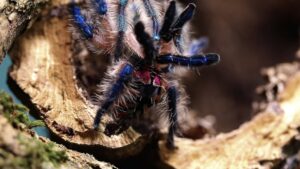
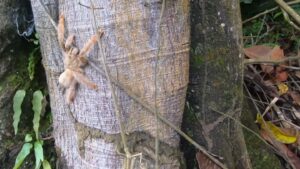
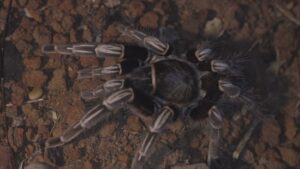
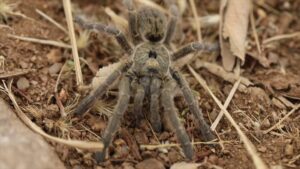
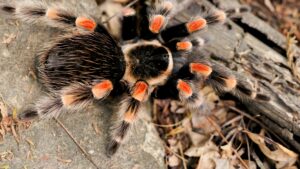
Chile has 21 recorded tarantula species in five genera: Euathlus (9), Homoeomma (7), Phrixotrichus (3), Grammostola (1) and Catumiri (1).[1] Their habitats run from the high Andes, where Euathlus condorito lives under loose rocks at around 2,400 metres, to greener and cooler country in the south. The best known is the Chilean rose hair, Grammostola rosea, which has its own page: rose hair tarantula, what Grammostola rosea means. This page gathers four field episodes from our 2018 Chile series about the other Chilean tarantulas, mostly Euathlus.
Which tarantulas live in Chile?
The family Theraphosidae is represented in Chile by five genera. Country names and authorities below follow the World Spider Catalog.[1]
- Grammostola rosea (Walckenaer, 1837) is recorded from Bolivia, Chile and Argentina. Its long-time companion name G. porteri is now a junior synonym.[5]
- Euathlus Ausserer, 1875 has nine species recorded from Chile, among them E. truculentus (Chile and Argentina), E. condorito and E. manicatus.[1]
- Phrixotrichus Simon, 1889 has three: P. vulpinus (Chile and Argentina), P. scrofa (Chile and Argentina) and P. jara (Chile). P. vulpinus was long listed as Euathlus vulpinus.[1]
- Homoeomma Ausserer, 1871 has seven Chilean species. The genus was first recorded in Chile in 2018.[3] The red and black Homoeomma chilense, listed on iNaturalist as the dwarf Chilean flame tarantula, is the spider formerly sold as Euathlus sp. “Red”.[6][7]
- Catumiri almonacidae Montenegro & Aguilera, 2025 was described in 2025 and is recorded from Chile.[1]

Where the episodes were filmed
The series ran from April to August 2018. Locations stay at region level on this page.
- Andean highlands: Euathlus condorito, a recently described species that lives under loose rocks in cold conditions, was the first spider of the series. Later episodes search snow-covered ground.
- Central Chile: after the highlands the route led back to the capital, where the rose hair search began.
- Southern Chile: the vegetation gets greener and more lush toward the south and the temperature drops. Phrixotrichus vulpinus was filmed here, with a second Euathlus species living beside it.
- Northern Chile: the “blue femur” Euathlus truculentus.


Four field episodes
All four films show wild animals in the field. They run in the order they were published.
Southern Chile: Euathlus, scorpions and a tarantula-like spider
Vlog 15 follows the search for an elusive Euathlus in the south of the country. Along the way we meet scorpions and a spider that looks like a tarantula but belongs to a different family.
Highlands under snow: the “Bronze” tarantula
Vlog 17 comes just after the red Homoeomma find. On the way down from the snow-covered highlands we saw an adult male tarantula cross the road but could not find him again. At the next stop we found an adult female and a freshly hatched egg sac of what appears to be the “Bronze” tarantula, Euathlus manicatus, which fits the species’ range.
Euathlus “Tiger”: a search through thorny scrub
In the last days of the trip we searched a region of thorny, spiky bushes for an elusive Euathlus, and the search paid off. The film runs just under four minutes.
Euathlus sp. “Metropolitana”: the last stop before the flight home
On the last stop before the flight home we found another elusive tarantula, uniquely coloured. By body shape it belongs to the Euathlus condorito group. Chilean tarantula enthusiasts call it Euathlus sp. “Metropolitana”, a hobby name and not a described species.
Two more films from the Chile series: This Tarantula Enjoys The Snow in Nature ?! (Euathlus condorito in the Andean highlands, field footage) and Blue Femur Tarantula – Euathlus truculentus in the wild (northern Chile, field footage).
How the names have moved
Chilean tarantula names have changed more than once, and videos from 2018 carry the older labels.
- 2014: Paraphysa became a junior synonym of Euathlus, and Phrixotrichus was resurrected as its sister genus. Euathlus condorito was described in the same paper.[2]
- 2018: two research teams described the same red and black Homoeomma independently, as H. chilensis in October 2018 and H. bicolor in November 2018. In 2019 the first name was kept as the valid one.[3][4] The World Spider Catalog now writes it as Homoeomma chilense.[1]
- 2022: Grammostola porteri was proposed as a junior synonym of Grammostola rosea.[5]
More on Chilean species
The rose hair has its own page, Grammostola rosea, with three films. The series also has films on Euathlus condorito, Euathlus truculentus, Phrixotrichus vulpinus and Homoeomma chilense.
For burrows in the wild, see what wild burrows show. The same approach for another country is on tarantulas of Mexico in the wild. The family as a whole is in the Theraphosidae overview, and the tarantula gallery sorts pictures by subfamily.
References
- World Spider Catalog (2026), genus pages for Euathlus, Phrixotrichus, Homoeomma and Grammostola. Natural History Museum Bern.
- Perafán, C. & Pérez-Miles, F. (2014). The Andean tarantulas Euathlus Ausserer, 1875, Paraphysa Simon, 1892 and Phrixotrichus Simon, 1889 (Araneae: Theraphosidae): phylogenetic analysis, genera redefinition and new species descriptions. Journal of Natural History 48(39–40): 2389–2418. doi:10.1080/00222933.2014.902142
- Montenegro V., R., Aguilera, M. A. & Casanueva, M. E. (2018). First record of Homoeomma Ausserer, 1871 in Chile and description of two new species (Araneae, Theraphosidae). Spixiana 41(1): 13–25.
- Sherwood, D., Gabriel, R. & Longhorn, S. J. (2019). A new synonymy in the genus Homoeomma Ausserer, 1871 (Araneae, Theraphosidae), with comments on potential homonymy. Bionomina 15: 69–73. doi:10.11646/bionomina.15.1.8
- Aguilera, M. A., Montenegro, R. & Casanueva, M. E. (2022). Revised taxonomic placement and distribution update of Grammostola Simon, 1892, Phrixotrichus Simon, 1889 and Thrixopelma Schmidt, 1994 species, a chaotic history of Chilean tarantulas (Araneae, Theraphosidae). Revista Ibérica de Aracnología 40: 63–71.
- birdspidersCH video descriptions (YouTube): Homoeomma Red Fire Tarantula in the nature and RED TARANTULA Confusion.
- iNaturalist taxon page, Homoeomma chilense (common name: Dwarf Chilean Flame Tarantula).