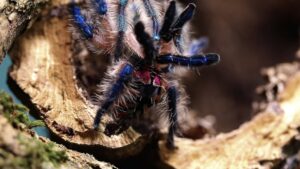
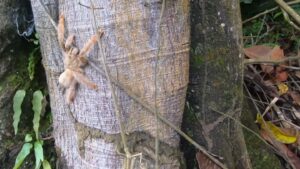
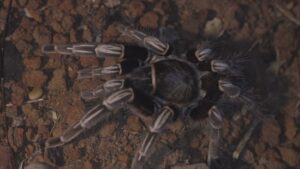
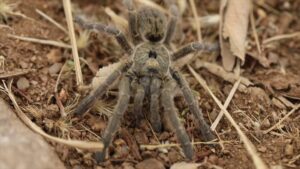
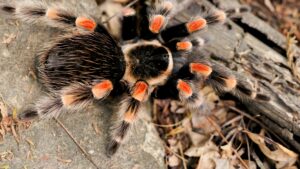
Coremiocnemis hoggi, the Malaysian purple femur tarantula, is a burrowing tarantula from the highlands of Peninsular Malaysia. Rick West and Steven Nunn described it in 2010, and the World Spider Catalog still accepts the name.1,2 Violet femora and a very hairy fourth pair of legs set it apart. In 2018 we found it in the Malaysian highlands, at night, with a stick to lure it out.

Coremiocnemis hoggi at a glance
| Feature | What the sources give |
|---|---|
| Accepted name | Coremiocnemis hoggi West & Nunn, 20101 |
| Family | Theraphosidae; a selenocosmiine tarantula in the original papers2,3 |
| Common name | Malaysian purple femur tarantula (often written purple-femur) |
| Distribution | Malaysia (peninsula).1 The describers knew it from one hill area in Selangor, between 550 and 1,150 meters2 |
| Lifestyle | Fossorial: a burrow with a silken collar on steep, shaded slopes of montane rainforest2 |
| Burrow | 20 to 60 centimeters deep, ending in an enlarged flask-shaped chamber2 |
| Color | Femora dark with a strong violet hue in natural light; no cream bands on the legs2 |
| Size | Holotype female: body length about 54 mm, carapace length 20.5 mm2 |
| Trade status | Not listed in CITES (as reported in December 2025); a petition to list it under the US Endangered Species Act was filed in December 20254 |
Who described it, and is the name still valid?
West and Nunn named C. hoggi in 2010, in a revision of the genus Coremiocnemis. Stephen Hogg, who collected specimens and natural history data in Malaysia for that paper, is honored in the name.2 Today the catalog still lists the species in Coremiocnemis, with a note that the genus is not monophyletic according to Briggs, Foley and Cook (2025).1 So the genus placement may change one day.
What does the Malaysian purple femur tarantula look like?
In the 2010 description the femora are dark with a strong violet hue in natural light, the segments toward the feet are light sandy, and the legs have no cream bands.2 Leg IV is what sets it apart from its relatives: it is the thickest leg, and in older adult females it carries extremely long setae.2 On camera the femora look dark, shiny and almost blue to me, and the amount of hair on the fourth leg is insane. I show it at 6:27 in our highland film.

Where does it live?
For distribution, the World Spider Catalog gives Peninsular Malaysia only.1 In 2010 the describers knew it from the summit and south-western slopes of one hill area in the state of Selangor, and later reports came from lower slopes nearby.2 Burrows sit on steep, shaded ground. Openings are mainly a silken collar that takes in leaf litter and other debris, and the soil is moist and clay-like.2 In our Malaysian earth tiger film we show these silk-sealed burrows on a steep, shaded slope (1:40).

How did we find it?
Rain made it hard. In the highlands we had about 15, sometimes almost 20 hours of rain in total, with thunderstorms at night. We search at night, because that is when tarantulas are easy to lure out of their burrows, so the rain cost us a lot of searching time. Four species of tarantula live up there that we could hope to find, and the first night we found two of them. C. hoggi was one, and it was an easy find: they were everywhere up the hills (5:39).
Inside the burrow it was about 17 to 21 degrees Celsius, cooler than most tarantulas like it. Most of the animals came out only about two thirds of the way and then went back in. One adult female came out completely. Once she was out she showed no aggression at all, and we took her out of her burrow for a size comparison, which she did not like (8:15).

Coremiocnemis or Psednocnemis?
Mixing up the two genera is easy, and the mix-up has a history. Three species West and Nunn described in 2010 as Coremiocnemis, brachyramosa, gnathospina and jeremyhuffi, now sit in Psednocnemis, a genus West, Nunn and Hogg erected in 2012.1,3 That paper also found that the male in the original C. hoggi type series was another species, Psednocnemis davidgohi.3 Both genera also share ground: P. davidgohi was found living beside C. hoggi and P. jeremyhuffi, sometimes only 70 centimeters away.3 At the end of our highland film there is a short look at P. jeremyhuffi, which lives close by. For the wider Malaysia and Thailand trip, see Wild tarantulas of Malaysia and Thailand. Liphistius, the old trapdoor spider, lives in the same hills, and what separates it from tarantulas is on trapdoor spiders and trapdoor tarantulas.
Is the Malaysian purple femur tarantula endangered?
In the highlands the person I was with told me there had been many more C. hoggi there a few years before, that the species had been smuggled by a lot of people, and that it still was (5:46). Living close to a city makes it an easy target for collectors and for people who make souvenirs for tourists. Our film on the most endangered Old World tarantulas makes the same point (6:01).
In December 2025 the Center for Biological Diversity petitioned the US Fish and Wildlife Service to list the species as endangered under the US Endangered Species Act. Courthouse News, reporting on the petition, writes that the species lives in an area of about 10 square miles on the western side of Malaysia, that no population estimate is known, and that it is not listed in CITES. That report also quotes US import records of 261 of these spiders between 2016 and 2024, 23 of them declared wild-sourced.4 Still, a petition is a request, not a listing. My advice is the one from our film: do not buy wild-caught animals. More on trade rules and wild populations is on our page are tarantulas endangered. How it compares with New World tarantulas is on Old World vs New World tarantulas, and the wild burrows we found elsewhere are collected in fossorial tarantulas.
References
- World Spider Catalog (2026). Natural History Museum Bern, wsc.nmbe.ch, genus Coremiocnemis and Coremiocnemis hoggi (LSID urn:lsid:nmbe.ch:spidersp:043291); accessed 2 October 2026.
- West, R. C. & Nunn, S. C. (2010). A taxonomic revision of the tarantula spider genus Coremiocnemis Simon 1892 (Araneae, Theraphosidae), with further notes on the Selenocosmiinae. Zootaxa 2443: 1-64. doi:10.11646/zootaxa.2443.1.1
- West, R. C., Nunn, S. C. & Hogg, S. (2012). A new tarantula genus, Psednocnemis, from west Malaysia (Araneae: Theraphosidae), with cladistic analyses and biogeography of Selenocosmiinae Simon 1889. Zootaxa 3299: 1-43. doi:10.11646/zootaxa.3299.1.1
- Courthouse News Service (2025). Environmentalists seek protections for Malaysian tarantula targeted by illegal pet trade, on the Center for Biological Diversity petition of December 2025. courthousenews.com