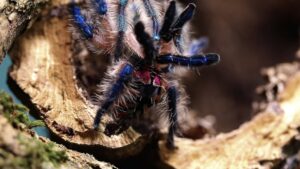
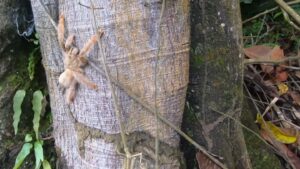
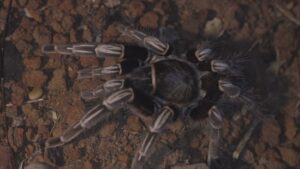
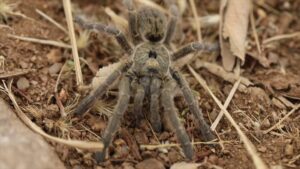
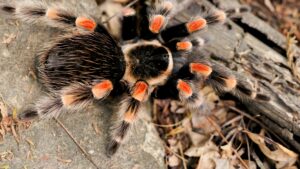
Costa Rica has 36 recorded tarantula species in 14 genera, according to the World Spider Catalog.[1] They include the striped zebra tarantula, Aphonopelma seemanni, one of the most widely kept pet tarantulas, and the red leg tarantula of the cloud forest. This page gathers our Costa Rica field films, lists the species known from the country, and points to the species pages that carry the other episodes. Two episodes play here: a rainforest walk and a roadside stop.
Which tarantulas live in Costa Rica?
All 36 species belong to the family Theraphosidae. Names, authorities and country records below follow the World Spider Catalog as checked on 1 October 2026.[1]
- Aphonopelma (5 species) includes A. seemanni, recorded from El Salvador, Honduras, Nicaragua and Costa Rica, and the type species of the genus.[2] The others recorded here are A. crinirufum, A. burica, A. sclerothrix and A. xanthochromum. Our page: Aphonopelma seemanni in Costa Rica.
- Sericopelma (8 species) has S. angustum, S. dota, S. ferrugineum, S. generala, S. immensum, S. melanotarsum, S. silvicola and S. upala. Our page: Sericopelma in Panama and Costa Rica.
- Stichoplastoris (5) has S. asterix, S. denticulatus, S. elusinus, S. obelix and S. stylipus, which is also found in Panama.
- Crypsidromus (5) has C. brevibulbus, C. carinatus, C. icecu, C. puriscal and C. rubitarsus.
- Abdomegaphobema (2) holds A. mesomelas, the red leg tarantula, and A. peterklaasi. Both are recorded only from Costa Rica. The genus dates from 2023.[3] Our page: Abdomegaphobema mesomelas in Costa Rica.
- Davus (2) has D. fasciatus (Costa Rica and Panama) and D. ruficeps (Costa Rica and Nicaragua).
- Trichopelma (2) has T. laselva and T. venadense.
- One species each: the curly hair tarantula Tliltocatl albopilosus, with its own page, curly hair tarantula; Sandinista lanceolatum (Nicaragua and Costa Rica); Sphaerobothria hoffmanni (Costa Rica and Panama); Neischnocolus panamanus (Costa Rica and Panama); Cyclosternum viridimonte; Aenigmarachne sinapophysis; and Psalmopoeus drolshageni, described in 2025.
Where the films were made
Locations stay at region level on this page. Habitat notes come from our own film descriptions unless a reference is cited.
- Central highland cloud forest: Abdomegaphobema mesomelas lives here at roughly 1,000 to 1,500 metres above sea level.
- Mid-elevation forest: Sericopelma melanotarsum lives at 800 to 1,100 metres and is sometimes found in the same area as A. mesomelas.
- Northern lowland forest: we searched here for the curly hair tarantula, and the same film looks for A. seemanni, A. crinirufum and Davus ruficeps in a dry-zone stretch.
- Pacific lowland dry forest: home of the small Sandinista lanceolatum, a genus described in 2019 for a spider of the Pacific lowlands of Nicaragua and Costa Rica.[2]

Two episodes from the field
Both films show wild animals in Costa Rica. They run in the order they were published.
Rainforest walk: the earliest Costa Rica episode
Field footage from Costa Rica, the first episode of the trip. We start in the garden of a house at the edge of the rainforest and then hike a rough trail. We find blue-legged poison dart frogs but no tarantulas in the first hours; the spider on the thumbnail comes in a later episode.
Sericopelma by the roadside
Field footage from Costa Rica. On a long drive we stopped for a quick, unplanned search of a dry roadside embankment and found a colony of Sericopelma: several juveniles and an adult female of about 6 cm body length, who met us in a threat posture. In the film we would rather have found them in primary forest, but tarantulas are often found beside roads. A GoPro gives the close-up view.

More Costa Rica films on the species pages
The other episodes already play on species pages, so they are linked here instead of repeated.
- Red leg tarantula: four films, including the first day in the habitat of Abdomegaphobema mesomelas, an adult in a huge burrow beside a street, and a search for Sericopelma ferrugineum.
- Zebra tarantula: a species documentary, a second episode on the animal in its surroundings, and a short.
- What wild burrows show: A. seemanni in its natural burrows, with a poison frog (Oophaga) along the way.
- Curly hair tarantula: the unlucky hunt in the northern lowland forest.
- Sericopelma: the S. melanotarsum hunt, a short summary of the genus in Costa Rica, and a lecture on a 2011 Panama trip.
- Theraphosidae overview: the film on Sandinista, a spider we found in Nicaragua in 2012.
- Megaphobema: the genus the red leg tarantula belonged to until 2023.
More Abdomegaphobema mesomelas from Costa Rica: Giant Arachnid on Adventure, Finding Tarantulas the Easy Way and Hunting Tarantulas in the wild / Red Leg Tarantula (field footage).
How the names have moved
Several Costa Rican tarantulas have changed genus since our first films, and the older labels are still on videos and in the pet trade.
- 2016: the genus Davus was redefined. Hapalopus ruficeps and Cyclosternum fasciatus were placed in it, and Metriopelma zebratum became a synonym of Davus ruficeps.[4]
- 2019: Sandinista was created for S. lanceolatum, which had been placed in Aphonopelma. The World Spider Catalog lists Brachypelma fossorium as a synonym.[1][2]
- 2020: the curly hair tarantula moved from Brachypelma to the new genus Tliltocatl.[5] The World Spider Catalog now spells the species albopilosus.[1]
- 2023: Megaphobema mesomelas and M. peterklaasi moved to the new genus Abdomegaphobema.[3]
Related pages
For the bigger picture, see where tarantulas live and the Theraphosidae overview. The same approach for other countries is on tarantulas of Chile in the wild and tarantulas of Mexico in the wild. The tarantula gallery sorts pictures by subfamily.
References
- World Spider Catalog (2026), genus pages for Aphonopelma, Sericopelma, Abdomegaphobema, Davus, Sandinista, Tliltocatl, Stichoplastoris and Crypsidromus. Natural History Museum Bern. The species and genus counts are ours, made from the Theraphosidae genus pages.
- Longhorn, S. J. & Gabriel, R. (2019). Revised taxonomic status of some Mexican and Central American tarantulas (Araneae: Theraphosidae), with transfers from Aphonopelma Pocock, 1901, and a new genus from the Pacific lowlands of Nicaragua and Costa Rica. Arachnology 18(2): 101–120. doi:10.13156/arac.2018.18.2.101
- Sherwood, D., Gabriel, R., Peñaherrera-R., P., León-E., R. J., Cisneros-Heredia, D. F., Brescovit, A. D. & Lucas, S. M. (2023). Pamphobeteus Pocock, 1901: redescriptions, new species and records, description of a missing sex, with taxonomic notes and changes in Megaphobema Pocock, 1901 (Araneae: Theraphosidae). Arachnology 19(6): 894–930.
- Gabriel, R. (2016). Revised taxonomic placement of the species in the Central American genera Davus O. Pickard-Cambridge, 1892, Metriopelma Becker, 1878, and Schizopelma F. O. Pickard-Cambridge, 1897, with comments on species in related genera (Araneae: Theraphosidae). Arachnology 17(2): 61–92.
- Mendoza, J. I. & Francke, O. F. (2020). Systematic revision of Mexican threatened tarantulas Brachypelma (Araneae: Theraphosidae: Theraphosinae), with a description of a new genus, and implications on the conservation of the species. Zoological Journal of the Linnean Society 188: 82–147.