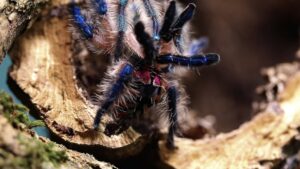
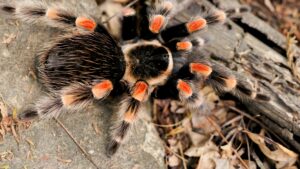
The curly hair tarantula is Tliltocatl albopilosus (Valerio, 1980), still sold and searched under its former name, Brachypelma albopilosum. It is a ground-dwelling tarantula, and the World Spider Catalog records it from Costa Rica only. Keepers describe it as calm, with long curled setae on its legs and abdomen; hobby sources give an adult leg span around 14 to 17 cm and a female lifespan that can run past two decades, which are reports and not measurements.
| Fact | Detail |
|---|---|
| Current accepted name | Tliltocatl albopilosus (Valerio, 1980) |
| Common former name | Brachypelma albopilosum |
| Family | Theraphosidae |
| Confirmed wild range | Costa Rica; type locality Caño Rito, Upala, Alajuela province |
| Genus-wide range | Mexico to Costa Rica, including Honduras, Nicaragua, El Salvador, Guatemala and Belize |
| Adult size | Roughly 14 to 17 cm (5.5 to 6.5 in) diagonal leg span (hobby-reported, not measured) |
| Lifespan | Females reported to 25 years; males around 5 years (hobby-reported) |
| Urticating setae | Types I and III, confirmed for the genus |
| CITES status | Trade restricted |
| Temperament reputation | Described in the hobby as calm and slow to flick hairs; not a tested measurement |
Because a scientific name is a map back to the literature, the 2020 change matters, particularly for a tarantula often reduced to a few care-sheet headings. We went looking for the animal itself in northern Costa Rica, and the habitat we walked through turned out to be a better guide to an enclosure than any list of numbers.
What is the curly hair tarantula’s scientific name today?
Valerio described the species in 1980 as Brachypelma albopilosa, from a male holotype collected at Caño Rito, near Upala, in Costa Rica’s Alajuela province. The catalog’s history then records the familiar spelling Brachypelma albopilosum. Using molecular and morphological evidence, Jorge Mendoza and Oscar Francke revised the group in 2020, dividing the old, broad Brachypelma into two genera and moving this species to the new genus Tliltocatl. The World Spider Catalog records both the epithet correction and the transfer from Brachypelma on 27 February 2020, and its record for the species carries a note that trade is restricted by CITES.
So Tliltocatl albopilosus is the accepted name, while Brachypelma albopilosum remains the old hobby name that people search, sell and recognize. Keeping both names visible is clearer than pretending the older one disappeared overnight, and it avoids a common spelling error, because the ending changed with the new genus: the catalog uses albopilosus, not albopilosum.
For a keeper, the change connects an older label with current taxonomy rather than demanding that every label be crossed out. Either name can lead you to a source, but its date and taxonomic context still matter: a pre-2020 account may be perfectly useful about a recorded animal while using Brachypelma albopilosum, although it cannot override the current catalogued placement. The 2020 revision also put this species beside another animal already documented on this site, Tliltocatl epicureanus. They are not the same tarantula, and sharing a genus is not a licence to copy details from one to the other, but the revision makes the relationship it tested clearer.
Where do curly hair tarantulas live in the wild?
The confirmed answer is narrower than the hobby name suggests. The World Spider Catalog gives the distribution as Costa Rica, and Valerio’s original 1980 description says that all the known specimens come from the Upala zone, in the country’s humid tropical north. The one female, found in a densely populated part of San José, was probably carried there by people. Mendoza and Francke’s 2020 revision widens the picture at a different level: the genus Tliltocatl as a whole, which now holds seven species including albopilosus, ranges from Mexico through Guatemala, Belize, Honduras, El Salvador and Nicaragua to Costa Rica, in deciduous forest, evergreen rainforest and grassland, with animals burrowing under flat rocks, fallen logs and tree roots, and some species digging into farmland close to flooded ground. That is a genus-wide range across seven species, not a confirmed country list for this species alone.

Are Honduran and Nicaraguan curly hair tarantulas a different animal?
Search demand keeps asking this, and the honest answer sits between two sources that do not fully agree. The taxonomic record only confirms Costa Rica for Tliltocatl albopilosus: Valerio’s original description worked from Costa Rican specimens, and the World Spider Catalog has never extended the species’ catalogued distribution beyond that country. Hobby literature tells a wider story. Marshall Arachnids describes two color forms kept under this name, one reportedly from Nicaragua and Costa Rica with whiter setae, and a distinct, more golden-setae form that entered the hobby from Honduras. The Tarantula Collective’s care sheet lists the species as native to Honduras, Nicaragua and Costa Rica outright.
Neither hobby source is a taxonomic revision, and neither documents a formally described subspecies or population study to back the split. Museum material from Honduras is filed as B. cf. albopilosum (Gabriel and Longhorn 2015), and the Nicaraguan live-trade exports described by Longhorn and Gabriel (2019) included A. seemanni and/or B. albopilosum alongside Sandinista lanceolatum. What the primary literature does confirm is that the genus Tliltocatl spans exactly that range, Mexico to Costa Rica, Honduras and Nicaragua included, so tarantulas resembling albopilosus turning up in Honduran or Nicaraguan collections is not implausible on distribution grounds alone. It is a live trade distinction, not a settled taxonomic one, and it lines up with something we saw ourselves: the animals photographed near the type region look different from most pet-trade material, which points at bloodlines that have not stayed clean rather than at two clean, separate populations.
Upala, and why the location matters
The part of the footage below that searches for curly hair tarantulas was filmed in the region of Upala, in northern Costa Rica, the region this species was originally described from. That gives the animals there a status nothing in a shop can match: if we find a curly hair here, it is the real thing, without the question mark that hangs over most of the material in circulation.

What surprised me on arrival was how little of the original forest survives. The habitat we searched is secondary rainforest, and it is man-made: almost the entire region is under agriculture, and finding primary rainforest here is close to impossible. This is the landscape the famous beginner tarantula now lives in.
The structure of a secondary forest is easy to read once you know what removed the canopy. We searched rock-covered formations carrying dense vegetation, and the vegetation was dense precisely because the big trees are gone. Inside primary rainforest the ground layer receives very little light, so very little grows on the soil itself; take the canopy away and the light reaches the floor. The floor answers.
What was the ground doing in March?
We filmed in March, in the dry season, and the top layer of substrate was about what you would expect: fairly dry, with only a little moisture left in it. Turning over the rocks changed the picture immediately. Underneath, the substrate was far moister, and the difference was obvious the moment the cover came off rather than something you had to dig for. Cover holds the water.
The substrate itself is clay-like, not the loose fibrous material most enclosures are filled with. Seasonally the contrast is even sharper than one dry-season visit suggests, because June brings much more rain than March, and much of the ground we walked over is flooded once the rainy season starts.
Scaping an enclosure from what the habitat shows
If you keep this species, the habitat gives you something better than a shopping list. Plenty of leaf litter is the first thing, and it is always worth having. A few small plants come next, because they lift the moisture and the general humidity a little above what a bare box would hold.
The substrate is where most enclosures go wrong. Loose fibre collapses. Pure coconut fibre will not hold a tunnel; mixed with a more clay-like material it will, and the burrow then survives being disturbed instead of collapsing the first time the enclosure is opened. A spider that can dig a structure which stays standing is doing something it would do at home.
The moisture lesson is a gradient rather than a setting. In the field the surface was dry while the ground under cover stayed damp, so an enclosure that offers both a drier surface and a sheltered, moisture-retaining zone below cover lets the spider choose. No measured burrow humidity, universal substrate depth or species-specific temperature target comes out of this footage, and inventing one would give the setup a precision the habitat never showed us.
The day we found nothing
Halfway through the day we had not spotted a single tarantula. Not one. That is how it goes sometimes, and other days in the same country were far kinder to us. The honest version of a field trip includes the hours that produce nothing but a snack in the car and a drive to the next site.
What does the rainy season show instead?
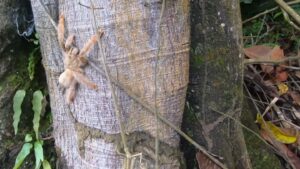
Eddy Hijmensen searched the very same area a few years earlier and sent me his photographs, and his timing was better than ours. He went in June, at the start of the rainy season, when the ground we had walked over in March was under water, and he found several specimens where we had found none. He also found them somewhere I would not have looked first: on the trees, rather than on the ground.
That is worth sitting with, because the published record points the other way. A peer-reviewed natural-history table, using the legacy name, lists Brachypelma albopilosum as a tropical-rainforest species that uses a ground burrow, and the burrow is what the substrate advice above is built on. Both can be true. A spider that digs is not thereby confined to the soil, and a wet June evidently puts these animals somewhere a dry March never would.
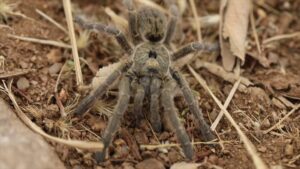
Eddy’s pictures include a subadult male, whose build reads differently once you have a female beside him for comparison. Two females in the same set make a second point on their own, because one had moulted recently and one had not. The freshly moulted female is stunning; the older moult is dull by comparison, and the colour difference between them is large enough to mislead anyone judging an animal from a single photograph, or judging a locality claim from one.
How big do curly hair tarantulas get?
Hobby care sheets converge on a similar figure: an adult diagonal leg span of roughly 14 to 17 cm, or 5.5 to 6.5 inches, with a body length of around 8 cm. Females run at the larger end of that range; mature males are typically smaller and leggier, a difference visible in Eddy’s photographs, where the subadult male’s build reads differently next to an adult female. No formal morphometric study of the species sets a population-wide average, so treat these as hobby-reported figures rather than a measured range.
How long do curly hair tarantulas live?
Females are the long-lived sex, reported in hobby sources to reach 25 years in captivity, while males mature faster and are shorter-lived, typically living around 5 years. This gap between the sexes is common across tarantulas generally, and it is one reason a subadult male and an adult female of the same species can look so different, as they do in the field photographs above. No published longevity study specific to wild Tliltocatl albopilosus exists among the sources reviewed here, so these figures describe captive-kept animals.
Why is it called the curly hair tarantula?
The common name describes the long, curled setae visible on the legs and abdomen, which make this dark-bodied tarantula look untidy in the best possible way. The name does not identify a separate taxon; it works as a visual nickname while the scientific name tells us which species the claim is meant to concern.
In the hobby, that distinction has a small but real consequence: photos, listings and older videos may show a range of hair colour and curl, especially when provenance is incomplete. Moult state alone can account for a lot of that variation, as the two females above show, so visible colour cannot settle a species identification, or reconstruct an animal’s origin, on its own.
Do curly hair tarantulas have urticating hairs?
Yes. Mendoza and Francke’s 2020 revision confirms that every species in the genus Tliltocatl, this one included, carries urticating setae of types I and III, with type III concentrated on the rear of the abdomen and type I surrounding it. These are the barbed, kick-flicked hairs that give a New World tarantula its main defence against a mammal predator. Hobby sources describe this species as slow to use them compared with more excitable relatives, and calm rather than quick to react, but that is a keeping reputation, not a controlled measurement, and the hairs are still there and still capable of causing irritation.
Are curly hair tarantulas good for beginners?
Hobby sources commonly recommend the curly hair to beginners because they describe a ground-dwelling, burrow-capable tarantula that is often tolerant and slow to show overt defence. That reputation comes from keeping experience, not a controlled score for temperament or ease of care, and individual spiders can retreat, flick hairs or react defensively; no source reviewed here establishes that this species is safe to handle.
The honest version of the beginner label is modest: this spider has a familiar presence in captivity, can use a simple ground-level refuge, and is usually less intimidating to many new keepers than a fast arboreal or strongly defensive species. Yet none of that removes the need to respect a living animal’s choice to hide, and the animals photographed up in the trees in June are a reminder that “terrestrial” is a summary rather than a rule. A 2021 captive study on this species found different behaviour in individuals that had dug burrows, though it did not show that enrichment reduced stress, which is a useful reminder to watch the animal rather than expect a care sheet to predict it.
Captive footage: rehousing a curly hair tarantula
Captive footage from the channel’s 2021 “Beyond Wild Tarantulas” series: a curly hair tarantula rehoused into a new enclosure. Chapters cover the tools, substrate mix, plants and handling.
Explore related field work
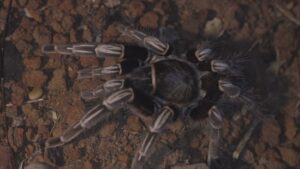
For the wider family context, visit the Theraphosidae overview and the Tarantula Gallery, while the gallery of related tarantulas puts this animal beside more of the group. The same Costa Rican trip crossed paths with a second ground-dwelling species; see our field account of Aphonopelma seemanni, the zebra tarantula. For two named relatives already covered here, see Brachypelma auratum, the Mexican flame knee tarantula and Tliltocatl epicureanus, a Yucatan tarantula field account.
Frequently asked questions
Is Brachypelma albopilosum still a correct name?
No. It is the widely used former name. The accepted name since 2020 is Tliltocatl albopilosus, following Mendoza and Francke’s revision and the World Spider Catalog’s current record.
Are Honduran and Nicaraguan curly hair tarantulas really from those countries?
The taxonomic record confirms only Costa Rica for this species. Honduras and Nicaragua sit inside the wider range of the genus Tliltocatl, and hobby sources describe Honduran and Nicaraguan-Costa Rican colour forms in trade, but we found no published study that tests that split.
Is the curly hair tarantula protected?
Trade in this species is restricted under CITES, according to its World Spider Catalog record.
Can you handle a curly hair tarantula?
Keepers commonly describe it as calm and slow to flick its urticating hairs, but that is a keeping reputation, not a tested safety rating, and individual animals still bite, flick hairs or flee.
Sources
- World Spider Catalog. Tliltocatl albopilosus (Valerio, 1980). Accepted name, genus, country-level distribution, CITES note, and taxonomic history.
- Valerio, C. E. (1980). Arañas terafosidas de Costa Rica (Araneae, Theraphosidae). I. Sericopelma y Brachypelma. Brenesia 18: 259–288. Original description of Brachypelma albopilosa from Caño Rito, Upala, Alajuela.
- Mendoza, J. & Francke, O. (2020). Systematic revision of Mexican threatened tarantulas Brachypelma, with a description of a new genus, and implications on the conservation. Zoological Journal of the Linnean Society 188(1): 82–147. New genus Tliltocatl, species transfer, genus-wide range, urticating setae types I and III.
- Nyffeler, M., Moor, H. & Foelix, R. F. (2001). Spiders feeding on earthworms. Journal of Arachnology 29: 119–124. Records the legacy-named species as a tropical-rainforest ground-burrower.
- Anderson-Whittaker, A. (2021). Toys for T’s: The Impact of Enrichment on Captive Tarantulas, Tliltocatl albopilosus. Undergraduate thesis, New College of Florida.
- Marshall Arachnids, Tliltocatl albopilosus care guide. Hobby source for the setae description and the Honduran versus Nicaraguan/Costa Rican colour-form claim.
- Fear Not Tarantulas, Tliltocatl albopilosus care sheet. Hobby source for the temperament reputation.
- The Tarantula Collective, Tliltocatl albopilosus care sheet. Hobby source for size, lifespan and the Honduras/Nicaragua/Costa Rica range claim.
- birdspidersCH. Brachypelma albopilosum: Unfortunate Tarantula Hunt, filmed in the Upala region, northern Costa Rica. Our own field record of the habitat, substrate and season described above.
- birdspidersCH. Big Brachypelma Revision! Tliltocatl?! Our own explainer on the 2020 genus revision.
- Gabriel, R. & Longhorn, S. J. (2015). Revised generic placement of Brachypelma embrithes (Chamberlin & Ivie, 1936) and Brachypelma angustum Valerio, 1980, with definition of the taxonomic features for identification of female Sericopelma Ausserer, 1875 (Araneae, Theraphosidae). ZooKeys 526: 75–104. Material examined, including Honduran museum specimens filed as B. cf. albopilosum.
- Longhorn, S. J. & Gabriel, R. (2019). Revised taxonomic status of some Mexican and Central American tarantulas (Araneae: Theraphosidae), with transfers from Aphonopelma Pocock, 1901, and a new genus from the Pacific lowlands of Nicaragua and Costa Rica. Arachnology 18(2): 101–120. Remarks on live-trade exports from Nicaragua.