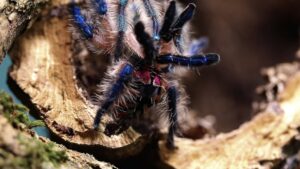
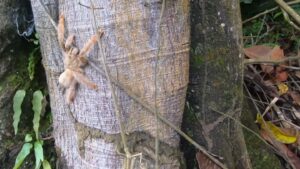
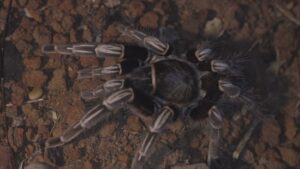
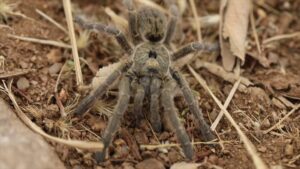
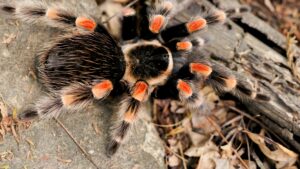
Cyriocosmus leetzi is a dwarf tarantula from Colombia, described by Fabian Vol in 1999 as the first Cyriocosmus known from that country.[1][2] Black and pale gold on the abdomen and silvery on the legs, the spider lives on the ground, and the World Spider Catalog records it from Colombia and Venezuela.[1][3] In Colombia in 2020 we went looking for it and found a young one under a rotten log within about half an hour. Below, that film sits next to the published descriptions, a second film on three dwarf tarantulas I keep, and what the literature says about where the species lives.
What is Cyriocosmus leetzi?
Cyriocosmus leetzi Vol, 1999 is a valid species in the family Theraphosidae and the subfamily Theraphosinae.[1] Vol published the description in the French journal Arachnides (no. 43, pages 2 to 10) under the title “Description d’une nouvelle espèce de Cyriocosmus Simon 1903 (Araneae, Theraphosidae), Cyriocosmus leetzi sp. n. de Colombie”.[2] Vol named it after André Leetz, a pioneer of rearing theraphosid spiders in France, who sent him the material.[2] A female holotype and a male paratype, the type specimens, are kept in the Muséum national d’Histoire naturelle in Paris.[2]
At the time the genus had eight species, and C. leetzi became the ninth.[2] Today the World Spider Catalog accepts 24 species and lists four synonyms for Cyriocosmus Simon, 1903.[1] Among the smallest tarantulas is how our film description counts the genus, and hobbyists call its members dwarf tarantulas.[6] In 2000 a Czech hobby article put the same idea in its title, trpaslik mezi sklipkany, a dwarf among tarantulas.[5]
What does Cyriocosmus leetzi look like?
Vol gives the dominant colours as black and golden yellow, with golden-yellow longitudinal stripes on the legs and palps. Stripes cover the upper side of the abdomen, and a broad, darker band runs along the underside.[2] Kaderka’s 2016 revision adds the points that separate it from its relatives:[3]

- a reddish-brown carapace with a black head region and seven black spots arranged like rays in the thoracic area;
- a dark longitudinal band on the underside of the abdomen;
- black femora with whitish stripes on the upper face;
- in males, a cluster of stiff spiny hairs on the palpal tibia.
Fukushima and colleagues (2005) use the same ventral band, together with three clear stripes on each side of the upper abdomen, to tell females of this species from the others in the genus.[4] Vol separates it from C. ritae and C. elegans by the male palp, where the paraembolic apophysis, a process next to the embolus, is very short.[2]
Small is the word for it. Vol’s female holotype has a carapace 8.5 mm long and 7 mm wide, with an abdomen of 13 mm along the underside, and the male paratype has a carapace 4.75 mm long.[2] Sejna, a Czech keeper, reported a freshly adult female at 1.6 cm in body length, which grew to 2 cm at the next moult. The maximum size was unknown to him, and he guessed 2.5 to 3 cm, with males a little smaller than adult females.[5]
Where does Cyriocosmus leetzi live?
Colombia and Venezuela are the countries the World Spider Catalog gives.[1] Of the 24 accepted species, this is the only one of the 24 accepted species the catalog places in Colombia.[1] Vol gives the type locality as Villavicencio, on the Rio Meta in Colombia, while Fukushima and colleagues cite the holotype from Colombia without further information.[2][4] Two further Colombian records, from the departments of Casanare and Meta, come from Fukushima and colleagues.[3][4]
Kaderka added the Venezuelan state of Táchira in 2016 and compared the two populations. Both share the carapace pattern, the striped abdomen, the short paraembolic apophysis and the shape of the spermathecae, the female’s sperm-storage organs. Only two features differed enough to note: a fourth pair of narrow stripes near the spinnerets that appeared only in the Venezuelan animals, and the range of the scopulae on the metatarsi. Kaderka found no reason to doubt that both belong to one species, and suggested the two populations may be connected along the eastern side of the Andes.[3]
Closest in Kaderka’s comparison is Cyriocosmus nicholausgordoni from Venezuela, which he separated from C. leetzi by the stripes on the femora.[3]
Two films on Cyriocosmus leetzi
The wild tarantula hunt in Colombia
Field footage from Colombia, published in January 2020, 7:48 long. Our first Cyriocosmus, this was a new genus and a new species for us, though not new to science.[6]

- 0:17. Introducing the search, we call C. leetzi one of the most beautiful members of the genus, with a silver shine on the legs and orange and black tones on the abdomen, and say it mainly lives under rocks and rotten logs, so those are what we turn over.
- 1:07. On the way in, we film monkeys playing in the upper parts of the forest.
- 2:19. A juvenile turns up, freshly moulted and not fully grown. Three of us had been turning rotten logs for about 30 minutes, putting each log back where it belonged.
- 4:11. Why we give the animal its name: Vol described the species in 1999 from a type locality close to where we were, and no other Cyriocosmus is known in that range, so we take the animal to be C. leetzi.
- 5:08. Raised from tiny spiderlings, the species should give an adult female in about a year and a half, and the young are extremely small.
- 6:59. Closing on the forest itself, we note that there are protected areas, but also a lot of farming and deforestation.
Captive observations: three dwarf tarantulas at home
These Cyriocosmus dwarf tarantulas are amazing
Captive footage from my collection, published in November 2021, 13:07 long. The film goes through the three Cyriocosmus species I keep: C. perezmilesi, C. elegans and C. leetzi, which starts at 10:40.[6] No wild footage is in it, and the macro shots were filmed at home.
What I say about C. leetzi in the film:
- 10:32. I point back to the field film above as the place to learn about the species in the wild.
- 10:50. I call C. leetzi the only Cyriocosmus that officially occurs in Colombia, and place the area east of the Andes, towards the Amazon basin.
- 11:42. Each cocoon can hold up to a hundred eggs, but 50 to 70 is the usual number, and the first spiderlings hatch after about one month.
- 12:05. The young are very small and finicky, like the other dwarf tarantulas in the film.
More from Colombia
Other tarantulas filmed in Colombia include a pumpkin patch tarantula in its Colombian habitat and a nocturnal Xenesthis encounter. Another page, what tarantulas eat, gathers wild diet reports across the family, and that is where the question of the right food for tiny dwarf spiderlings leads.
References
- World Spider Catalog (2026), genus page Cyriocosmus (includes C. leetzi, LSID urn:lsid:nmbe.ch:spidersp:001955). Natural History Museum Bern.
- Vol, F. (1999). Description d’une nouvelle espèce de Cyriocosmus Simon 1903 (Araneae, Theraphosidae), Cyriocosmus leetzi sp. n. de Colombie. Arachnides 43: 2–10.
- Kaderka, R. (2016). The Neotropical genus Cyriocosmus Simon, 1903 and new species from Peru, Brazil and Venezuela (Araneae: Theraphosidae: Theraphosinae). Journal of Natural History 50(7–8): 393–465. doi:10.1080/00222933.2015.1076082
- Fukushima, C. S., Bertani, R. & Silva, P. I. da, Jr (2005). Revision of Cyriocosmus Simon, 1903, with notes on the genus Hapalopus Ausserer, 1875 (Araneae: Theraphosidae). Zootaxa 846: 1–31.
- Sejna, V. (2000). Cyriocosmus leetzi – trpaslik mezi sklipkany. Sklipkan 1: 9–10.
- birdspidersCH films (YouTube): Wild Tarantula Hunt in Colombia! | Cyriocosmus leetzi (2020) and These Cyriocosmus Dwarf Tarantulas are amazing (2021).
Related Images: