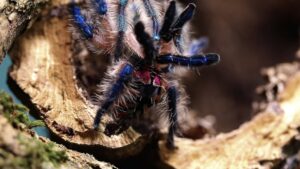
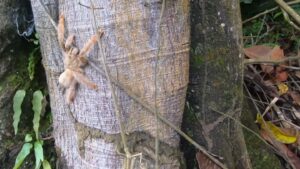
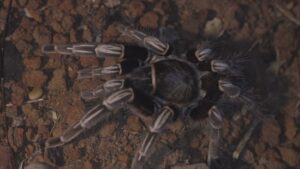
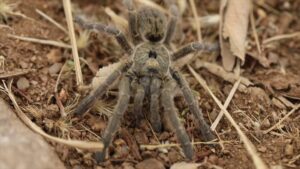
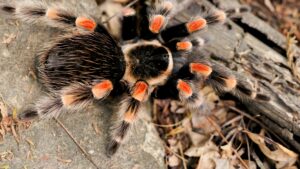
Davus is a genus of small tarantulas, the tiger rump tarantulas, with four accepted species from Mexico to Panama: D. fasciatus, D. pentaloris, D. ruficeps and D. santos.1 The animal sold as “Davus pentaloris” is the Guatemalan tiger rump. The “Costa Rican tiger rump” sold as D. fasciatus is not the real D. fasciatus: the 2016 revision found that pet-trade animals under that name were D. pentaloris.2 I kept D. ruficeps, we photographed the real D. fasciatus in Panama, and our Mexican Davus stays Davus sp.
What is Davus?
Davus O. Pickard-Cambridge, 1892 sits in the Theraphosidae. In the World Spider Catalog, Davus has four species and a range from Mexico to Panama.1 The 2016 revision defines the genus by a laterally striped abdomen, a single spermatheca in the females and a heavily keeled male palpal bulb. Gabriel also suggests that Davus is a close relative of Chromatopelma and Hapalopus.2 In D. pentaloris, D. santos and D. ruficeps, small juveniles have pale legs and carapace, older juveniles turn orange or pink with a dark abdomen, and the legs darken to black with age. The juvenile colour of D. fasciatus is unknown.2
| Species | Authority | Range (country level) | Have I seen it? |
|---|---|---|---|
| Davus fasciatus (type species) | O. Pickard-Cambridge, 1892 | Costa Rica, Panama | Photographed in Panama |
| Davus pentaloris | (Simon, 1888) | Mexico, Guatemala, El Salvador, Honduras | No species-level record from me |
| Davus ruficeps | (Simon, 1891) | Costa Rica, Nicaragua | Found in Nicaragua, kept |
| Davus santos | Gabriel, 2016 | Panama | No |
Which spider is the trade name Davus pentaloris?
Davus pentaloris (Simon, 1888) is the Guatemalan tiger rump. The World Spider Catalog gives it from Mexico, Guatemala, El Salvador and Honduras, and the 2016 revision records it in the Mexican states of Veracruz, Oaxaca and Chiapas.1,2 So a spider sold as Davus pentaloris is the northern species, not a Costa Rican one. It has carried many names in the hobby literature: Hapalopus pentaloris, Pseudoschizopelma pentalore and Davus pentalore all point to the same species.1
There is a catch. A 2021 study of D. pentaloris in southern Mexico found enough variation in the shape of the male palp and in DNA to recognise 13 diagnosable species in what had been one, 12 of them new to science.3 None of the 12 has a name yet, and the World Spider Catalog lists the study under “Davus aff. pentaloris”.1 A spider labelled pentaloris may therefore turn out to be one of several species, and that is why I keep the Mexican animals we found at genus level.
The real Davus fasciatus
The photo below is the real Davus fasciatus, taken on our Panama trip. I show it in my Panama lecture (52:48). Green, not blue, is the tint on all the legs, and the markings on the abdomen are unique in the genus. No other Davus in Central America looks identical. The World Spider Catalog gives the species from Costa Rica and Panama.1 It looks different from the animal in the trade.

Hobbyists mixed them up early on. Striped spiders with a coloured carapace were first sold as Metriopelma zebratum, and males with tibial apophyses were then called Cyclosternum fasciatum. An early pet-trade male given to the Oxford museum turned out to be D. pentaloris. The revision traces almost every pet-trade illustration labelled fasciatus back to D. pentaloris and concludes that D. fasciatus has never been in the pet trade.2 That is the spider behind the name “Costa Rican tiger rump”.
Davus ruficeps and the Metriopelma move
Davus ruficeps (Simon, 1891) lives in Costa Rica and Nicaragua. Simon described it as Hapalopus ruficeps, and Banks named the same spider Metriopelma zebratum in 1909. Gabriel’s 2016 revision moved it into Davus and made M. zebratum a synonym.1,2 Older labels still say Metriopelma; the move to Davus dates from Gabriel’s 2016 revision.
In the dry forest of Costa Rica, D. ruficeps shares its habitat with the zebra tarantula Aphonopelma seemanni. It is one of three tarantulas sharing that forest, as we show in the zebra tarantula film, and one of the species on the Costa Rica list. We found D. ruficeps in Nicaragua around 2013, and I have kept it. Small, yes: the one female measured in the 2016 revision was 26 millimeters long including the chelicerae.2
Mine did not dig an open burrow. When I kept them, they built a trapdoor of sorts, but not a sophisticated one: more a flap hanging above the entrance (1:00:59). The Panama D. fasciatus showed no open burrows to us either, so I think it builds a similar structure, although I only saw the animals above ground (54:42). More about lids and flaps is in the post on trapdoor spiders and trapdoor tarantulas. For the trip itself, see our Panama field notes.
My Mexican Davus sp.
Reto filmed Davus on the Pacific coast of Mexico, in an area he had visited before, including an adult male (3:52). For now it stays Davus sp., because the Mexican animals are the ones still without names. On our 2018 trip we also found Davus in Oaxaca and Chiapas, under logs and rocks, and did not collect any. More Mexican finds are in tarantulas of Mexico in the wild.


Published field notes describe the group as living in leaf litter, soil and fallen logs, in burrows covered with a thick layer of silk, rather than in deep vertical burrows. Adult males walk along roads between the rainy seasons looking for females.3 Reto’s film fits that: the animals were out on the ground at night.
How to tell the Davus species apart
Country comes first. A striped small tarantula from Costa Rica or Panama is D. fasciatus, D. ruficeps or D. santos; one from Guatemala or Mexico is D. pentaloris or one of the Mexican forms. The revision separates the species by the male palp, the tibial apophyses of the first leg, and the females’ spermatheca, none of which you see from the front of an enclosure.2 The abdominal pattern helps for D. fasciatus and D. santos, but it is too variable to separate species inside D. pentaloris.2,3 Without a locality, a Davus from the trade is a guess.
Davus santos is the youngest name in the genus. Gabriel described it in 2016 from a male found at Coclesito, in Coclé province, Panama.2
References
- World Spider Catalog (2026). Natural History Museum Bern, wsc.nmbe.ch, genus Davus and its four species; accessed 2 October 2026.
- Gabriel, R. (2016). Revised taxonomic placement of the species in the Central American genera Davus O. Pickard-Cambridge, 1892, Metriopelma Becker, 1878, and Schizopelma F. O. Pickard-Cambridge, 1897, with comments on species in related genera (Araneae: Theraphosidae). Arachnology 17(2): 61-92. doi:10.13156/arac.2006.17.2.61
- Candia-Ramírez, D. T. & Francke, O. F. (2021). Another stripe on the tiger makes no difference? Unexpected diversity in the widespread tiger tarantula Davus pentaloris (Araneae: Theraphosidae: Theraphosinae). Zoological Journal of the Linnean Society 192(1): 75-104. doi:10.1093/zoolinnean/zlaa107