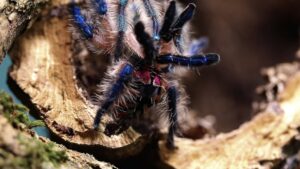
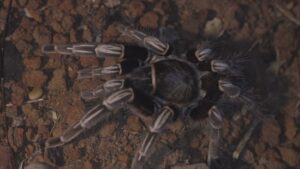
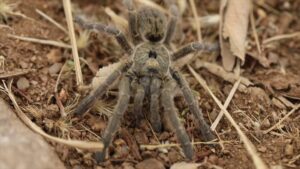
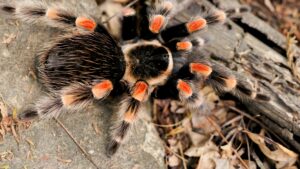
No. Tarantulas do not usually spin capture webs. They sit in a burrow or a silk retreat and ambush what walks past, so silk is part of the shelter and not a trap.1,2 They still use a lot of it: to line burrows and tree hollows, to build tubes in trees, to lay a sperm web, and to wrap eggs. One arboreal genus goes further and closes its retreat with a hinged lid.
Do tarantulas spin webs to catch food?
The mygalomorph spiders, the group that contains the tarantulas, are described as mostly nocturnal species that build silk-lined refuges from which they forage as sit-and-wait predators.2 Tarantulas are likewise described as large, hairy spiders that live more or less hidden in burrows, under stones or in silken retreats on the ground or in trees.1 That is the whole hunting strategy: wait at the entrance, then strike.
The silk is easy to misread. A white sheet over a hole or a tube on a trunk looks like a web, but it is the front door of a home.
Silk in a burrow
Burrow linings are the commonest use. A handbook of south-east Asian spiders says that for the tarantulas of that region the hole “may be lightly silked over, but is never finished by a door”.3 In an Indian species, Lyrognathus crotalus, adult female burrows were J-shaped and entirely lined with silk, ending in an enlarged chamber about 30 to 50 centimetres deep.4
The silk at the entrance is also a clue for anyone searching in the field. Tarantula holes most of the time, but not always, have a silk entrance (at 9:27 in our Panama film), and the film shows a burrow with silk both outside and inside. But several tarantulas on the same trip had no silk at all at the entrance, and most of the tarantulas we found carried egg sacs or had newly hatched spiderlings, so I wonder whether silk at the entrance appears when a female is breeding.
Silk is not universal. In our film on Brachypelma albiceps in Mexico there is no silk at the entrance, only a dark opening (0:10). In another Mexican night film, a hole is covered with silk during the day and the spider reopens it every night (6:01). For more on what wild burrows look like, see Fossorial tarantulas: what wild burrows show and Where Do Tarantulas Live?
Do tree tarantulas make webs?
Arboreal tarantulas make the most visible silk, and this is where the web question comes from. They build retreats on leaves, on tree trunks and palms, in bromeliads and sometimes on human structures.5 In Brazil, Psalmopoeus irminia was seen near a tubular web retreat about 1.6 metres up that ended in rock crevices.5 In the Dominican Republic, the female of Antillena rickwesti (described as an Avicularia) lived in a narrow tree hole with a silken tube reaching about 15 centimetres out of it.6 The same authors contrast this with Iridopelma, which makes retreats of leaves joined with silk.6

In our film from Suriname and Trinidad I show a juvenile Avicularia whose silk was stitched between two leaves; juveniles often do this (at 3:37). In Colombia Psalmopoeus does a lot of webbing, which makes the retreats easy to spot even when the spider will not come out. Photographs of a webbed Psalmopoeus retreat are in Where Do Tarantulas Live? and in our Trinidad Chevron Tarantula page.
The tarantula that builds a trapdoor in a tree
One genus goes beyond a silk tube. In Typhochlaena, a small Brazilian genus, Christian Andre and I describe a strictly arboreal trapdoor lifestyle that was new for tarantulas.7 Typhochlaena seladonia builds flattened retreats into shallow hollows in tree bark. The lid is a thin, soft, D-shaped flap on a hinge, with a thickened silk stop. The structure is made of small bark particles stuck to the outside, with the inside always lined with silk, so it looks like the bark around it.7 Females hardly ever leave. Adult males were seen outside only after maturing, when they look for mates.7

The film shows the same behaviour in a captive adult female: the hind legs pull the lid shut (0:44), and later she is shown with the bark-and-silk entrance she built herself (7:31). More on this spider is on our Typhochlaena seladonia and Typhochlaena costae pages.
Trapdoors are the exception among tarantulas. Andre and I compare the lifestyle with the tree trapdoor spiders of the family Migidae, although cladistic work does not suggest a close relationship.7 For a trap that works with silk, our film on the primitive Liphistius trapdoor spider shows silk lines laid in front of the lid that tell the spider when prey walks past (0:37). That is a trip-line trap, and it belongs to a spider outside the tarantulas.
Other jobs for tarantula silk
Mating. Males spin a small sperm web before mating. Large juvenile males carry special spigots, the epiandrous apparatus, that produce part of the silk for it.1 In our feeding film an adult male’s sperm web shows as white webbing in the enclosure (18:03). The full sequence is in How Do Tarantulas Mate and Breed?
Eggs. Most tarantulas make a mobile egg sac that the female carries and guards. In some groups the sac is a hammock or a flat disc fixed to the retreat with silk bands.1 In Acanthoscurria gomesiana, the silk of the egg sac contained many urticating hairs.8 Urticating hairs also sit in the silk of moulting webs in some species.9
Marking a captive home. In the rehousing film, a curly hair tarantula had spread silk over the whole enclosure. I left the old hide and the glass unwashed, because her silk carries her scent and tells her the enclosure is hers (at 5:15 in the film). That is a captive observation of one animal, and the film does not test it.
Short answers
Do tarantulas make webs? They make silk, not capture webs. The silk lines burrows, forms retreats and tubes, and wraps eggs.
Do tree tarantulas make webs? They make silk retreats and tubes in leaves, bark and tree holes, and one genus adds a hinged lid.
References
- Pérez-Miles, F. (2020). Introduction to the Theraphosidae. In: Pérez-Miles, F. (ed.) New World Tarantulas, Zoological Monographs 6, pp. 1-23 (pp. 2, 9-10, 17-18). doi:10.1007/978-3-030-48644-0_1
- Ortiz, D., Francke, O. F. & Bond, J. E. (2018). A tangle of forms and phylogeny: extensive morphological homoplasy and molecular clock heterogeneity in Bonnetina and related tarantulas. Molecular Phylogenetics and Evolution 127: 55-73 (p. 67).
- Murphy, F. & Murphy, J. (2000). An Introduction to the Spiders of South East Asia. Malaysian Nature Society, Kuala Lumpur (p. 73, Family Theraphosidae).
- West, R. C. & Nunn, S. C. (2010). A taxonomic revision of the tarantula spider genus Lyrognathus Pocock 1895. Zootaxa 2362: 1-43 (p. 10).
- Bertani, R., Santos, A. S., Abegg, A. D., Ortiz, F. R. & Freitas, M. A. (2016). First record of the genus Psalmopoeus (Araneae: Theraphosidae) in Brazil. Check List 12(2): 1860 (p. 1). doi:10.15560/12.2.1860
- Bertani, R. & Huff, J. (2013). Avicularia rickwesti sp. nov., a remarkable new species of Avicularia (Theraphosidae: Aviculariinae) from Dominican Republic. Zoologia 30(3): 333-337 (pp. 334, 337). doi:10.1590/S1984-46702013000300012
- Andre, C. & Hüsser, M. (2018). About trapdoors and bridges: new insights in the little-known ecology and lifestyle of the genus Typhochlaena C. L. Koch, 1850. Journal of the British Tarantula Society 32(3): 3-29 (pp. 8-9, 17).
- Gonzalez-Filho, H. M. O., Lucas, S. M., Paula, F. S. et al. (2012). On the taxonomy of Acanthoscurria Ausserer from southeastern Brazil with data on the natural history of A. gomesiana Mello-Leitão. International Journal of Zoology 2012: 721793 (p. 9). doi:10.1155/2012/721793
- Foley, S., Lüddecke, T., Cheng, D.-Q. et al. (2019). Tarantula phylogenomics: a robust phylogeny of deep theraphosid clades inferred from transcriptome data sheds light on the prickly issue of urticating setae evolution. Molecular Phylogenetics and Evolution 140: 106573 (p. 2). doi:10.1016/j.ympev.2019.106573
Explore this site
For the wider picture, see the Theraphosidae overview and the Tarantula Gallery.