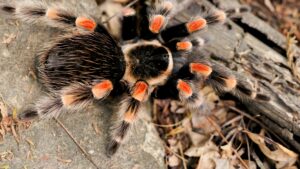
Ephebopus is a small genus of South American tarantulas with five accepted species, found in northeastern South America, and hobbyists often call them skeleton tarantulas. What sets them apart is where their urticating hairs sit. Almost every other New World tarantula carries them on the abdomen. Ephebopus carries a dense pad of them on the palps, and the authors of the 2008 review of the genus give that pad as the character that sets the genus apart from all other theraphosid genera.[1]
What are Ephebopus tarantulas?
Eugène Simon named the genus in 1892, with Mygale murina Walckenaer, 1837 as the type species, now Ephebopus murinus.[1][5] The 2008 review by West, Marshall, Fukushima and Bertani places the genus in Brazil, Guyana, Suriname and French Guiana, and describes the spiders as generally fossorial.[1] Our own pages on the Theraphosidae and where tarantulas live cover the wider picture.
The same review also settled two names that you may still meet. Ephebopus violaceus Mello-Leitão, 1930 was moved to Tapinauchenius after the authors found that the holotype has no urticating hair pad on the palp, and Ephebopus fossor Pocock, 1903 was declared a nomen dubium because its type is lost and its Ecuadorian origin lies far outside the known range of the genus.[1] The World Spider Catalog follows the fossor decision, while Tapinauchenius violaceus has since been treated as a junior synonym of Tapinauchenius plumipes (C. L. Koch, 1842).[5][7]
Which species of Ephebopus are there?
The World Spider Catalog lists five valid species, checked on 1 October 2026.[5] The notes in the last column come from the 2008 review.[1]
| Species | Countries (World Spider Catalog) | What the 2008 review says |
|---|---|---|
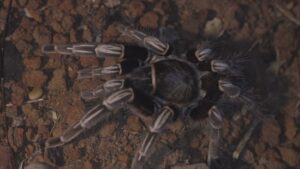
| Ephebopus murinus (Walckenaer, 1837) | French Guiana, Suriname, Brazil | Bold ivory stripes on the patellae and tibiae of all legs. Burrow with a large trumpet-shaped silk turret. Lowland rainforest and grassland above river flood plains. |
| Ephebopus uatuman Lucas, Silva & Bertani, 1992 | Brazil | Similar to E. cyanognathus but females lack the metallic blue chelicerae. Upland forest; simple burrow with a raised, flared collar of leaves and silk. |
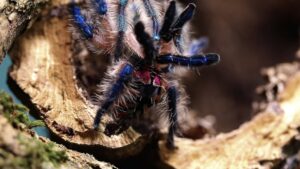
| Ephebopus cyanognathus West & Marshall, 2000 | French Guiana | Females have metallic blue chelicerae. Upland rainforest; flare-mouthed burrow. |
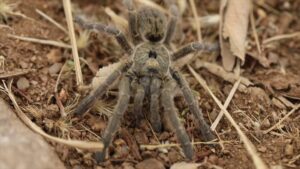
| Ephebopus rufescens West & Marshall, 2000 | French Guiana, Brazil | Dark reddish brown, without yellow bands at the leg joints. Lowland and upland forest; retreats in hollow logs, termite nests, moss and palm trees. |
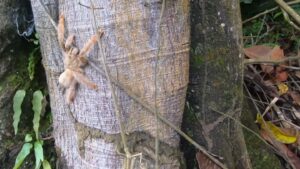
| Ephebopus foliatus West, Marshall, Fukushima & Bertani, 2008 | Guyana | Leaf-like pattern on the top of the abdomen, seen from the side. Known only from its type locality; collected at night on tree trunks. |

How do you tell them apart?
For E. murinus it is easy: the ivory bands on the legs are the diagnostic character.[1] The blue-fanged E. cyanognathus is the other one people know. For the rest, the review separates the species by the shape of the male palpal bulb and the female spermathecae, and by colour and habit, so a photo alone is not always enough.[1] A 2015 study of tarantula hair colour included E. cyanognathus; we cover it on why tarantulas are blue. We therefore name a species on this page only where we have a source or a determination for it.
Where do Ephebopus live, and do they climb?
Mostly in the ground, but not only. The review found E. murinus burrows with a vertical tube ending in a chamber and a large trumpet of silk at the entrance, and the authors also observed early instars of E. murinus living in silk retreats in terrestrial bromeliads. They add that spiderlings of the other Ephebopus species had not been found in silk tubes in vegetation.[1] The burrows of E. uatuman in upland forest were about 30 to 40 centimetres deep, and those of adult female E. cyanognathus about 30 centimetres, each ending in an enlarged chamber.[1]
Ephebopus rufescens was the most flexible of the five. Its retreats were found in hollow logs and stems, in arboreal termite nests, in moss on rock faces, and once about three metres up in a decaying palm.[1] Ephebopus foliatus goes further. All the specimens were collected at night one to four metres up the sides of trees, none on the ground, and the authors conclude from the collecting records that it is arboreal.[1]

Silk, burrow collars and tree retreats are the subject of our page Do tarantulas make webs?
Why do Ephebopus have urticating hairs on the palps?
The hairs are called type V. They sit in a dense pad on the distal, inner face of the palpal femur in males and females of every species the 2008 review examined.[1] In the 2019 revision of urticating setae, Kaderka and colleagues describe them as sitting in sockets with no supporting stalk, breaking off inside the socket, and measuring about 0.55 to 0.67 millimetres.[4] A disturbed spider moves its palps along the base of the chelicerae, which directs the airborne hairs toward the intruder.[4] In our film we say that this lets an adult in its burrow flick them straight at a predator or intruder that it is facing (from 3:13).
Where the hairs came from is a separate question. The 2019 phylogenomic study found it the most probable scenario that urticating setae arose independently in the Theraphosinae, in the Aviculariinae and in Ephebopus, and that type V could be a separate gain.[3] The types, the competing scenarios and the other New World defences are laid out on Urticating hairs: how New World tarantulas defend themselves, so we do not repeat them here. Psalmopoeus, another genus of the Psalmopoeinae, has no abdominal hairs; see our page on the Trinidad chevron tarantula.
Which subfamily do Ephebopus belong to?
This has been argued for more than a century. West and colleagues list the placements the genus had received before 2008: Selenocosmieae (Simon, 1892), Avicularieae (Pocock, 1901), Phoneyuseae (Simon, 1903), Aviculariinae (Mello-Leitão, 1923), Eumenophorinae (Roewer, 1942), Theraphosinae (Raven, 1985) and Aviculariinae again (Lucas and colleagues, 1991). In their words, no other theraphosid genus has had its taxonomic position so uncertain.[1] Their own cladistic analysis put it in a broad Aviculariinae, together with Psalmopoeus, Tapinauchenius and the Old World Stromatopelma and Heteroscodra.[1]
Later work moved it. My 2018 ZooKeys paper followed molecular studies in treating Psalmopoeus, Tapinauchenius and my new genus Pseudoclamoris as Psalmopoeinae, concluded that the definition of the subfamily “must be altered” to take in Ephebopus, and noted that its exact position in the subfamily stayed unresolved.[2] The 2019 phylogenomic study supported the split between Aviculariinae and Psalmopoeinae, with Ephebopus in the latter, and called it “one of the most controversially placed genera of Theraphosidae in recent times”.[3] Kaderka and colleagues use the same arrangement.[4] The World Spider Catalog does not list subfamilies. On this site Ephebopus sits in our Psalmopoeinae gallery, with the older placement in the Aviculariinae gallery as the one you will find in older books and papers.
Skeleton tarantulas in our films
Our main film on the genus is Ephebopus and Urticating Hairs! Evolution and husbandry notes (2019). It is embedded on our urticating hairs page, so we link it here by moment instead of embedding it a second time. The footage in it is captive, apart from one photo of a wild animal.
- 2:18: why the genus has a special place in the paper’s tree, and that it sits in the Psalmopoeinae with Tapinauchenius and Psalmopoeus.
- 3:13: the palpal hairs, and the claim that no other tarantula genus has this.
- 4:17: small spiderlings build a silk retreat like Avicularia, in the wild and in captivity, shown in a small planted enclosure.
- 4:49: after the second or third moult they move to the soil.
- 5:05: a photo of a wild one that Reto found in Suriname. We were there together and did not find any.
- 5:32: feeding a cricket at the entrance of a second enclosure. The spider takes it very fast.
Two other films show E. murinus in passing, both captive. In Bioactive Tarantula Feeding Tour! we show the enclosure of our adult female from 4:07, and in Huge Pet Tarantula & Bioactive Tank Tour! an E. murinus enclosure with live plants from 4:28.
What we say from our own keeping
These are our statements in that film, not a care sheet. At 5:53 we call these spiders extremely fast and not perfectly suited to beginners, and you will not see them very often. At 6:10 we describe the blue-fanged Ephebopus as E. cyanognathus and remark on the hair-flicking while it looks at you. Our advice is high humidity, good ventilation and a good amount of substrate. In the planted enclosure the juvenile built its first retreat in the upper right corner once we had put it in.
Short answers
Why are they called skeleton tarantulas?
We found no source that explains the name. We use it in our film Bioactive Tarantula Feeding Tour! (4:07) for E. murinus, and the 2008 review says is that E. murinus has bold ivory stripes on the legs that set it apart from the other species.[1]
How many Ephebopus species are there?
Five valid species: murinus, uatuman, cyanognathus, rufescens and foliatus.[5]
Do Ephebopus flick hairs from the abdomen?
No. The hairs sit on the palps, and no other genus is known to have them there.[1][3]
Are Ephebopus arboreal?
Adults of most species are not. E. murinus spiderlings live in silk retreats above ground, and E. foliatus appears to be arboreal as an adult.[1]
References
- West, R. C., Marshall, S. D., Fukushima, C. S. & Bertani, R. (2008). Review and cladistic analysis of the Neotropical tarantula genus Ephebopus Simon 1892 (Araneae: Theraphosidae) with notes on the Aviculariinae. Zootaxa 1849: 35–58.
- Hüsser, M. (2018). A first phylogenetic analysis reveals a new arboreal tarantula genus from South America with description of a new species and two new species of Tapinauchenius Ausserer, 1871. ZooKeys 784: 59–93, pp. 70–72. doi:10.3897/zookeys.784.26521. Open access.
- Foley, S., Lüddecke, T., Cheng, D.-Q., Krehenwinkel, H., Künzel, S., Longhorn, S. J., Wendt, I., von Wirth, V., Tänzler, R., Vences, M. & Piel, W. H. (2019). Tarantula phylogenomics: a robust phylogeny of deep theraphosid clades inferred from transcriptome data sheds light on the prickly issue of urticating setae evolution. Molecular Phylogenetics and Evolution 140: 106573, sections 4.2 and 4.3. doi:10.1016/j.ympev.2019.106573.
- Kaderka, R., Bulantová, J., Heneberg, P. & Řezáč, M. (2019). Urticating setae of tarantulas (Araneae: Theraphosidae): morphology, revision of typology and terminology and implications for taxonomy. PLOS ONE 14(11): e0224384, pp. 2, 16 and 33. doi:10.1371/journal.pone.0224384. Open access.
- World Spider Catalog (2026). Ephebopus Simon, 1892. Natural History Museum Bern, checked 1 October 2026.
- birdspidersCH, Ephebopus and Urticating Hairs! Evolution and husbandry notes (2019); Bioactive Tarantula Feeding Tour! (2020); Huge Pet Tarantula & Bioactive Tank Tour! (2019).
- Cifuentes, Y. & Bertani, R. (2022). Taxonomic revision and cladistic analysis of the tarantula genera Tapinauchenius Ausserer, 1871, Psalmopoeus Pocock, 1985, and Amazonius n. gen. (Theraphosidae, Psalmopoeinae). Zootaxa 5101(1): 1–123, Tapinauchenius plumipes, Remarks. doi:10.11646/zootaxa.5101.1.1