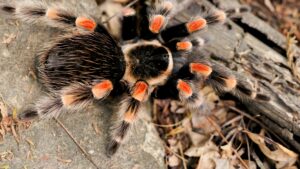
Thrixopelma cyaneolum, the cobalt red rump tarantula from Peru, is now called Ewok cyaneolus. A paper published on 14 November 2025 moved it out of Thrixopelma into a new genus, Ewok, and the World Spider Catalog follows that change.[1][2] Günter Schmidt and Frank and Maja Friebolin gave the species its name in 2005, and that part has not changed. In 2019 we filmed it under the old genus, and you will still find the old name on most labels and in most listings, although a few dealers have already switched.
Which names does this tarantula go by?
- Ewok cyaneolus (Schmidt, Friebolin & Friebolin, 2005): the accepted name in the World Spider Catalog. The 2025 paper wrote the ending as cyaneolum. The catalog lists cyaneolus, with the genus masculine, and recorded the correction on 15 November 2025.[1][2]
- Thrixopelma cyaneolum: the name from 2005 until 2025, now a synonym but still the name on most pages.[1]
- Thrixopelma cyaneum: the first spelling, from February 2005. Unavailable under the zoological code, which is why the second name exists (see below).[1][3][5]
- Homoeomma sp. “ex Peru” and Grammostola sp. “ex Peru”: the trade names from about 1999, before anyone had described it.[3]
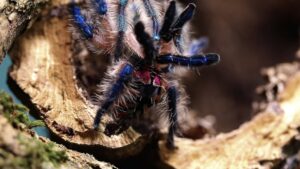
- Cobalt red rump tarantula: the common name we use in our film. Some dealers list it as the blue Peruvian tarantula.
Why was Thrixopelma cyaneolum moved to Ewok?
Thrixopelma Schmidt, 1994 held 13 species in 2025, and its authors had suspected for years that it was a mix of unrelated groups.[2] New work on the male palp of the type species, T. ockerti, gave them the data to act.[2] In one paper Sherwood and colleagues described four new genera, and Ewok is the one for eight Peruvian species, six moved over from Thrixopelma and two newly described, while Thrixopelma in the strict sense keeps T. ockerti, T. choquequirao and two species from Ecuador, and several other former members went into the new genera Warmiru and Crypticarachne.[1][2]
For females of Ewok the authors give two characters, hardened sperm receptacles and no dark stripe running lengthwise along the top of the abdomen, a stripe that females of Thrixopelma in the strict sense do have.[2] The male of E. cyaneolus described in 2005 is considered lost, so our knowledge of this species rests on females.[1][5]
The name Ewok comes from Star Wars. According to the authors, Ewoks are small, furry creatures, much like tarantulas, and just as the Ewok language is difficult to understand, the taxonomy of these spiders is complex and challenging.[2]
Where does the name cyaneolum come from?
For about six years it was sold in Germany and Austria without a name, and dealers called it Homoeomma sp. “ex Peru” or, later, Grammostola sp. “ex Peru”. Schmidt and the Friebolins examined shed skins in 2005 and found that it was neither, but an undescribed Thrixopelma.[3]
- February 2005: they described it as Thrixopelma cyaneum from three female skins and one live male. They did not say where the type material would be kept, and under the zoological code that made the name unavailable.[3][5]
- October 2005: a one-page note replaced it with cyaneolum and named a museum in Basel.[4]
- 2021: Sherwood and colleagues found that nothing had gone to Basel. The three skins are in the Senckenberg museum in Frankfurt, and the male is lost. Calling the species somewhat enigmatic, they left open whether it might be an older name for another Peruvian species, T. lagunas, now in Warmiru.[1][5]
What does Ewok cyaneolus look like, and where does it live?
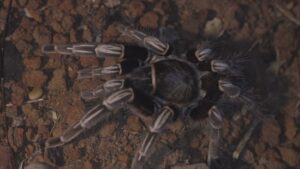
In the 2005 description the carapace and legs are iridescent cyan-blue, the abdomen carries long fox-red hairs, and the legs have pale stripes on the knee segments and pale bands at the ends of the segments. Their female measured about 38 millimetres in body length.[3] In our film we put adult females at three to four centimetres of body length, blue over the whole body.[6]
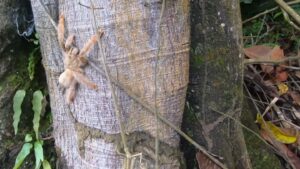
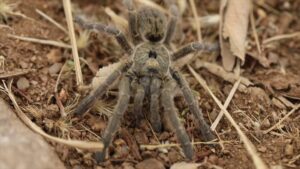
The catalog lists it from Peru and nothing more precise.[1] The first authors report wild-caught animals from the highlands on the western side of the Andes and from the Pacific coast, on a trader’s word, and published no exact locality.[3] In the film we say the highlands, probably around 2,000 metres and not the very high country near 4,000 metres. The tarantulas of that high country are on our page about Peruvian highland tarantulas in the wild.[6]
What we saw in our own animals
These notes come from our own collection. All of it is captive.

In the 2019 film we introduce an animal that had just joined the collection. We say the species is rarely offered, grows slowly and is hard to tell from similar Peruvian tarantulas as a juvenile, so we would buy it from a seller we trust.[6] The abdomen carries a patch of urticating hairs. Ours never kicked them, and the defence we describe is to rub the abdomen against whatever is bothering it.[6] Schmidt and the Friebolins saw the same calm temperament in their animals: they raise the abdomen when pressed and flick hairs only very rarely.[3]
In April 2020 we filmed a breeding attempt. We had added a male and tried to pair the two, and the female kept attacking him. In the film she had just moulted and her colours looked stronger than before, even through dirty glass. Another pairing attempt was planned for that week.[7] Schmidt and the Friebolins report that a cocoon follows three to four months after a successful mating, with around 112 eggs for a normal-sized female and about 257 for a large one.[3]
Films with this tarantula
- Best Blue Beginner Tarantula? docile new world tarantula (2019): our film on the species under its old name. Appearance and defence start at about 3:04 and the seller advice at 1:43. You can also watch it on our Peru highlands page.
- Bioactive Tarantula Feeding Tour! (2020): the male, the failed pairing and the moult, from 10:46.
- Huge Pet Tarantula & Bioactive Tank Tour! (2019): a quick look at its enclosure from about 3:46.
More on tarantulas from Peru
For the other Peruvian highland tarantulas we filmed, including Hapalotremus, Bistriopelma and Antikuna, see Peru highland tarantulas in the wild. How a Peruvian species lives under rocks is in the field article on Antikuna cimrmani. The family as a whole is in the Theraphosidae overview, and the tarantula gallery sorts pictures by subfamily.
References
- World Spider Catalog (2026), genus Ewok, Ewok cyaneolus and genus Thrixopelma. Natural History Museum Bern.
- Sherwood, D., Gabriel, R., Peñaherrera-R., P., León-E., R. J., Rollard, C., Leguin, E.-A., Brescovit, A. D. & Lucas, S. M. (2025). On the identity of some taxa in the tarantula tribe Hapalopini, with two synonymies, and description of four new genera and three new species (Araneae: Theraphosidae). ZooNova 46: 1–23. doi:10.5281/zenodo.17612014
- Schmidt, G., Friebolin, F. & Friebolin, M. (2005). Gibt es jetzt wirklich eine neue Homoeomma-Art (Araneae: Theraphosidae: Theraphosinae) aus Peru? Tarantulas of the World 102: 4–17.
- Schmidt, G., Friebolin, F. & Friebolin, M. (2005). Ergänzung zur Erstbeschreibung von Thrixopelma cyaneum sp. n. Tarantulas of the World 110: 3.
- Sherwood, D., Gabriel, R., Kaderka, R., Lucas, S. M. & Brescovit, A. D. (2021). Stabilizing a chaotic taxonomy: redescription and redefinition of the genera Lasiodorides Schmidt & Bischoff, 1997 and Thrixopelma Schmidt, 1994 (Araneae: Theraphosidae). Arachnology 18(8): 893–917. doi:10.13156/arac.2021.18.8.893
- birdspidersCH (2019). Best Blue Beginner Tarantula? docile new world tarantula. YouTube.
- birdspidersCH (2020). Bioactive Tarantula Feeding Tour! YouTube.