At ground level or below it, a fossorial tarantula may spend important parts of its life. Yet the word is only a starting point. Used alone, it cannot identify an animal, explain every shelter it uses, or tell us what a captive enclosure will reveal; the useful question is simpler: what does the animal actually do with the ground around it when nobody has turned the scene into a care-sheet diagram?
Across our field films, that question gains some texture. A burrow can appear as a dark opening in soil, as a chamber reached below ground, or as a shallow refuge beneath a rock, yet none of those scenes by itself settles a species-wide rule. The film records one animal in one place and at one moment.
Fossorial is a habit, not a taxon
The word is often used as if it divided tarantulas into a neat underground group and everything else. In the field, the evidence is untidier. Labels can lag behind what the camera actually records. Some spiders make deep shelters, while others use a short retreat under cover. Conditions may also change how one animal uses a site. Those are different observations, which is why a label borrowed from a captive listing can hide more than it explains. A burrow closed with a hinged lid is a different case, and I cover it in Trapdoor Spiders and Trapdoor Tarantulas.
For that reason, this page does not sort the animals into obligate burrowers, opportunistic burrowers, or terrestrial spiders with retreats, because those categories need evidence. Our video catalogue does not provide that proof for every named animal, and a title or creator description is not a taxonomic or behavioural paper.
What the footage can give us is more immediate: it can show where a spider disappears, whether the entrance has a visible silk edge, and whether the shelter runs into soil or begins under existing cover. Before any larger claim, a viewer can see the evidence.
Measurements from one Chilean burrow
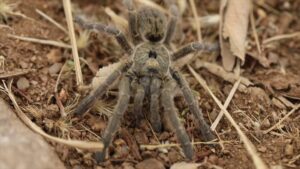
In the film we search for wild tarantulas in central Chile and measure the temperature inside and outside a burrow: 20.3 C inside against about 17 C on the surface, roughly 3 C warmer. The narration also says females dig burrows up to 40 cm deep. It is the most concrete field comparison in this collection, since the crew measured something rather than only filming an entrance.
Even a measured comparison has a boundary. It belongs to the burrows and conditions observed on that expedition, not to every animal the catalogue may name or to every enclosure built elsewhere. The 3:07 chapter, “Temperature Testing Inside Burrows,” lets the viewer place the figures beside the field sequence. It does not turn one observation into a care prescription.
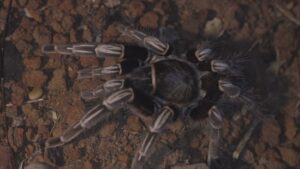
In the film we try to tickle a zebra tarantula out of its deep burrow in Costa Rica from 2:32, after a poison frog search; the spider does not come out, and the narration puts these tunnels well over 60 cm deep. The linked Aphonopelma seemanni field page remains the place for that animal’s wider record.
A shallow retreat answers a different question
Underground does not always mean a long tunnel. In the film we turn rocks high in the Peruvian Andes and find the tarantulas directly beneath them, about six larger spiders and at least eight spiderlings. That setting puts a useful boundary around the search term: a spider can use a protected space in the ground beneath existing cover.
The creator description calls the Andes shelters shallow burrows beneath rocks. Because the catalogue does not approve a scientific name for the film, the page does not assign its animals to a species. It shows a covered refuge, but the frame limits what can be said.
Wild records do not become care instructions
A captive spider may dig, web, move substrate, or take over a prepared hide. Because a keeper has shaped that enclosure, the footage can tell us about that animal in that setting but cannot substitute for a wild record, where the scene has not been arranged by people, containers, or a keeper’s selected materials before the observation; a film of a captive retreat cannot fill the gaps in a wild observation, just as one wild burrow cannot prescribe an enclosure.
The same caution applies to names, which need review. A video description can record what the creator called an animal during filming. It cannot settle an identification later, and it does not make a behaviour universal. When the identification has been independently reviewed, a published field page can say more. Until then, the honest caption is often the smallest one: this is what the camera showed.
Which tarantulas in our catalogue are genuine burrowers?
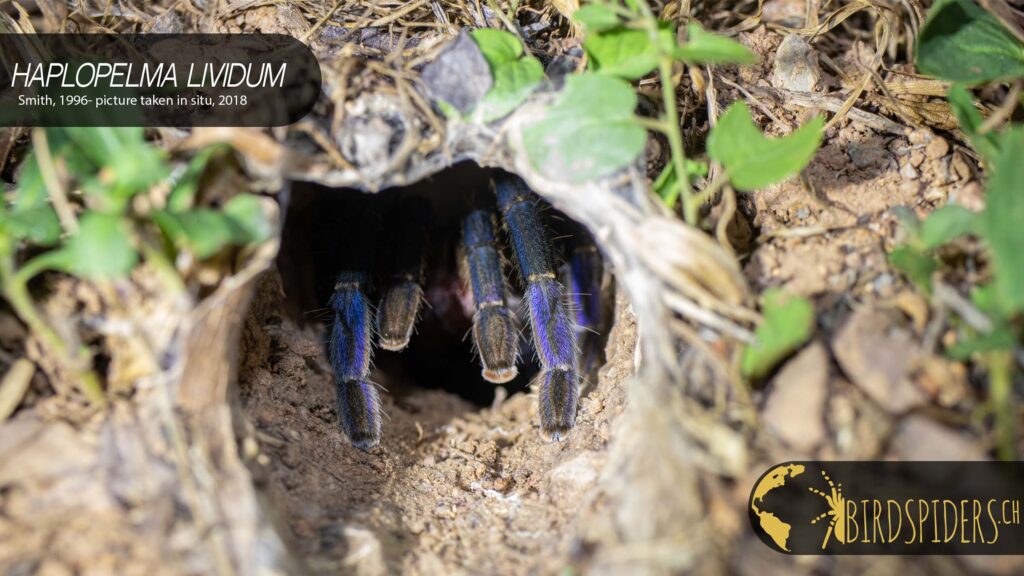
Our catalogue has genuine field material of burrows and retreats. It does not yet justify a complete species list headed “genuine burrowers.” The sounder answer is evidence-led: the Chilean expedition records a temperature comparison and a stated depth, the Costa Rican film goes underground, and the Andes record describes shallow burrows beneath rocks. Each is worth watching in its original context.
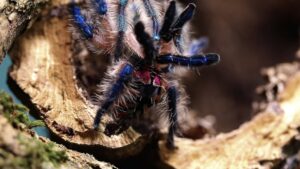
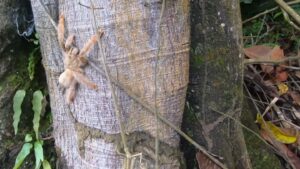
For another field route into the subject, visit the cobalt blue tarantula page. It is a separate, published record and remains the better place for its own animal and footage. Beyond this question, the Theraphosidae overview and the Tarantula Gallery offer broader routes. They do not turn a burrow habit into a taxonomic label. For the tree side of the same question, see Arboreal Tarantulas: Species and Genera That Live in Trees.
That leaves a more useful picture of a fossorial tarantula. Sometimes the story is a deep entrance in soil or a shallow retreat under stone. At other times, the footage only tells us that the spider chose cover. The rest has to remain unknown, which is why a strong field record keeps that uncertainty in the frame.
Research sources
- World Spider Catalog: Aphonopelma seemanni
- BirdspidersCH: We Found Wild Tarantulas in Chile
- BirdspidersCH: Why Aphonopelma Seemanni Belong Underground
- BirdspidersCH: I Explored the Andes and Found These Insane Tarantulas