The final climb
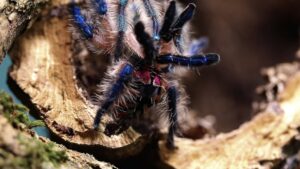
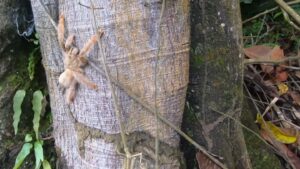
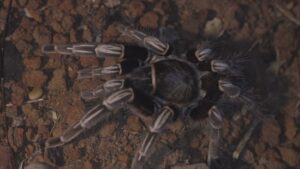
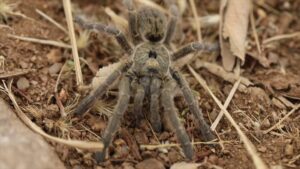
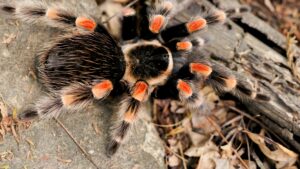
Near the end of our time on a forested hill in Suriname, one large Theraphosa finally appeared after days of searching, its legs covered with long setae. It was among the largest animals of the genus I had seen and the only one we found on that trip.
Why the record stops at Theraphosa
Because the photographs and videos do not contain the anatomical evidence needed for a species diagnosis, this record stops at Theraphosa sp. The World Spider Catalog currently accepts T. apophysis, T. blondi, T. spinipes, and T. stirmi [1]. Its range summary for T. blondi includes Suriname, which the ranges of the other three do not [2][3][6], but a country list narrows the candidates without making a diagnosis.
Two films, one unresolved identity
While the first video follows the Suriname encounter and the second compares several very large tarantulas, neither is a taxonomic examination. The frog photographs remain part of the same field record without a genus-level identification.
The Suriname encounter and surrounding fauna

In the countdown film, we find this animal at 1:45, in a burrow we spotted on the drive back.


What the name does, and does not, tell us
“Goliath birdeater” is the common name usually attached to Theraphosa blondi, while “bird-eating spider” is a loose common-language description. Neither phrase identifies every large tarantula or turns this Suriname animal into T. blondi. Although the name is memorable because a bird is an impressive meal, it is a poor description of everyday prey: Guinness World Records says bird attacks have been recorded very rarely, while a scientific account describes Theraphosa taking a wide variety of invertebrates from the forest floor and sometimes small vertebrates [4][5].
“Birdeater” survives partly because, in 1705, Maria Sibylla Merian published an illustration, drawn from her expedition to Suriname, of spiders with one of them feeding on a small bird. Fukushima and Bertani (2017) write that Linnaeus referred to this illustration when he named Aranea avicularia, and that the spiders drawn are unmistakably Avicularia, not Theraphosa; Merian’s own notes give no locality or other information that would allow an unequivocal species identification [8]. A vivid historical label is not a species diagnosis.
On the question people usually mean, the cited evidence is less dramatic: the accessible 2018 account describes Theraphosa taking forest-floor invertebrates and sometimes small vertebrates [4]. Guinness World Records says bird attacks have been recorded very rarely [5], and the 2021 paper says published reports of tarantulas feeding on birds are rare [7]. The sources support an opportunistic large predator rather than a specialist that lives on birds.
Search phrases need separating from the record because “Goliath birdeater” and “Goliath bird-eating spider” are common names used for T. blondi [5], whereas “Gargantuan bird eating spider” is search wording, not another taxon. None of those phrases can identify a Suriname animal from size, hairiness or a general photograph, so this page keeps Theraphosa sp. because the evidence supports the genus and no further.
A record can use the popular word birdeater while leaving the species unnamed. The word tells a reader why the page may be relevant to a search, but it neither states that this animal was observed taking a bird nor replaces a morphological examination [4][7].
The genus behind the search term
The World Spider Catalog currently accepts four species in Theraphosa: T. apophysis (Tinter, 1991), T. blondi (Latreille, 1804), T. spinipes (Ausserer, 1871), and T. stirmi Rudloff & Weinmann, 2010 [1][3]. Older articles often name three. That is not a reason to discard them. T. spinipes entered the genus in Rogério Bertani’s 2023 revision, transferred from Lasiodora, so a 2018 paper could not have included it [3].
That changing list is one reason a field label needs care. A name in a video title, a big body, long setae, or a country on a map does not replace a diagnosis. This record therefore uses the genus where the record supports the genus, and leaves the species question open.
How the species are distinguished
The published distinctions are anatomical and sex-specific. Almeida, Salvatierra and Morais identify adult male T. apophysis by a tibial apophysis on the first leg, a structure they report as absent in T. blondi and T. stirmi. For females, their key uses the stridulatory organ on the coxae and long curved hairs on the patella to separate T. apophysis from those species [4]. Their specimen was examined under a stereomicroscope, with the palpal bulb and the leg structure illustrated. That is a very different standard from matching a brown spider in a field photograph.
The fourth name needs its own caution. The current catalog records T. spinipes as a 2023 transfer from Lasiodora [3]. The Suriname footage shows no character that could identify it. We will not pretend that a species can be found by elimination from an unscaled image.
Size records
For the documented size records, including the distinction between body length and leg span, see our guide to the biggest spider in the world.
Range and habitat, kept broad
The World Spider Catalog gives country-level distributions for the currently accepted names: Colombia, Venezuela and Brazil for T. apophysis; Venezuela, Guyana, Suriname, French Guiana and Brazil for T. blondi; Guyana and Brazil for T. stirmi; and Brazil for T. spinipes [2][3][6]. They describe a northern South American genus, not a collector’s map. A 2018 ecological summary places Theraphosa in ground holes used as burrows near tributary streams in primary forest, and says its ecology remains poorly known [4]. That is useful habitat context, not a substitute for an identification.
Why a photograph is not a species key
The comparison is worth making because the published work is very concrete. Almeida, Salvatierra and Morais did not identify their T. apophysis from a general appearance alone. They examined a deposited male specimen, state that identification followed earlier taxonomic work, photographed it with a stereomicroscope, and illustrated the palpal bulb and the first-leg structure with scale bars [4]. Their identification paragraph then names the characters used. A proper field image can be valuable evidence of an encounter, but it is not the same thing as that examination.
That is why the long setae visible in our footage have a limited role here. They support the field description already on this page. They do not let us choose among species, sex the animal, or reconstruct characters on hidden surfaces. Even the current species list has changed after a revision, with T. spinipes transferred into the genus in 2023 [3]. Treating a still image as a final species key would make the label sound more certain than the evidence is.
For the Suriname animal, Theraphosa sp. is not a placeholder waiting for a more exciting name; it is the result this record can defend. The page can still answer questions behind a search for Theraphosa blondi, including what the accepted genus contains, how the named species are diagnosed, and why the birdeater name misleads. It does not borrow a species name for an animal the footage cannot identify.
Continue exploring
- Megaphobema robustum in Colombia
- Wild tarantula videos
- Theraphosidae family overview
- Tarantula Gallery
Notes from the field, by email
I send a short tarantula briefing by email, with field notes from our trips written for the newsletter when I have them, and once a month a roundup of new posts. It is free, and you can unsubscribe at any time.
Later, if you want to support the fieldwork and the films, I am also on Patreon.
References
- World Spider Catalog (2026). World Spider Catalog, version 27. Natural History Museum Bern. Theraphosa species list. doi:10.24436/2.
- World Spider Catalog (2026). Theraphosa blondi species record. Natural History Museum Bern.
- World Spider Catalog (2026). Theraphosa spinipes record; transfer from Lasiodora attributed to Bertani (2023).
- Almeida, M. Q., Salvatierra, L. & Morais, J. W. (2018). First record of Theraphosa apophysis in Brazil. Check List 14(4): 647-650.
- Guinness World Records. Largest spider. Read for the 28 cm record and its description of bird predation.
- World Spider Catalog (2026). Theraphosa stirmi record. Natural History Museum Bern.
- Bertani, R. & Maciel, A. O. (2021). Report of the arboreal tarantula Iridopelma vanini feeding on the wren Troglodytes musculus. Journal of Arachnology 49: 393-396.
- Fukushima, C. S. & Bertani, R. (2017). Taxonomic revision and cladistic analysis of Avicularia Lamarck, 1818 (Araneae, Theraphosidae, Aviculariinae) with description of three new aviculariine genera. ZooKeys 659: 1-185 (pp. 37-38).