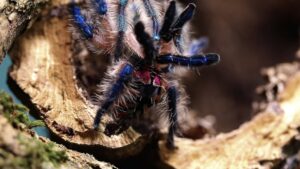
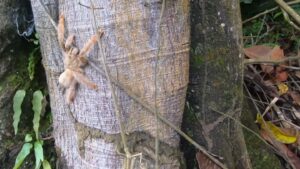
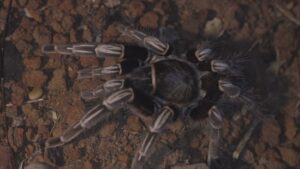
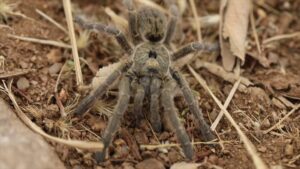
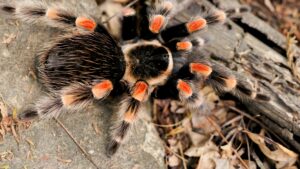
Hapalotremus is a genus of tarantulas from the high Andes with 15 species: ten recorded from Peru, three from Bolivia and two from Argentina.[1] They live between about 1,300 and 4,500 metres in the Puna and Yungas regions, and one of them, H. vilcanota, set the altitude record for the whole tarantula family at 4,524 metres in 2018.[2] A 2021 paper on a related genus, Antikuna, later raised that record to 4,689 metres.[3]
Which tarantulas live highest?
Two genera hold the altitude records for the family Theraphosidae, and both are from Peru. A 2018 revision of Hapalotremus reported 4,524 metres, and at the time it called Hapalotremus the only known theraphosid spiders found living at such elevation.[2] In 2021 the authors of the new genus Antikuna found A. valladaresi at 4,689 metres and described it as a new highest altitude record.[3] We know of no later paper that moves the number, but we have not searched for one beyond the papers listed below. The same 2018 paper gives 4,398 metres for the Bistriopelma species described in 2015.[2]

The 15 species and where they are recorded
Genus Hapalotremus Simon, 1903. Authorities and countries follow the World Spider Catalog.[1]
| Species | Authority | Country |
|---|---|---|
| H. albipes | Simon, 1903 | Bolivia |
| H. apasanka | Sherwood, Ferretti, Gabriel & West, 2021 | Peru |
| H. carabaya | Ferretti et al., 2018 | Peru |
| H. chasqui | Ferretti et al., 2018 | Argentina |
| H. chespiritoi | Ferretti et al., 2018 | Peru |
| H. hananqheswa | Sherwood, Ferretti, Gabriel & West, 2021 | Peru |
| H. kaderkai | Sherwood, Ferretti, Gabriel & West, 2021 | Peru |
| H. kuka | Ferretti et al., 2018 | Bolivia |
| H. major | (Chamberlin, 1916) | Peru |
| H. marcapata | Ferretti et al., 2018 | Peru |
| H. martinorum | Cavallo & Ferretti, 2015 | Argentina |
| H. munaycha | Ferretti, Chaparro, Ochoa & West, 2025 | Peru |
| H. perezmilesi | Ferretti et al., 2018 | Peru |
| H. vilcanota | Ferretti et al., 2018 | Peru |
| H. yuraqchanka | Sherwood, Ferretti, Gabriel & West, 2021 | Bolivia |
The count grew in steps. Before 2018 the genus had three species: H. albipes, H. major and H. martinorum. The 2018 revision described seven more and counted ten.[2] Four species followed in 2021 from Peru and Bolivia,[4] and H. munaycha in 2025 brought the total to 15.[5] The 2025 paper places H. munaycha in central Peru at about 4,000 metres, in inter-Andean valleys, as the sister species of H. vilcanota.[5]
Habitat
The genus is endemic to South America and ranges from central Peru in the north to north-western Argentina in the south.[2] The 2018 revision describes two habitat types: high-altitude cloud forests and grassy, rocky mountains.[2] The spiders are found among fallen logs or under rocks, where they make short burrows, and several can share one stone.[2] The 2018 paper shows a female and a juvenile of H. vilcanota found under the same stone.[2]
That matches what we saw on our own trips to Peru. In the film from the third day I say that tarantulas of this genus mostly sit in shallow tunnels beneath objects such as stones.[6] In the first film of the trip we found a Hapalotremus under a big rock beside a tussock of grass, and the next morning, at about 4,200 metres, an adult and a juvenile under a huge rock.

What we saw in Peru
We filmed Hapalotremus in the field on our Peru expeditions. All of the films below are field footage, and they are collected with our other Peru films on Peru highland tarantulas in the wild. The links open each film at the moment it describes.

- At 2:30 in We Found A New Tarantula Species Above The Clouds: we name the 2018 and 2021 papers as our guide. We say the first tarantula of the trip could be H. major or H. kaderkai, since both fit the locality, but we cannot tell which.
- At 5:38 in the same film: we find two Hapalotremus and say they could be either H. vilcanota or H. carabaya.
- At 7:05 in the same film: at about 4,200 metres we say the species was not known to science when we filmed it.
- At 0:28 in This Tarantula Is Special – Here Is Why!: at about 3,300 metres we search a known spot for H. marcapata, and at 3:15 we say it is one of the few Hapalotremus species you can tell by looking: entirely black, with red hairs on the abdomen.
- At 2:54 in I Traveled to Peru & Found Wild Tarantulas: we find a small colony of Hapalotremus in an area with no known species of the genus, and we say we are not sure which one it is.

My connection to Hapalotremus
I am the honouree of Hapalotremus martinorum, not its author. Patricio Cavallo and Nelson Ferretti described the species in 2015 from northern Argentina. The name honours Martin Gamache and me, because we took part in its collection and discovery.[7] I tell that trip in finding Hapalotremus martinorum in Argentina, and the Argentine species is covered there rather than on this page. I am not an author of any of the Hapalotremus papers cited here. I am the third author of the 2021 Antikuna paper, which belongs to the next-door genus.[3] For the species of that genus we found, see Antikuna cimrmani.
How to tell Hapalotremus from its neighbours
Female Hapalotremus have spermathecae in the form of a single oval receptacle, and the males have a very short first tibia.[5] In Antikuna the female spermathecae are in two parts.[3] Those features need a specimen under the microscope. In the field we have only the looks, and in the third-day film I say that few species of the genus can be told apart by looks alone, such as the black one with red hairs on the abdomen.
More on where tarantulas live
For the full set of our Peru films, see Peru highland tarantulas in the wild. For how elevation, climate and burrows shape tarantula ranges worldwide, see where do tarantulas live, and for the family as a whole, the Theraphosidae overview.
References
- World Spider Catalog (2026), genus page for Hapalotremus, and genus page for Antikuna. Natural History Museum Bern. Read 1 October 2026.
- Ferretti, N., Cavallo, P., Chaparro, J. C., Ríos-Tamayo, D., Seimon, T. A. & West, R. (2018). The Neotropical genus Hapalotremus Simon, 1903 (Araneae: Theraphosidae), with the description of seven new species and the highest altitude record for the family. Journal of Natural History 52(29–30): 1927–1984. doi:10.1080/00222933.2018.1506521
- Kaderka, R., Ferretti, N., Hüsser, M., Lüddecke, T. & West, R. (2021). Antikuna, a new genus with seven new species from Peru (Araneae: Theraphosidae: Theraphosinae) and the highest altitude record for the family. Journal of Natural History 55(21–22): 1335–1402. doi:10.1080/00222933.2021.1936680
- Sherwood, D., Ferretti, N. E., Gabriel, R. & West, R. C. (2021). Redescription of the theraphosine Hapalotremus albipes Simon, 1903 and description of four new species of Hapalotremus Simon, 1903 from Peru and Bolivia (Araneae: Theraphosidae). Arachnology 18(9): 965–989.
- Ferretti, N., Chaparro, J. C., Ochoa, J. A. & West, R. (2025). Phylogeny of the high-altitude tarantulas Hapalotremus Simon, 1903 with the description of a new species. Insect Systematics & Evolution 56(1): 90–110. doi:10.1163/1876312x-bja10068
- birdspidersCH (2022). This Tarantula Is Special – Here Is Why! YouTube, 4:28.
- Cavallo, P. & Ferretti, N. E. (2015). The first Hapalotremus from Argentina: description and natural history of Hapalotremus martinorum sp. nov. Journal of Natural History 49(15–16): 873–887. doi:10.1080/00222933.2014.953226