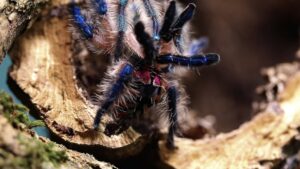
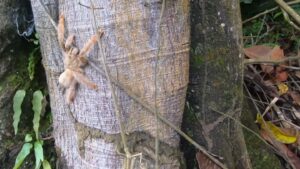
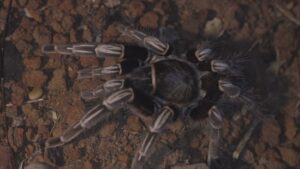
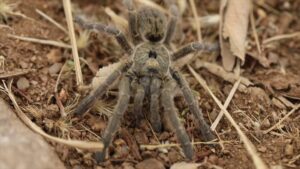
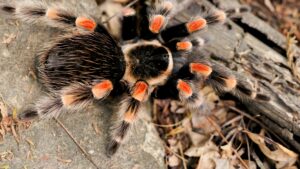
Harpactira pulchripes is a golden and blue baboon tarantula from South Africa, and hobbyists call it the golden blue leg baboon (GBL). R. I. Pocock described it in 1901 from females collected in South Africa, and the World Spider Catalog still lists it as Harpactira pulchripes Pocock, 1901, one of 15 species in the genus. In our overview film, embedded below, we cover it as an Old World tarantula from South Africa.
What names does this tarantula go by?
- Harpactira pulchripes Pocock, 1901: the accepted name in the World Spider Catalog, with South Africa as its distribution.[1]
- Golden blue leg baboon, golden blue leg baboon tarantula: the hobby names. iNaturalist lists “Golden Blue Leg Baboon Spider” as the common name.[4]
- Golden blue leg starburst tarantula: the name we use for it in our overview film.[5]
The catalog lists no synonyms and no other scientific name for this species. It cites only the original description, and it records the female only.[1]
What is Harpactira pulchripes?
Harpactira Ausserer, 1871 is a feminine genus of South African baboon tarantulas whose type species is Harpactira atra.[1] It belongs to the subfamily Harpactirinae, and Gallon lists it among the seven Harpactirinae genera that have scopulae on the retrolateral side of the chelicerae, together with Augacephalus, Ceratogyrus, Eucratoscelus, Idiothele, Pterinochilus and Trichognathella.[3] Our page on the subfamily is Harpactirinae.
In the original description, the female has a deep mahogany carapace covered in silky golden-yellow hairs. The femora are yellow, and the upper sides of the other leg segments are mahogany-brown with olive-grey hairs. The undersides of the patella and tibia carry long fiery yellow hairs, and the abdomen is olive-black with golden-yellow hairs above and at the sides.[2] The specimen measured 26 mm in total length, with a carapace of 13 mm.[2] Blue never appears in the 1901 text. The “blue leg” of the hobby name comes from the live animal, not from the original description.
Where does Harpactira pulchripes live?
For distribution, the catalog gives South Africa as the only country.[1] In our overview film description we put its habitat at about 500 metres above sea level, with relatively mild temperatures all year round.[5]
Our film on the golden blue leg baboon
Our film on Harpactira pulchripes
Captive footage from our collection. In the film we pair a male with a female Harpactira pulchripes and call it one of the most beautiful Old World tarantulas. In our experience it is not very defensive, which makes it a reasonable first Old World species.[5] I compare the two groups in Old World vs New World Tarantulas.
More on African and baboon tarantulas
Baboon tarantulas of the genus Ceratogyrus, the horned baboons, are covered on their own page. Another African tarantula we cover is Heteroscodra maculata, the Togo starburst tarantula. Our page on whether tarantulas are poisonous quotes a field guide that lists Harpactira among the African genera with painful bites. The family as a whole is in the Theraphosidae overview, and the tarantula gallery sorts pictures by subfamily.
References
- World Spider Catalog (2026), genus page Harpactira. Natural History Museum Bern.
- Pocock, R. I. (1901). Descriptions of some new African Arachnida. Annals and Magazine of Natural History (7) 7(39): 284–288, doi:10.1080/00222930108678472 (Harpactira pulchripes on p. 287).
- Gallon, R. C. (2008). On some poorly known African Harpactirinae, with notes on Avicuscodra arabica Strand, 1908 and Scodra pachypoda Strand, 1908 (Araneae, Theraphosidae). Bulletin of the British Arachnological Society 14(5): 232–246.
- iNaturalist taxon page, Harpactira pulchripes.
- birdspidersCH video description (YouTube): Blue Golden Old World Tarantula – Summary & Overview.