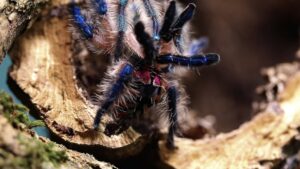
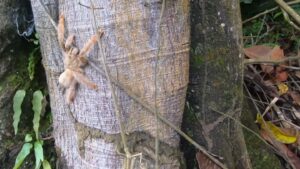
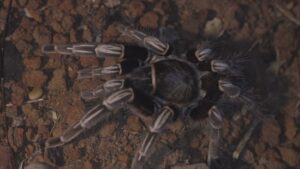
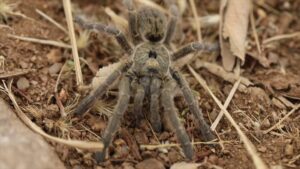
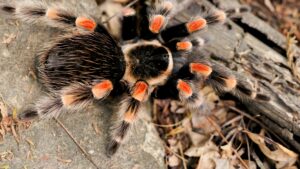
Yes. Hemirrhagus is a genus of Mexican tarantulas with 27 described species, all known only from Mexico.3 Some live under logs in pine forest, some use caves, and a handful have never been found outside one. The two main papers on the genus, a 2014 revision and a 2018 description of five new cave species, set out which is which and what the cave species lost along the way.1,2 Below that we add our own film of one in a cave.
What Hemirrhagus is
Simon described the genus in 1903. In 2003 Pérez-Miles and Locht revised it, treating the cave genus Spelopelma as a junior synonym and describing six new species.4 The 2014 revision by Jorge Mendoza puts its range from Tamaulipas in the north to Chiapas in the south, mostly in the mountain ranges of the Sierra Madre Oriental, the Transverse Volcanic Axis, the Sierra Norte de Oaxaca, the Sierra Madre del Sur and the Chiapas highlands.2 He describes a natural distribution in cold climate zones, mainly in pine, oak or pine-oak forest, with most of the surface-living species between about 1,500 and 3,100 metres above sea level.2 That puts them in the same cool, high ground we cover on our page about tarantulas in snow and at high altitude.
What sets the genus apart is that it contains surface-living (epigean), partly cave-living (troglophile) and strictly cave-living (troglobitic) species side by side. In the 2018 paper Mendoza and Francke call it the only theraphosid genus with all three.1 At the time of that paper 22 species had been described. Eleven of them had been collected inside caves, and only five showed a high degree of adaptation to cave life: H. stygius, H. puebla, H. reddelli, H. grieta and H. mitchelli.1
In the field the genus behaves unlike most tarantulas you see in Where Do Tarantulas Live? Mendoza found the surface species under fallen logs or rocks; they do not dig burrows, and they live without webs.2 They have not been seen throwing urticating hairs; when disturbed, he writes, their first reaction is to run away quickly. Inside caves they walk on walls or hide among rocks and cracks.2 For the wider family, see the Theraphosidae overview.
The 27 species, state by state
The World Spider Catalog lists 27 valid species today, all with the distribution “Mexico”.3 The states below come from the descriptions in the two papers and the 2003 revision; habitat is given as those papers state it. The five species described in 2018 are marked with an asterisk.
| Species | Described by | State | Habitat as published |
|---|---|---|---|
| H. akheronteus* | Mendoza & Francke, 2018 | Querétaro | Cave only; collected on walls 400 m from the entrance |
| H. benzaa | Mendoza, 2014 | Oaxaca | High-altitude pine forest, Sierra de Juárez |
| H. billsteelei* | Mendoza & Francke, 2018 | Oaxaca | Cave only; collected on rocks 100 m from the entrance |
| H. cervinus | (Simon, 1891) | none recorded | Known only from the holotype, without locality |
| H. chilango | Pérez-Miles & Locht, 2003 | Mexico City | Surface; shrubland and pine forest |
| H. coztic | Pérez-Miles & Locht, 2003 | Morelos | Lives inside a cave |
| H. diablo* | Mendoza & Francke, 2018 | Morelos | Cave; hides in rock crevices on the floor, rarely on walls |
| H. elliotti | (Gertsch, 1973) | San Luis Potosí | Shallow cave, under 50 m deep, in an oak-forest area |
| H. embolulatus | Mendoza, 2014 | Guerrero | Surface; tropical forest to pine forest transition, under rocks or logs |
| H. eros | Pérez-Miles & Locht, 2003 | Oaxaca | Surface; pine forest |
| H. franckei | Mendoza, 2014 | Oaxaca | Surface; pine forest, under fallen logs |
| H. gertschi | Pérez-Miles & Locht, 2003 | Guerrero | Lives within a cave |
| H. grieta | (Gertsch, 1982) | Oaxaca | Cave; from one of the deepest cave systems in Mexico |
| H. guichi | Mendoza, 2014 | Oaxaca | Surface; pine forest |
| H. kalebi* | Mendoza & Francke, 2018 | Chiapas | Cave only; collected on a sloping wall 150 m below the entrance |
| H. lochti | Estrada-Alvarez, 2014 | State of Mexico | Not stated |
| H. mitchelli | (Gertsch, 1982) | Tamaulipas | Lives within a cave |
| H. nahuanus | (Gertsch, 1982) | Puebla | Surface; the specimen label says it was collected on the surface |
| H. ocellatus | Pérez-Miles & Locht, 2003 | State of Mexico | Cave; found under rocks and on walls 30 m deep |
| H. papalotl | Pérez-Miles & Locht, 2003 | Guerrero | Cave only; collected on walls 20 m from the entrance |
| H. perezmilesi | García-Villafuerte & Locht, 2010 | Chiapas | Surface; pine forest, caught in pitfall traps |
| H. pernix | (Ausserer, 1875) | Veracruz and Puebla | Presumed pine forest; exact site unknown |
| H. puebla | (Gertsch, 1982) | Puebla | Cave; never found outside it |
| H. reddelli | (Gertsch, 1973) | Oaxaca | Cave; never found outside it |
| H. sprousei* | Mendoza & Francke, 2018 | Oaxaca | Cave only; collected on walls 300 m from the entrance |
| H. stygius | (Gertsch, 1971) | San Luis Potosí | Cave; never found outside it |
| H. valdezi | Mendoza, 2014 | Guerrero | Cave, under 50 m from the entrance, on walls (troglophile) |
Two things stand out in the table. Cave species turn up in nine states, most often in Oaxaca (four) and Guerrero (three), but also as far north as Tamaulipas and as far south as Chiapas. And many cave species are known from a single cave. That is why the genus keeps producing new names: the 2018 paper describes five from cave specimens in the Mexican national arachnid collection, some of them raised to adulthood from juveniles.1,2
Troglomorphic traits, as the papers state them
Cave biologists call the body changes that come with a life underground troglomorphisms. In general terms, Mendoza and Francke list loss or reduction of eyes and pigmentation, slender and elongated appendages, thinner cuticle and more sensitive sense organs for obligate cave animals.1 For Hemirrhagus they name four traits shared by troglophile and troglobitic species: reduced eyes, long slender legs, lack of pigmentation, and urticating setae of type VI that sit in one or two dorsal patches in the troglophiles and are absent in the troglobites.1 They interpret lack of urticating setae, loss of eye pigmentation and reduced eyes as evolutionary reversals tied to cave life.1
The five species they described show how uneven this is. The table compares what the descriptions say. Eyes and pigment are reduced in some and normal in others, even though all five come from caves.1 Even H. sprousei is not blind: its lateral eyes are well developed and only the median eyes are slightly reduced.1 More on tarantula eyes and how tarantulas sense the world.
| Species | Eyes | Eye pigment | Urticating setae |
|---|---|---|---|
| H. akheronteus | Posterior median eyes absent; anterior median and posterior lateral eyes reduced | Absent | Absent; males carry 11 movable spinose setae on the rear of the abdomen |
| H. billsteelei | Normally developed | Complete | Two lateral black patches |
| H. diablo | Normally developed | Complete | Two brown paramedian patches |
| H. kalebi | All reduced; posterior median eyes only integumentary spots | Absent | Absent |
| H. sprousei | Anterior and posterior median eyes slightly reduced; lateral eyes well developed | Only around the anterior median eyes | Absent |
One trait has no precedent. Males of H. akheronteus have a group of mobile spinose setae on the back of the abdomen, which the authors say had never been reported in any other tarantula.1 It was collected on cave walls 400 metres from the entrance, and lives only inside its cave.1 H. kalebi shares a Chiapas cave with pseudoscorpions and ricinulids.1
Two more features are worth noting. First, two types of stridulatory setae that were known only from surface species also occur in the new cave species H. billsteelei and H. kalebi.1 Second, some of these spiders fix their egg sacs in place. Mendoza reported fixed hammock egg sacs for H. papalotl and H. valdezi, the first Theraphosinae known to do this, and raised the possibility that it is a cave adaptation, while saying it was too early to assume every species does it.2 In a terrarium, a female H. valdezi fixed her egg sac between two rocks, and spiderlings emerged 31 days later.2 The 2018 paper adds H. kalebi and H. sprousei; in H. sprousei the females fixed the sacs between two bumps on the cave wall.1
Our film: a Hemirrhagus in a Mexican cave
We filmed a Hemirrhagus in a cave in Mexico in 2026. The film is on our Tarantulas of Mexico in the wild page, where you can watch it in full, and the moments below link to the film on YouTube. We do not give the location. The caves are closed to the public, and we are glad they are protected (5:55).

The film opens with the genus. Hemirrhagus is a very special genus in Mexico. Some species live only in caves and have no eyes because they do not need any in total darkness, and others live outside and get quite big, almost as big as a small Brachypelma (0:28). After a steep hike we reach the cave entrance. Inside, every surface is wet, with slick limestone and water trickling down the walls. We are looking for Hemirrhagus ocellatus, and then we find one (1:53).

What the animal does matches the papers’ picture of a spider without a burrow. These spiders hunt from exposed rock surfaces and wait for cave crickets, beetles and cockroaches, with no web and no burrow (2:01). They blend in perfectly on brown, cold rock. As far as we saw in the three animals we found, they make no webbing; they go from crevice to crevice, with plenty of cockroaches and other insects to eat (4:57).
Look at the eyes: they are still there, eight of them, functional (3:25). That fits the paper: H. ocellatus has an ocular tubercle that is only slightly reduced, eyes that are all normally developed and complete pigment around them.2 Mendoza does not count it among the five highly troglomorphic species. It is a cave animal without the strongest cave traits. He also describes its urticating setae as two dorsal patches, yellowish-orange in life on a black spider.2 It has a distinct urticating-hair pattern (5:26), and the orange patch is easy to see in the stills.

Jorge Mendoza has worked on the genus for years (2:55) and made it possible for us to enter the cave. Species in this genus are still waiting to be described, and some populations are isolated in single cave systems (3:11), which is what the table above shows. Almost every cave system seems to have its own species.


Photographed and put back
We took a few pictures and videos and then returned the animal to its cave (6:12). For a moment we brought it outside onto green moss in daylight, so you can see how muted it is, with no shimmer or iridescence. On every trip we keep one rule: we do not collect or remove, and the whole point is to see the animals where they live and leave them there (7:13).


More of our Mexico field work, including Tliltocatl and Brachypelma, is on the Mexico hub.
Short answers
Do tarantulas live in caves? Some do. In Hemirrhagus, a genus found only in Mexico, 11 of 22 species counted in 2018 had been collected inside caves, and five of them show the strongest cave adaptations.1 Elsewhere, Tmesiphantes hypogeus from Bahia, described in 2013, is the first troglobitic tarantula known from Brazil.5
Are cave tarantulas blind? Not all. Some Hemirrhagus cave species have reduced eyes and no eye pigment, but others, including H. billsteelei and H. diablo, have normally developed eyes.1
Do cave tarantulas have urticating hairs? The most strongly cave-adapted species lack them, but H. billsteelei and H. diablo, which also live in caves, still have patches.1 More on these hairs is in Urticating Hairs: How New World Tarantulas Defend Themselves.
How many Hemirrhagus species are there? The World Spider Catalog lists 27, all from Mexico, five of them described in 2018.1,3
References
- Mendoza, J. I. & Francke, O. F. (2018). Five new cave-dwelling species of Hemirrhagus Simon 1903 (Araneae, Theraphosidae, Theraphosinae), with notes on the generic distribution and novel morphological features. Zootaxa 4407(4): 451-482 (pp. 451-452, 455, 460, 463-464, 469, 473-474, 477-479). doi:10.11646/zootaxa.4407.4.1
- Mendoza, J. I. (2014). Taxonomic revision of Hemirrhagus Simon, 1903 (Araneae: Theraphosidae, Theraphosinae), with description of five new species from Mexico. Zoological Journal of the Linnean Society 170: 634-689 (pp. 634-638, 642-643, 648-650, 654, 657, 662-667, 669, 672, 674, 678, 681, 685, 687). doi:10.1111/zoj.12112
- World Spider Catalog. Natural History Museum Bern. Hemirrhagus Simon, 1903, species list. Accessed 1 October 2026.
- Pérez-Miles, F. & Locht, A. (2003). Revision and cladistic analysis of the genus Hemirrhagus Simon, 1903 (Araneae, Theraphosidae, Theraphosinae). Bulletin of the British Arachnological Society 12(8): 365–375.
- Bertani, R., Bichuette, M. E. & Pedroso, D. R. (2013). Tmesiphantes hypogeus sp. nov. (Araneae, Theraphosidae), the first troglobitic tarantula from Brazil. Anais da Academia Brasileira de Ciências 85(1): 235–243. doi:10.1590/S0001-37652013005000007
Explore this site
For the wider picture, see the Theraphosidae overview and the Tarantula Gallery.
Related Images: