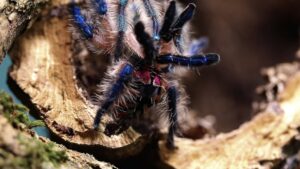
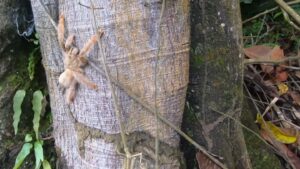
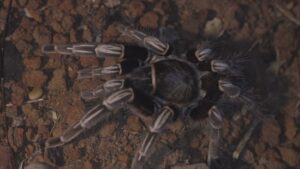
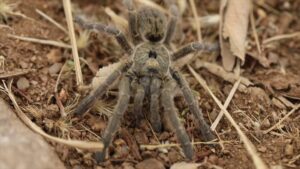
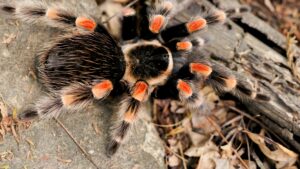
Homoeomma chilense is a small red and black tarantula from south-central Chile. Hobbyists call it the Chilean flame tarantula, and until 2018 it was sold as Euathlus sp. “Red”. Two research teams described it independently a month apart, so for a short time it carried two scientific names, and the World Spider Catalog now writes it Homoeomma chilense although the spelling in the first description was chilensis. You will still find both on labels and in listings. We filmed it in the field in 2018 and later made a second film about the name mix-up. Both are below.
Which names does this tarantula go by?
- Homoeomma chilense Montenegro & Aguilera, 2018: the accepted name in the World Spider Catalog.[1]
- Homoeomma chilensis: the spelling used in the original description. The catalog lists the genus as neuter and writes the species name chilense.[1][2]
- Homoeomma bicolor Sherwood, Gabriel & Longhorn, 2018: a junior synonym. It names the same species.[1][4]
- Euathlus sp. “Red” and Homoeomma sp. “Red”: the hobby names used in the pet trade before the description.[3]
- Chilean flame tarantula, dwarf Chilean flame tarantula: common names. iNaturalist lists the second.[7]
What is Homoeomma chilense?
Homoeomma Ausserer, 1871 is a genus of small tarantulas, two to three centimetres in body length.[6] Until 2018 every known species lived east of the Andes, and then Montenegro, Aguilera and Casanueva published the first record of the genus in Chile in October 2018 and described two species, H. chilensis and H. orellanai, the first of the genus found west of the Andes.[2] Since then five more Chilean species have been added, four in 2024 and one in 2026, so the World Spider Catalog now lists seven.[1]

The colour is the giveaway. Both sexes are blackish, with legs that turn greyer toward the tips, and long, bright reddish-orange hairs cover the top of the abdomen, densest at the front.[3] The 2018 description of the male puts it as an opaque black abdomen with a tuft of orange hairs at the front.[2]
Where does Homoeomma chilense live in the wild?
It is found only in Chile, in the regions of Maule and Ñuble, on the western slope of the Andes from about 300 metres upward.[2][6] In the north of that range it lives near sclerophyll forest. Further south, where the air is wetter, it lives in Nothofagus forest.[6]

It digs under stones and fallen trunks rather than deep into the ground. Burrows are no more than 5 cm deep, lined with cottony silk, and usually sit in places with plenty of vegetation, often close to water. They can lie only a few centimetres apart, and two or more adults are often found under the same stone.[2][6] The spiders spend much of the day hidden, which makes them hard to find,[2] yet in some places they are very common: Sherwood and colleagues report around 200 large adults to be found in a single day of searching.[3]
The describers saw it feed on ground beetles, wasps and other spiders, and they give the breeding season as May to June, with eggs laid ten to twelve weeks after mating, spiderlings hatching after about eight weeks and more than 130 eggs in the egg sac.[2] Chile’s environment ministry lists the species as Vulnerable.[6]
Why did one spider get two scientific names?
The animal was in European collections long before anyone described it. Sherwood and colleagues write that it had been legally exported, bred in captivity and traded as Euathlus sp. “Red” or Homoeomma sp. “Red” for years before its formal description.[3] Then two teams worked on it at the same time.
- October 2018: Montenegro and colleagues describe Homoeomma chilensis from specimens collected in Chile.[2]
- November 2018: Sherwood, Gabriel and Longhorn describe Homoeomma bicolor, the name meaning two-coloured. Their male holotype had been imported to the UK and was preserved in 2012.[3][4]
- 2019: the same authors compare the two descriptions and find the male holotypes and female paratypes essentially indistinguishable, from type localities very close together. Because chilensis was published first, it is the valid name and bicolor becomes a junior synonym.[4]
The only difference they note is a slight variation in the shape of the tegular apophysis on the male palp, which they treat as variation within one species.[4] The catalog writes the species name chilense.[1]
Two films about the red Chilean tarantula
Lifting rocks in Chile: the red Homoeomma
Field footage from Chile, 2018. Still in the same area as the previous episode, we found a second tarantula while lifting rocks. Our film names it Homoeomma “Red” or “Fire”, the animal the hobby sold under the wrong genus as Euathlus sp. “Red”. It is a dwarf tarantula with no tiger stripes on the abdomen, only reddish hairs, and it is described as docile.[8] It is part of our series on Chilean tarantulas in the wild.
The red tarantula that got a second name
Our beloved red tarantula from Chile, once Euathlus sp. “Red”, now has a second scientific name. This film from December 2018 explains how two independent groups of researchers described the same species, and why that cost resources that better communication could have saved.[8] The species is native to central and southern Chile.
More on Chilean tarantulas
The best known Chilean tarantula is the rose hair, Grammostola rosea, on its own page: rose hair tarantula, what Grammostola rosea means. Like Homoeomma, many tarantulas shelter under stones and in shallow burrows, and what wild burrows show collects what we have seen of that. The family as a whole is in the Theraphosidae overview, and the tarantula gallery sorts pictures by subfamily.
References
- World Spider Catalog (2026), genus page Homoeomma. Natural History Museum Bern.
- Montenegro V., R., Aguilera, M. A. & Casanueva, M. E. (2018). First record of Homoeomma Ausserer, 1871 in Chile and description of two new species (Araneae, Theraphosidae). Spixiana 41(1): 13–25.
- Sherwood, D., Gabriel, R. & Longhorn, S. J. (2018). A new species of Homoeomma Ausserer, 1871 from Chile (Araneae: Theraphosidae). Journal of the British Tarantula Society 33(3): 18–32.
- Sherwood, D., Gabriel, R. & Longhorn, S. J. (2019). A new synonymy in the genus Homoeomma Ausserer, 1871 (Araneae, Theraphosidae), with comments on potential homonymy. Bionomina 15: 69–73. doi:10.11646/bionomina.15.1.8
- Montenegro V., R. & Aguilera, M. A. (2024). Tarántulas chilenas de la subfamilia Theraphosinae (Mygalomorphae: Theraphosidae): una revisión a nivel de género. Revista Chilena de Entomología 50(2): 329–352. doi:10.35249/rche.50.2.24.16
- iNaturalist taxon page, Homoeomma chilense (common name: Dwarf Chilean Flame Tarantula).
- birdspidersCH video descriptions (YouTube): Homoeomma Red Fire Tarantula in the nature and RED TARANTULA Confusion.