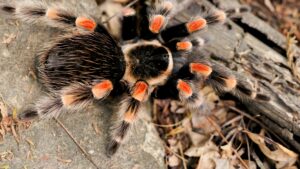
A male tarantula spins a small sheet of silk, deposits a drop of sperm on it and draws the sperm into the copulatory organs at the tips of his palps. He then looks for a female and signals to her. If she accepts, he catches her fangs with the spurs on his front legs, in the species that have them, and inserts a palp into her genital opening. The sperm goes into her sperm receptacles, the spermathecae, and she lays her eggs in an egg sac later. A male stops molting once he is adult, and getting there takes anything from 500 to 600 days in some African species to as long as ten years in the Arkansas tarantula.[1][2]
Below is what the published studies report, tied to the species they were observed in, followed by our own mating footage.
What is a tarantula sperm web?
Before mating, a male loads his palps with sperm, and in the tarantulas studied he does it on a silk sheet built for the purpose. Large juvenile males already carry a group of silk spigots, the epiandrous apparatus, in front of the genital opening. Females lack it, and the silk it makes goes into the sperm web.[1] The sperm drop itself leaves through the genital opening.[1]
The most detailed account is Baerg’s study of a captive Arkansas tarantula, Aphonopelma hentzi, summarised by Smith. The male made his first web on the sixth day after his final molt. Weaving took 40 minutes. He then lay on his back beneath the sheet, and droplets of seminal fluid appeared and were deposited on its underside. Standing over the web again, he tapped the tips of his palps into the fluid and charged both palpal bulbs over about 140 minutes, then tore the web down.[2]
The number of webs differs a lot between males. Baerg saw individual males build as many as 17 in six weeks and others as few as one in their adult life. Prentice, working on desert tarantulas in the same genus, found the sperm webs typical of Baerg’s account. The first web of Aphonopelma joshua males came three to twelve days after the final molt, and the eight males he raised built between one and four webs each.[3]
What do the palps and the hooks on the front legs do?
In an adult male each palp ends in a palpal bulb, the copulatory organ. The bulbs are heavily sclerotised and cannot expand. Sperm is taken in and released by glandular mechanisms instead.[1] During copulation the bulb delivers sperm into the female’s spermathecae.[1] In a laboratory study of Catumiri argentinense, published under the name Oligoxystre argentinensis[11], one palp could inseminate either or both of the two receptacles, and the embolus put the sperm deep inside them.[4]
Most New World tarantula genera also give the male a specialised spur, or hook, the tibial apophysis, on the front legs. It clasps the female’s chelicerae during copulation. It has one branch in some genera, two in most and is missing in a few, among them Theraphosa blondi.[1] In several species it also helps to recognise adult males, which the palpal organs mark out clearly.[1]
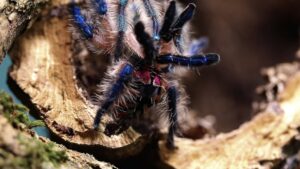
The Brazilian jewel tarantula, Typhochlaena seladonia, is one of the exceptions. Males of Typhochlaena have no tibial spurs and no spiniform process on the cymbium of the palp.[5][6]
How does tarantula courtship work?
Courtship is described species by species, and the signals differ.
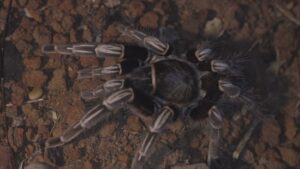
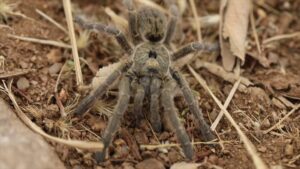
- Mojave Desert Aphonopelma, mainly A. mojave (Prentice): at the turret of a female’s burrow, males alternately stridulate, with a bobbing movement, and tap the turret wall hard with both front legs and both palps. A female may answer by drumming with her forelegs, and her drumming always followed the male’s stridulation, not his leg tapping. Once the pair made contact the female commonly rushed the male and pushed him back a few centimetres until he secured her fangs. Contact in several field matings lasted from just under one minute to just under three. At the end the male let go of one fang and pulled away to leave quickly.[3]
- Aphonopelma hentzi (Baerg, captive animals): the female met the male in a belligerent pose, rising on her hind legs with her fangs spread. He caught her fangs on the spurs of his front legs and bent her backwards. After some swaying and tapping of a palp on her sternum he pushed the embolus of the left palp, and later the right, into her epigastric furrow. Copulation took about 60 seconds.[2]
- Dolichothele (four species, Guadanucci reviewing earlier work): sympatric species share many courtship behaviours but perform them in different sequences and intensities, which suggests strong reproductive isolation.[7]
- Sickius longibulbi: the male bites the female before he introduces his palpal bulb.[7]
- Pamphobeteus ultramarinus (Andre): a mating sequence between animals from two separate populations failed. Both showed courtship behaviour and were ready to mate, but the female avoided copulation by pressing her prosoma to the ground and lifting her opisthosoma.[8]
When is tarantula mating season?
It depends on the species and the climate.
- Temperate Aphonopelma have two breeding seasons, one starting in summer and one in fall.[3] Aphonopelma mojave males searched for females from early October until nearly the end of November, and all mating Prentice saw was by day. Aphonopelma joshua is strictly a summer breeder, and all mating he saw was at night.[3]
- Pamphobeteus ultramarinus mates in the rainy season, between September and December. In its habitat, females usually carry egg sacs in the dry period between May and October.[8]
- Adult males of Typhochlaena seladonia are found mainly between September and December.[6]
- The describers of the Chilean Homoeomma chilense give May to June as its breeding season.[9]
Do male tarantulas die after mating?
Not necessarily at once. In Prentice’s field observations no male was ever caught by a female. In the laboratory, males with little running space were occasionally caught and killed.[3] Adult males are short-lived all the same. A male cannot molt again, because of anatomical limits such as a constriction at the base of the palpal bulb,[1] and Prentice noted that even captive Aphonopelma males rarely lasted through the year in which they matured.[3] One of Baerg’s males, born in August 1926, matured in August 1936. In the year that followed he built 17 sperm webs and mated 12 times with four females, and he died in August 1937.[2]
What happens after mating: eggs and egg sacs
The female keeps the sperm in her spermathecae.[1] Two species lack spermathecae, Sickius longibulbi and Encyocratella olivacea. Their females store sperm in the oviducts and uterus, so a short interval between mating and egg laying is expected.[1]
In Homoeomma chilense, the describers give about ten to twelve weeks from mating to egg laying, and about eight weeks from laying to hatching.[9] A laboratory Aphonopelma joshua female’s young began to leave the egg sac about seven weeks after the eggs were laid.[3] Females with egg sacs stay close to them. Two laboratory A. joshua females were never seen without a front appendage in contact with the sac,[3] and Baerg’s field females guard theirs until the young have hatched and left.[2] Captive A. joshua and A. mojave females did not molt in the year they produced egg sacs and molted the next year.[3]
How many eggs does a tarantula lay? Egg sacs hold very different numbers:
| Species | What was counted | Source |
|---|---|---|
| Typhochlaena seladonia | 15 to 30 eggs per egg sac (T. costae: 3 to 9) | Andre & Hüsser 2018[6] |
| Pamphobeteus ultramarinus | 40 to 80 young per egg sac | Andre 2018[8] |
| Homoeomma chilense | more than 130 eggs in an egg sac | Montenegro et al. 2018[9] |
| Aphonopelma joshua | 51 young counted from one egg sac, a wrinkled sphere about 12 mm across | Prentice 1997[3] |
| Aphonopelma mojave | 186 developed eggs and 150 to 200 small developing eggs in one dissected female | Prentice 1997[3] |
The counts are not like for like: some are eggs in a sac, some are hatched young, and one is a dissection.
How long does a tarantula take to become adult?
Tarantulas usually take three to six years to reach adulthood in humid tropical and temperate conditions and can take longer in arid zones, up to ten years in Aphonopelma hentzi.[1] Males mature sooner than females, after 8 to 12 juvenile molts. The shortest male juvenile periods, about 500 to 600 days, belong to African species of Pterinochilus and Stromatopelma.[1] Females keep molting after they mature and males do not.[1] Only adult males are clearly recognisable as adults, and telling an adult female from a juvenile is harder.[1]
Two films about tarantula mating

Typhochlaena seladonia mating, filmed with several cameras
Captive footage. In this film we recorded the mating ritual of the Brazilian jewel tarantula, Typhochlaena seladonia, with a multi-camera setup and 4K macro shots, and we cover the species’ trapdoor lifestyle. We hoped for offspring a couple of months later, to give to friends.[10]

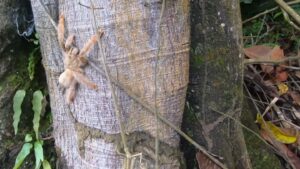
Our paper with Christian Andre on the genus covers the rest of the picture. In the field, females hardly ever leave their retreats, and adult males are found outside only after they mature and go looking for mates, mainly between September and December. The egg sac of T. seladonia holds 15 to 30 eggs.[6] Pairings of the same species, filmed on a visit to a breeder in Germany, are in our film on the Brazilian jewel tarantula page.
How tarantulas mate and breed in one minute
Captive footage: a one-minute educational short in which a brown male courts a black female in a plastic enclosure and inserts his palps.
More on tarantula biology
The family as a whole, with its subfamilies and range, is in the Theraphosidae overview.
References
- Pérez-Miles, F. (2020). Introduction to the Theraphosidae. In: Pérez-Miles, F. (ed.), New World Tarantulas, Zoological Monographs 6, Springer, pp. 1–23. doi:10.1007/978-3-030-48644-0_1
- Smith, A. M. (1995). Tarantulas of the USA and Mexico (Theraphosid Spiders of the New World, vol. 2). Fitzgerald Publishing, London. Section on sperm webs and mating, summarising Baerg (1928, 1958).
- Prentice, T. R. (1997). Theraphosidae of the Mojave Desert west and north of the Colorado River (Araneae, Mygalomorphae, Theraphosidae). The Journal of Arachnology 25: 137–176.
- Costa, F. G., Pérez-Miles, F. & Corte, S. (2000). Which spermatheca is inseminated by each palp in Theraphosidae spiders? A study of Oligoxystre argentinensis (Ischnocolinae). The Journal of Arachnology 28: 131–132. Current name Catumiri argentinense (World Spider Catalog).
- Cifuentes, Y. & Perafán, C. (2020). Arboreal tarantulas and their allies: Aviculariinae and Psalmopoeinae. In: Pérez-Miles, F. (ed.), New World Tarantulas, Zoological Monographs 6, Springer, pp. 93–119. doi:10.1007/978-3-030-48644-0_4
- Andre, C. & Hüsser, M. (2018). About trapdoors and bridges: new insights in the little-known ecology and lifestyle of the genus Typhochlaena C. L. Koch, 1850. Journal of the British Tarantula Society 32(3): 3–29.
- Guadanucci, J. P. L. (2020). Ischnocolinae and Schismatothelinae. In: Pérez-Miles, F. (ed.), New World Tarantulas, Zoological Monographs 6, Springer, pp. 77–91. doi:10.1007/978-3-030-48644-0_3
- Andre, C. (2018). Pamphobeteus ultramarinus Schmidt, 1995: habitat, lifestyle, captive care and breeding. Journal of the British Tarantula Society 33(2): 17–46.
- Montenegro V., R., Aguilera, M. A. & Casanueva, M. E. (2018). First record of Homoeomma Ausserer, 1871 in Chile and description of two new species (Araneae, Theraphosidae). Spixiana 41(1): 13–25.
- birdspidersCH video description (YouTube): Brazilian Jewel Tarantula – Most Colourful Tarantula on Earth.
- World Spider Catalog (2026). Natural History Museum Bern. wsc.nmbe.ch