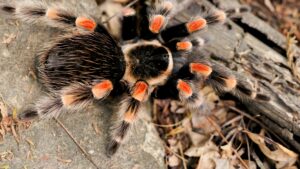
Female tarantulas live for decades and males usually die within a year or two of their final molt. In a laboratory study of Tliltocatl albopilosus, females lived about 21 years in total and males about 6, with only 1.2 of those years as adults.[1] The longest estimate for a tarantula below is about 30 years, for a Uruguayan Grammostola female.[2] Wild lifespans are hardly known: the female figures all come from animals kept in captivity. The 43-year-old spider that holds the spider longevity record is a trapdoor spider, not a tarantula.[3]
Every figure below belongs to the species it was measured in. Tarantula lifespans differ a lot between species, and most of the numbers on the web are not tied to a species at all.
Tarantula lifespan by species and sex
| Species | Sex | Setting | What was recorded | Source |
|---|---|---|---|---|
| Tliltocatl albopilosus (published as Brachypelma albopilosa) | Female, 10 animals | Laboratory, reared from egg sac | 2,034 days to adulthood (5.6 years), then 5,790 days as an adult (15.9 years); 7,824 days in total (21.4 years) | Criscuolo et al. 2010[1] |
| Tliltocatl albopilosus | Male, 30 animals | Laboratory, reared from egg sac | 1,792 days to adulthood (4.9 years), then 437 days as an adult (1.2 years); 2,229 days in total (6.1 years) | Criscuolo et al. 2010[1] |
| Grammostola mollicoma, southern form (now G. anthracina in the World Spider Catalog) | Female | Laboratory | Three females lived more than 12, 16 and 20 years as adults. Two females reared from hatchlings matured at 9 and 13 years. The authors estimate a maximum of about 30 years (10 years to maturity, 20 as an adult). | Costa & Pérez-Miles 2002[2] |
| Grammostola mollicoma, southern form | Male | Laboratory | Four males caught as adults lasted 33.3 months on average in the laboratory (SD 7.4). One male whose whole adult life was recorded lived 48 months. | Costa & Pérez-Miles 2002[2] |
| Grammostola rosea | Male, one animal | Captive, Spain | 8.5 years in total, the last 3 years and 13 days as an adult. It went without food for up to 22 months and 3 weeks. The authors call both figures outside the usual range for a male. | Cortés-Fossati & Martín-Rodríguez 2022[4] |
| Eupalaestrus weijenberghi | Male | Laboratory | 19 males caught as adults lasted 6.1 months on average (SD 1.1); one male whose whole adult life was recorded lived 8.7 months. In the field, adult males were found mostly in March and April. | Costa & Pérez-Miles 2002[2] |
| Acanthoscurria cordubensis (published as A. suina) | Male | Laboratory | 21 males caught as adults lasted 3.9 months on average (SD 1.2); one male whose whole adult life was recorded lived 6.8 months. | Costa & Pérez-Miles 2002[2] |
| Aphonopelma hentzi (Arkansas colony studied by Baerg) | Female | Laboratory | One female collected at about 2 years old became adult at 11 and died at 22 years and 4 months. | Baerg, in Smith 1995[5] |
| Aphonopelma hentzi (Arkansas colony studied by Baerg) | Male | Laboratory | One male hatched in August 1926, matured in August 1936 and died in August 1937. Baerg’s laboratory males collected as juveniles matured in 10 to 13 years. | Baerg, in Smith 1995[5] |
| Aphonopelma species of the Mojave Desert | Male | Captive | Even captive males rarely last through the year in which they matured. | Prentice 1997[6] |
| Gaius villosus, a trapdoor spider (Idiopidae), not a tarantula | Female | Wild, Western Australia | 43 years, recorded during a long-term population study. | Mason et al. 2018[3] |
How long do female tarantulas live?
Tarantulas are among the longest-lived spiders, and the long lives belong to the females.[7] They keep molting after they mature, about once every two years in the large species Costa and Pérez-Miles kept, and they stay in or near their burrows.[2][7] The numbers come from captivity, because following a burrow-dwelling spider for 20 years is hard. In Grammostola mollicoma the 30-year figure is an estimate built from three females that lived at least 12, 16 and 20 years as adults and from the age at which reared hatchlings matured. It is not a single animal watched for 30 years.[2]
The longest single life in the table that has a recorded end is Baerg’s Arkansas female, Aphonopelma hentzi, at 22 years and 4 months, counted from her estimated age when she was collected. William Baerg measured and weighed his animals between 1927 and 1949.[5] His animals grew slowly: Baerg believed his Arkansas females needed about ten years to mature, and the 22-year female matured at 11.[5] Pérez-Miles gives up to ten years to adulthood for this species.[7]
In the long film below we give a number for the genus. Standing at the burrow of an adult female in Mexico, we say: “Female [Brachypelma] can live 20, 30 years. They don’t reach maturity until they’re nine or 10 years old, and then they might live another 20 years after that” (14:03-14:14 in the long film). That is our statement from the field, not a measured record for a named species. For Mexican Brachypelma and Brachypelmides, Locht, Yáñez and Vázquez report that males reach maturity in 7 to 8 years and live a year or less after their last molt, while females mature in 9 to 10 years and then live about 10 more.[9]
How long do male tarantulas live?
Males usually die after their first breeding season.[7] In Tliltocatl albopilosus a laboratory male lasted 437 days as an adult, on average, against 5,790 days for a female.[1] The authors measured why: adult males produced more mitochondrial superoxide in their blood cells and had weaker antioxidant defences than females, which the authors propose helps explain why males die sooner.[1] Pérez-Miles points to a related cost. Males have higher metabolic rates at rest and while moving, and they spend their adult life walking in search of females.[7]
Several of the longest male records come from captivity, and the authors say so. Costa and Pérez-Miles judged that adult male lifespans in the laboratory overestimate what happens in the field, where males wander, feed little and lose body mass. For Eupalaestrus weijenberghi and Acanthoscurria they found adult males in the field mainly in March and April, against 6 and 4 months in the laboratory.[2] Pérez-Miles reports males of these two species living about two months as adults in the wild and almost a year in captivity.[7] His explanation is that captive males feed less and move less, so they spend less energy.
The record male in the table is a single Grammostola rosea kept in Spain. It matured in August 2019, spent most of its adult life refusing food and died on 30 June 2022, after going 22 months and 3 weeks without eating. Its keepers wrote that conclusive results cannot come from one animal, and that they did not test whether the conditions affected the male in other ways, such as fertility.[4]
How long does a tarantula take to become an adult?
Tarantulas usually take three to six years to reach adulthood in humid tropical and temperate conditions and can take longer in arid zones, up to ten years in Aphonopelma hentzi.[7] The shortest male juvenile periods, about 500 to 600 days, belong to African species of Pterinochilus and Stromatopelma.[7] The laboratory Tliltocatl albopilosus reached adulthood at 4.9 years (males) and 5.6 years (females).[1] The Uruguayan Grammostola females matured at 9 and 13 years.[2] Baerg’s Arkansas males took 10 to 13 years.[5] How the same species develops in the wild is not recorded in these studies.
A tarantula’s age is therefore mostly time spent growing up. For a male, the adult stage is the short last part of a life that began years earlier.
Do tarantulas live longer in captivity than in the wild?
For males of Eupalaestrus weijenberghi and Acanthoscurria cordubensis, yes. For females there are no wild figures to compare. The 20 to 30 year female figures all come from animals kept in laboratories, and the Tliltocatl albopilosus were fed freely on a standard diet.[1] Pérez-Miles also notes that a large compilation of captive lifespans for 85 theraphosid species (Ibler et al. 2013) gave shorter averages than other studies. Its animals were kept warm and fed all they would eat, and it averaged male and female lifespans together.[7] Cortés-Fossati and Martín-Rodríguez suggest that food availability could affect lifespan, and note that there are few data on it.[4]
Is the 43-year-old spider a tarantula?
No. The record-holder is Gaius villosus, a trapdoor spider from Western Australia, a mygalomorph like the tarantulas but in a different family (Idiopidae). The authors report a 43-year-old female that died during a long-term population study in south-western Australia, and call it the longest-lived spider documented.[3]
What we saw in the field
On our 2025 trip to Mexico we filmed an adult female Mexican red knee tarantula at her burrow. The short film below is cut from that trip, and in it we talk about the males:
Field footage from Mexico, 2025. In the film we say that males “mature faster, seven or eight years” (0:14 to 0:17), and that once they reach adulthood “they have maybe a year, one mating season, and then they’re gone” (0:17 to 0:24). Males leave their burrows between September and January to look for females (0:24 to 0:37). The female stays put. Of the female we say that she “might have been here since the early 2000s, sitting in this same burrow” (0:01 to 0:14). That is an estimate, not a record.
The complete trip is in our film The Mexican Red Knee Tarantula You’ve Never Seen Before, which also sits on the smithi versus hamorii page. The lifespan passage starts at 13:54. The one-captive-male case from Spain is walked through in our Chile film at 10:01.
More on tarantula biology
How males and females reproduce, including what happens to the male afterwards, is on the page about how tarantulas mate and breed. What wild tarantulas eat is in What do tarantulas eat?, and the habitats they live in are in Where do tarantulas live?. The family as a whole is in the Theraphosidae overview.
References
- Criscuolo, F., Font-Sala, C., Bouillaud, F., Poulin, N. & Trabalon, M. (2010). Increased ROS production: a component of the longevity equation in the male mygalomorph, Brachypelma albopilosa. PLoS ONE 5(10): e13104. doi:10.1371/journal.pone.0013104. The World Spider Catalog lists the species as Tliltocatl albopilosus (Valerio, 1980).
- Costa, F. G. & Pérez-Miles, F. (2002). Reproductive biology of Uruguayan theraphosids (Araneae, Mygalomorphae). The Journal of Arachnology 30: 571-587. Lifespan data on pp. 580 and 585. The World Spider Catalog treats Grammostola mollicoma (Ausserer, 1875) as a junior synonym of G. anthracina (C. L. Koch, 1842) and Acanthoscurria suina Pocock, 1903 as a junior synonym of A. cordubensis Thorell, 1894.
- Mason, L. D., Wardell-Johnson, G. & Main, B. Y. (2018). The longest-lived spider: mygalomorphs dig deep, and persevere. Pacific Conservation Biology 24: 203-206. doi:10.1071/PC18015
- Cortés-Fossati, F. & Martín-Rodríguez, I. (2022). On the life expectancy of a male Chilean rose tarantula, Grammostola rosea (Walckenaer, 1837) (Araneae: Theraphosidae) reared in captivity. Revista Chilena de Entomología 48(4): 755-760. doi:10.35249/rche.48.4.22.09
- Smith, A. M. (1995). Tarantulas of the USA and Mexico (Theraphosid Spiders of the New World, vol. 2). Fitzgerald Publishing, London. Summary of the field and laboratory work of W. J. Baerg (1928, 1958).
- Prentice, T. R. (1997). Theraphosidae of the Mojave Desert west and north of the Colorado River (Araneae, Mygalomorphae, Theraphosidae). The Journal of Arachnology 25: 137-176. Statement on p. 170.
- Pérez-Miles, F. (2020). Introduction to the Theraphosidae. In: Pérez-Miles, F. (ed.), New World Tarantulas, Zoological Monographs 6, Springer, pp. 1-23 (lifespan and development on pp. 17-18). doi:10.1007/978-3-030-48644-0_1
- World Spider Catalog (2026). Natural History Museum Bern. wsc.nmbe.ch
- Locht, A., Yáñez, M. & Vázquez, I. (1999). Distribution and natural history of Mexican species of Brachypelma and Brachypelmides (Theraphosidae, Theraphosinae) with morphological evidence for their synonymy. The Journal of Arachnology 27: 196-200 (phenology on p. 198).