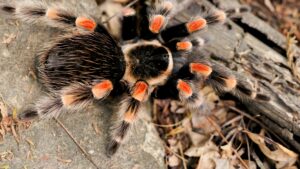
A tarantula molts to grow: it builds a new exoskeleton under the old one and leaves the old one behind as an exuvium, the empty “skin” you find in a burrow or enclosure.1 A lost leg comes back the same way, as a smaller leg that appears at a molt and gets closer to full size at each molt after that.3 Adult males are the exception. They almost never molt again, so a leg they lose practically always stays lost.1 This page puts what we have filmed in the wild next to what the papers say.
What a molt is, and what the exuvium shows
Spiders can only grow by molting, and tarantulas do it for years. Pérez-Miles, in his 2020 introduction to the family, says theraphosids usually take 3 to 6 years to reach adulthood in humid tropical and temperate conditions and up to 10 years in arid zones, as in the Arkansas tarantula Aphonopelma hentzi.1 One book on the spiders of South-East Asia calls molting “a dangerous business”, with some spiders losing legs or dying in the process.7 Two tarantulas in one Brazilian paper died that way. A small Iridopelma seladonium (the jewel tarantula we cover as Typhochlaena seladonia), kept in captivity in Brazil, left its retreat, stopped feeding and died after an unsuccessful ecdysis, and an adult female of the same species died the same way before she laid eggs.5
The exuvium is more than a husk. The cuticle lining a female’s spermathecae, her sperm-storage organs, is shed with it, and you can see the spermathecae inside the molt next to the epigastric furrow. Pérez-Miles gives the inner face of the exuviae as a more accurate way to tell a female from a male than looking at the animal.1 Some tarantulas also work urticating hairs into their molting mat, which he counts as passive defence.1
Wild molts we have filmed
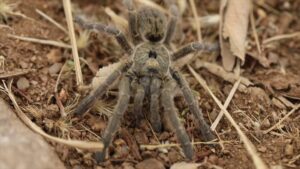
Molts turn up in our field films more often than you might expect, because the animal that made one is nearby and looks its best. In our Sericopelma film from Costa Rica the first burrow on a roadside embankment belonged to an adult female, but only her exuvium was there. She had freshly molted, and the burrow went about one metre deep, as far as our tickling sticks reached. Further along I find a smaller animal that is also freshly molted. Maybe it is the season on this stretch of road when they are all molting, which is good for filming because the spiders look far better right after a molt.

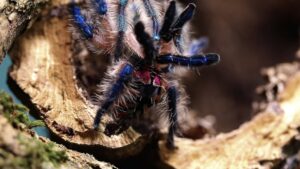
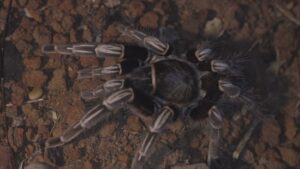
The most striking example is the red-legged Abdomegaphobema mesomelas (filmed as Megaphobema mesomelas). The female I coaxed out of a bank in Costa Rica was “freshly molted, velvet black, and awesome orange coloration” (at 7:59), and the species is probably the best-looking tarantula in Costa Rica. Our Poecilotheria subfusca film from Sri Lanka ends the same way, with a freshly molted adult female with a pink-purple sheen on her femora, the first adult female we saw in the wild (see the subfusca page). In our collection the same change shows: freshly molted animals have a very dark, almost black tone (captive footage, at 10:54).
Before a molt: what we saw and what the sources say
We do not have a stopwatch for the build-up, and the papers we could read give no timetable. What we can offer is a few observations. In the field in Chile, I show a female Phrixotrichus that looks to me like one that needs a molt: the carapace is extremely dark, while other animals we found had many more bright hairs (at 9:45). The Brazilian Iridopelma above had stopped feeding and left its retreat before it died in a failed molt.5
The molt itself is often hidden. At a Mexican Brachypelma site a freshly molted tarantula sits inside a burrow I cannot see into, and I think the webbing around it means she sealed the burrow against moisture (at 11:23). For animals in my own collection I take a cricket out again if the tarantula will not eat it, so that it cannot hurt the spider if she is molting (at 4:11), and a recently molted tarantula is not ready to eat and should be left to rest a little longer. This is how I keep my own animals, filmed in captivity.
Lost legs: loss, regrowth and the word “autotomy”
Wild tarantulas with a missing leg are an ordinary sight. We often find them on our expeditions, and it does not bother the spider much (at 0:14 in our Short on the subject). In the Short the word is autotomy. Arachnologists draw a finer line. Roth and Roth, in a 1984 review of “appendotomy”, reserve autotomy for an instant, reflex break at a built-in weak point and conclude it occurs rarely, if ever, among spiders. For a spider removing its own leg they use autotilly, and for a leg pulled off by something outside, autospasy.2 Among the reasons they list for spiders dropping a leg are escape from a predator, escape from an aggressive female after mating (especially tarantulas, from their own observations) and release from an incomplete molt. They add that Aphonopelma tarantulas do not lose legs easily; in two cases the spiders twisted around until the leg came off at the coxa-trochanter joint, near the body, once after being grasped and once when a male freed himself from a female that had caught his leg.2 A 2025 laboratory study on juvenile Davus pentaloris uses autotomy for the same event, and lists leg loss when a leg is restrained or damaged by a predator, in mating and in incomplete molting.4
The Short itself is on YouTube: Tarantula Lost its Leg! Regeneration & Autotomy (55 seconds).
A lost leg comes back at the molt. In his 1990 paper on spider leg regeneration, Vollrath states that regenerated legs emerge during a molt and often seem poorly functional or non-functional until they have molted at least once more; the paper is on web-building spiders, but its survey lists tarantulas among the families that regenerate at the joint where they shed the leg.3 For a tarantula it gives numbers, reported from the German work of Ruhland in 1976 on Dugesiella hentzi, the name then in use for the Arkansas tarantula, now Aphonopelma hentzi:3
| After the leg was lost | Regrown leg, as a share of the normal leg on the other side |
|---|---|
| First molt | 61 to 71 percent |
| Second molt | 76 to 85 percent |
| Third molt | 83 to 90 percent |
So the new leg is a short version at first and catches up over several molts. What that does to running was measured in the 2025 Davus study. Within a day of losing two legs, juveniles ran at their old speed again, and after the legs had regrown to the same length, thickness and shape as the opposite leg they again ran as fast as before.4 In the lab the researchers induced the leg loss by chilling the spiders and restraining legs, so this shows what a regrown leg can do, not how often it happens in the wild.
One of our own films catches a leg in the middle of this process. In a live lecture on a Panama field trip, I show a photo of a Sericopelma from Santa Catalina. The second leg on the left side is growing again, and missing legs in the wild are something you see a lot (at 37:00). The film is also on our page about Sericopelma in Panama.
Adult males almost never molt again
Females keep molting after they mature, and males stop. According to Pérez-Miles, males are prevented from molting after adulthood by anatomical limits, such as the basal constriction at the palpal bulb, and that the few males that molted after maturity, which he attributes to hormonal disorders, showed deformed palpal organs.1 Males usually take 8 to 12 juvenile molts to get there, females usually more than nine.1
A captive male rose tarantula in Spain shows the end of the sequence. The last recorded molt was on 17 August 2019, which made him an adult; the molt before it was on 1 August 2018. Afterwards he lived about three years as an adult, outside the usual range for a male.6 Our own films say the same in the field. In our film I Found a Tarantula That Scientists Can’t Find a male goes through one final molt and one breeding season, then wanders for perhaps a year before he dies (at 8:18). More on that in How Long Do Tarantulas Live? and How Do Tarantulas Mate and Breed?.
It follows that a male with a missing leg practically cannot regrow it. That is our inference from two statements in the papers, since regeneration happens at a molt, and we found no report that tests it.1,3 A mature female still molts, so in principle she still has the chance. Napiórkowska and colleagues, summarising earlier work on a house spider, say a spider can regenerate lost appendages for as long as it is able to molt.8
Short answers
How do tarantulas molt? They grow a new exoskeleton under the old one, then step out of the old one, leaving the exuvium. The process is risky, and failed molts are a recorded cause of death and of lost legs.
Do tarantulas regrow legs? Yes, at a molt. The regrown leg starts shorter and approaches normal size over several molts.
Do adult male tarantulas molt? Almost never. Adult males stop molting; the few that have molted as adults afterwards had malformed palpal organs. Females keep molting after maturity.
References
- Pérez-Miles, F. (2020). Introduction to the Theraphosidae. In: Pérez-Miles, F. (ed.), New World Tarantulas, Zoological Monographs 6, Springer, pp. 1-23 (molting on pp. 9, 10 and 18). doi:10.1007/978-3-030-48644-0_1
- Roth, V. D. & Roth, B. M. (1984). A review of appendotomy in spiders and other arachnids. Bulletin of the British Arachnological Society 6(4): 137-146 (pp. 137, 139, 142-143).
- Vollrath, F. (1990). Leg regeneration in web spiders and its implications for orb weaver phylogeny. Bulletin of the British Arachnological Society 8(6): 177-184 (pp. 177, 178, 183). The D. hentzi figures are Ruhland (1976), as reported there.
- Kane, S. A. et al. (2025). Unsupervised learning reveals rapid gait adaptation after leg loss and regrowth in spiders. Journal of Experimental Biology 228(12): jeb250243. doi:10.1242/jeb.250243 (open access).
- Almeida-Silva, L. M., Camacho, A., Brescovit, A. D., Lucas, S. M. & Brazil, T. K. (2008). Redescription and notes on the natural history of the arboreal tarantula Iridopelma seladonium (Araneae: Theraphosidae: Aviculariinae). Revista Brasileira de Zoologia 25(4): 728-736 (p. 735).
- Cortés-Fossati, F. & Martín-Rodríguez, I. (2022). On the life expectancy of a male Chilean rose tarantula, Grammostola rosea (Walckenaer, 1837) (Araneae: Theraphosidae) reared in captivity. Revista Chilena de Entomología 48(4): 755-760 (p. 756). doi:10.35249/rche.48.4.22.09
- Murphy, F. & Murphy, J. (2000). An Introduction to the Spiders of South East Asia. Malaysian Nature Society, Kuala Lumpur (p. 30).
- Napiórkowska, T., Jacuński, L. & Templin, J. (2006). The effect of amputation of polymelic walking legs and of parts of appendage complexes in Tegenaria atrica (Araneae: Agelenidae). Bulletin of the British Arachnological Society 13(9): 347-352 (p. 347).
Explore this site
For the wider picture, see the Theraphosidae overview and the Tarantula Gallery.