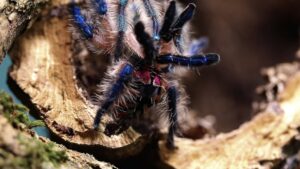
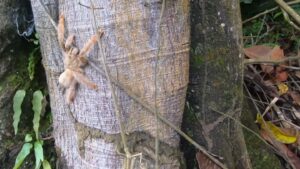
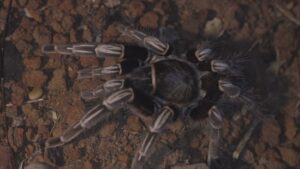
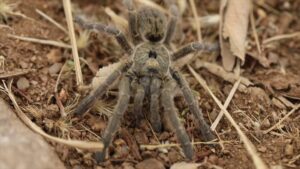
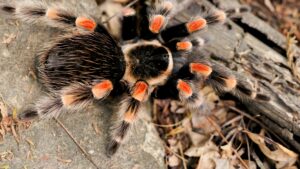
Most tarantulas have eight small eyes, bunched on a raised patch at the front of the carapace.12 What comes up first when we tickle a spider out of a burrow is not the head but the front legs, because tarantulas feel the world through their legs and palps, which carry hair-shaped detectors of moving air and strain sensors in the cuticle,4,8 and they react to ground vibration as well.3 They have no ears. The hiss some of them make is not a voice either: it is stridulation, setae rubbed against each other.6
| Question | Short answer |
|---|---|
| How many eyes? | Eight, in four pairs, usually together on a small raised tubercle. |
| Can tarantulas see? | They are not blind as a group, but cave species of Hemirrhagus have reduced eyes. |
| Can tarantulas hear? | There are no ears. Hairs called trichobothria detect air movement, and the legs also register touch and ground vibration. |
| Why do they hiss? | Stridulation: setae on mouthparts or leg bases are rubbed together. |
How many eyes do tarantulas have?
Eight. Spiders typically have four pairs of eyes of two kinds: one pair of principal eyes, the anterior median eyes, and three pairs of secondary eyes.1 A 2025 developmental study describes its tarantula, the Brazilian white-knee tarantula Acanthoscurria geniculata, as having eight small eyes at the centre of the cephalothorax.1
In tarantula descriptions the eyes sit together on a tubercle, a small raised hump. One example is a Cuban tarantula, Cubanana cristinae, whose eight eyes are set in two rows on a tubercle, the front row straight or only slightly procurved and the back row recurved.2

Can tarantulas see? Are they blind?
Tarantulas are not blind as a group, they have eyes. Tarantulas have long been assumed to have poor colour vision on the basis of low opsin diversity. A 2020 study found a considerable diversity of opsin genes in tarantula transcriptomes, which contradicts that consensus. That shows which light-sensing genes are active, not what a tarantula actually sees.9
In a 2026 paper of field observations, an adult female Aphonopelma chalcodes in Arizona stood motionless on a trail at night, then retreated about 1.5 metres to her burrow when the observer approached. The authors write that advancing footstep vibrations or the increased intensity of the flashlight beam likely triggered the retreat.3 Light or vibration: for us this matters, because we search with headlamps.
The exceptions are cave tarantulas. Troglobitic species of the Mexican genus Hemirrhagus show ocular reduction and loss of eye pigmentation.10 In Hemirrhagus sprousei from Oaxaca the eye tubercle is undeveloped and the eyes are reduced, and its eye cells may be non-functional.3,10 It still reacted to slight ground vibrations, such as walking, and to air currents, such as breathing, when people approached it.3 The cave Hemirrhagus of Mexico have their own page: Hemirrhagus: Mexico’s cave tarantulas.
Do tarantulas hear? Hairs, not ears
Tarantulas have no ears. When we tickle a spider out of her burrow, her front legs come up slightly, feeling vibrations in the air and in the ground. Moving air is picked up by trichobothria, erect and very long setae that stand in a deep cup-like socket, on the legs and palps, and are specialised in detecting air movement.4 Strain in the leg cuticle, from touch and load, is measured by slit sensilla.8 A cave tarantula reacted to even slight ground vibrations such as walking.3 Trichobothria are also found on the tarsi of mygalomorphs, the group that contains the tarantulas.4 In one description of Ceratogyrus, for example, the club-shaped (clavate) trichobothria are restricted to a U-shaped region on the apical half of every tarsus.5
Tickling works because of this. You gently vibrate a thin twig or grass stem at the entrance of a burrow, and if a spider is home she takes it for prey. It is on film (3:19 in our Mexican red knee film).
When I feed my tarantulas I stay quiet, because speech produces vibrations that tarantulas are very sensitive to (13:24 in the feeding film).
Why do tarantulas hiss?
A tarantula’s hiss is stridulation: two surfaces covered with setae are rubbed together. Where they sit depends on the group. In Lasiodora, a genus that Pocock diagnosed in 1901 by this character, stridulatory setae stand on the front faces of the leg coxae, best developed on the first two pairs, and on the maxillae.6 The same character appears in Phormictopus and Theraphosa, but it evolved there separately.6
I keep the Malaysian earth tiger, Omothymus schioedtei. She tries to climb away from danger first, and only when there is nowhere to go does she go into the defense posture and hiss. She rubs her chelicerae together, and it is a warning. Only the large adult females do it (3:35 in the earth tiger film). The species has its own page: Omothymus spider: Malaysian earth tiger explained.
Hobbyists also use the stridulating setae to tell the rose hair tarantulas apart. Grammostola porteri carries more of them on the palp coxa than G. rosea, and you can check it on a molt. This is a hobby method, not a taxonomic character, and the World Spider Catalog treats G. porteri as a synonym of G. rosea.7 The idea is in our film on the two rose hair names. For a species whose sound is the subject of a film, see the king baboon spider page.
What the hairs on the legs do
A tarantula carries several kinds of hair, and they do different jobs. Trichobothria sense air movement, as above. The dense setae that cover the legs are sensory too: through them an earth tiger feels vibrations, air movement and temperature changes. The scopulae on the feet are dense pads of tiny hairs that help a climbing tarantula grip vertical surfaces. The urticating hairs are a defense and a separate subject, covered in Urticating hairs: how New World tarantulas defend themselves.

What this means when I film
A spider in a burrow knows we are there before we do anything: in Guerrero, as we tickled her out, she of course knew. So I keep quiet near a burrow or a feeding.
References
- Baudouin Gonzalez, L., Schönauer, A., Harper, A., Arif, S. et al. (2025). Development and patterning of a highly versatile visual system in spiders. Proceedings of the Royal Society B 292(2042): 20242069. doi:10.1098/rspb.2024.2069
- Ortiz, D. (2008). Description of Cubanana cristinae, a new genus and species of theraphosine tarantula (Araneae: Theraphosidae) from the island of Cuba. Boletín de la Sociedad Entomológica Aragonesa 42: 107–122.
- Zamani, A. & West, R. C. (2026). Insights into spatial orientation and cognition in tarantulas (Araneae: Theraphosidae) under natural conditions, with notes on possible ontogenetic niche shifts. Ecology and Evolution 16(4): e73329. doi:10.1002/ece3.73329
- Eskov, K. Y. & Marusik, Y. M. (2024). A comparative morphology of trichobothrial bases in araneoid spiders and its significance for the phylogeny and system of the superfamily Araneoidea (Arachnida, Araneae). ZooKeys 1219: 1–60. doi:10.3897/zookeys.1219.133002 (the Introduction cites Ramírez 2014 and Coddington & Levi 1991)
- Gallon, R. C. (2008). On some poorly known African Harpactirinae, with the genus Ceratogyrus Pocock, 1897, and its type species. Bulletin of the British Arachnological Society 14(5): 232–246.
- Bertani, R. (2023). Taxonomic revision and cladistic analysis of Lasiodora C. L. Koch, 1850 (Araneae, Theraphosidae) with notes on related genera. Zootaxa 5390(1): 1–116. doi:10.11646/zootaxa.5390.1.1
- World Spider Catalog. Natural History Museum Bern, wsc.nmbe.ch, accessed 2 October 2026.
- Barth, F. G. (2004). Spider mechanoreceptors. Current Opinion in Neurobiology 14(4): 415–422. doi:10.1016/j.conb.2004.07.005
- Foley, S., Saranathan, V. & Piel, W. H. (2020). The evolution of coloration and opsins in tarantulas. Proceedings of the Royal Society B 287: 20201688. doi:10.1098/rspb.2020.1688
- Mendoza, J. I. & Francke, O. F. (2018). Five new cave-dwelling species of Hemirrhagus Simon 1903 (Araneae, Theraphosidae, Theraphosinae), with notes on the generic distribution and novel morphological features. Zootaxa 4407(4): 451–482. doi:10.11646/zootaxa.4407.4.1