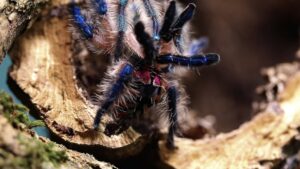
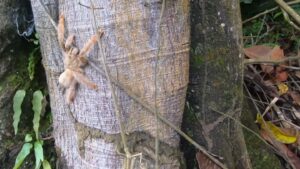
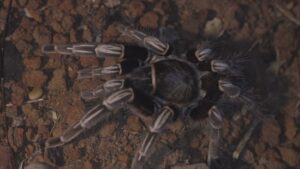
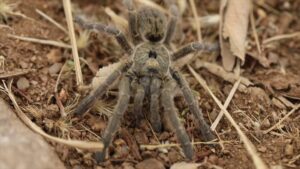
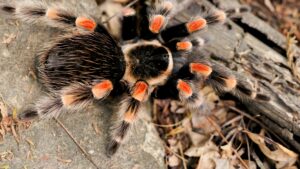
Hysterocrates elephantiasis is a Central African tarantula with a strongly thickened first pair of legs, and our film about it is titled “The Elephant Tarantula”. It was described in 1917 as Phoneyusa elephantiasis from a single female collected in Congo in 1904, and Richard Gallon and Ingo Wendt moved it to Hysterocrates in 2015.[1][2] The paper lists only preserved specimens from museum collections and states that the ecology is unknown.[2] Our film goes through that paper and then turns to the fire that destroyed the arachnid collection of the Museu Nacional in Rio de Janeiro in September 2018.
Which names does the elephant tarantula go by?
- Hysterocrates elephantiasis (Berland, 1917): the accepted name in the World Spider Catalog. The catalog gives its distribution as the Republic of the Congo and the Democratic Republic of the Congo.[1]
- Phoneyusa elephantiasis Berland, 1917: the original combination. Berland described the female in the Bulletin du Muséum National d’Histoire Naturelle, and Laurent described the male in 1946.[1][2]
- Elephant tarantula: the name in our film’s title. We found no source that treats it as an established common name.
Why was it moved from Phoneyusa to Hysterocrates?
Because of the male palp, Gallon and Wendt moved it. Among the Eumenophorinae, only Hysterocrates species have a small hooked conductor on the prolateral side of the tegulum, and the long embolus of elephantiasis arises from the rear of the oval tegulum, as in Hysterocrates.[2] Phoneyusa in the strict sense has a much larger conductor at the front and a short, strongly keeled embolus.[2] Berland described the species from a female. Laurent later took two males for the same species because leg I was longer than leg IV, remarking that in other Phoneyusa species the reverse is true.[2]
Within the genus, the female spermathecae are unusual: Hysterocrates elephantiasis lacks the lobes found in other examined species, and the paper uses that as one of its diagnostic features.[2] The same paper moved two more species, H. celerierae and H. efuliensis, into the genus.[2]
How do you recognise Hysterocrates elephantiasis?
The female has a strongly thickened tibia on the first leg, which separates it from all other African eumenophorines, according to Gallon and Wendt.[2] In most other Hysterocrates species leg IV is the longer one, while in this female leg I is longer (H. celerierae is the one exception the paper names).[2] Males have leg I clearly longer and thicker than leg IV, and the scopula on the fourth metatarsus covers about half of its length rather than more than three quarters.[2]
In the paper the colour is uniformly brown for the holotype and chestnut brown for the Dimonika female and male, always noted as the colour of dried specimens, so it says little about the living animal.[2] The holotype female measures 37.8 mm in total length, with a wizened abdomen, and a second female measures 45.7 mm.[2]
What do we know about its biology?
Very little. Under ecology, the paper reads “Unknown. Presumably fossorial.” It adds that males are mature in March and September.[2] The specimens it examined come from Brazzaville, Dimonika and M’Bamou in the Republic of the Congo and from two places in the Democratic Republic of the Congo. In museum collections in Paris, Tervuren and Frankfurt, the holotype is the one in Paris.[2] Two of the 1972 specimens carry the label “Dimonika, swimming pool”.[2]
In the film we go further than the paper and say that the species is not available in the hobby, that we know of no live images, and that it has not been seen alive for more than a hundred years (1:11, 5:26), and viewers who travel to Congo are asked to photograph it.[3] That is our statement from 2018. The paper itself says only that the ecology is unknown, and its material examined includes specimens collected in 1937, 1971 and 1972, much more recently than the 1904 holotype.[2]
Our film: a thick-legged tarantula and a lost collection
Page by page, the film from 2018 goes through the Gallon and Wendt paper. Timestamps follow.[3]
- 1:11: why this species is special: not in the hobby and known only from dead specimens, with good pictures in the scientific redescription.
- 1:43: the paper, its authors and the four species it moves.
- 3:27: the type material, a single female collected long ago, and its transfer from Phoneyusa.
- 4:14: the specimen photographs and the thick first legs, which we call “something I’ve never seen before”.
- 4:53: we compare it to a reversed king baboon spider, since Pelinobius muticus has the thickened pair at the back instead.
- 6:01: ecology unknown.
- 6:18: the distribution map with the female holotype and the males, then the turn to Brazil.
- 7:26: the lost neotropical spider collection of the Museu Nacional.
- 7:48: our Facebook post and what we say we would like to donate.
Between the film and the paper, one detail differs. At 3:23 we say that only one specimen is known, a single female. A little later, around 6:18, we say that males are now illustrated too, which matches the paper: it describes the holotype female, a second female and males from Congo and the Democratic Republic of the Congo.[2]
What happened to the arachnid collection of the Museu Nacional?
On the night of 2 September 2018, a fire at the Museu Nacional, Brazil’s oldest scientific institution, destroyed its arachnid and insect collections.[4][5] National Geographic reported on 6 September that Museu Nacional curator Débora Pires had written in an email on 5 September that the entomology and arachnology collections were completely destroyed, as was most of the mollusc collection, while technicians saved 80 percent of the mollusc holotypes.[4]
On 6 October 2018 the Department of Entomology gave more detail. It said ten of its eleven laboratories were destroyed and that its main collection, about five million specimens, was lost except for part of the Diptera and specimens that were on loan elsewhere. Specimens that other institutions had lent to the museum were lost as well. It also said that more than three thousand primary types of insects, the work of several generations of scientists, were almost completely lost.[5] That statement is about insects. In the sources we read, we found no published count of spider type specimens, so this page gives none.
In the film we say that the museum’s neotropical spider collection “is all gone now” (7:26) and that we made a short Facebook post about it. Beyond that, we say that birdspiders.ch was collecting Brazilian tarantula material and, once the museum starts rebuilding its collection, would like to donate it for science (7:48).[3] That is how we put it in 2018.
For this species, the fire matters in one way only: the paper that the film covers rests on specimens that museums kept for decades. In Rio, that loss shows what happens to such collections when they burn.
More African tarantulas on this site
On this site, the baboon tarantulas of Africa have their own pages: the king baboon spider, Pelinobius muticus, Ceratogyrus, the horned baboon tarantulas and Harpactira pulchripes, the golden blue leg baboon tarantula. For the family as a whole, see Theraphosidae: an overview of tarantula spiders.
References
- World Spider Catalog (2026), genus page Hysterocrates. Natural History Museum Bern.
- Gallon, R. C. & Wendt, I. (2015). On the taxonomic placement of four African Phoneyusa species (Araneae, Theraphosidae, Eumenophorinae). Arachnology 16(8): 298–304. doi:10.13156/arac.2015.16.8.298
- birdspidersCH (2018). The Elephant Tarantula & Tarantula crisis in Brazil. YouTube.
- Greshko, M. (2018). Fire devastates Brazil’s oldest science museum. National Geographic, 6 September 2018.
- Department of Entomology, Museu Nacional, Universidade Federal do Rio de Janeiro (6 October 2018). Official announcement on the fire at the São Cristóvão Palace.
Further reading: Kury, A. B., Giupponi, A. P. L. & Mendes, A. C. (2018). Immolation of Museu Nacional, Rio de Janeiro – unforgettable fire and irreplaceable loss. Journal of Arachnology 46: 556–558.
Related Images: