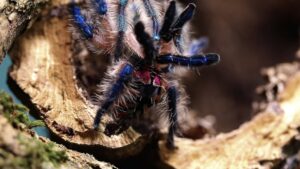
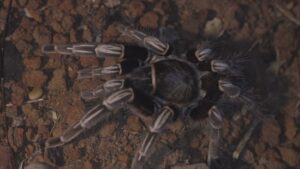
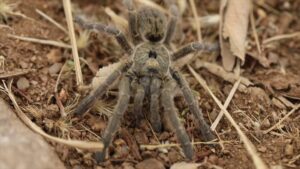
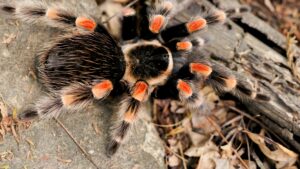
Ischnocolus valentinus is the tarantula of Spain. It is a small, brown, shaggy spider that lives under flat stones on sunny Mediterranean slopes, and it is the only tarantula recorded from Spain.3,4 It is not the only one in Europe: Chaetopelma lymberakisi, described in 2019, lives on Crete.11,12 Adults are small: the one female measured in its revision was 14.8 mm long, the one male 16.9 mm.2
Most people who search for a Spanish tarantula meet a different animal, a large wolf spider. Lycosa tarantula itself lives from France and Italy to Croatia, and Spain, Portugal and Morocco have Lycosa hispanica; both belong to the wolf spider family, Lycosidae.9,10 Ischnocolus valentinus sits in the Theraphosidae, the family of the goliath birdeater.7 Urticating hairs are absent.2
Name and classification
Louis Dufour described the male in 1820 as Mygale valentina, from the province of Valencia, which the name still recalls.3,7 For the next century, animals from Spain, Sicily and North Africa were described again and again under other names, among them Ischnocolus holosericeus, Avicularia andalusiaca and I. algericus. Guadanucci and Wendt (2014) folded nine of those names into I. valentinus, and Zonstein (2018) added Leptopelma cavicola.2,6 One of the nine, I. mogadorensis, was taken back out in 2022 and is now a separate species of southern Morocco.1
Since then the genus has been redrawn. Korba and colleagues (2022) showed that Ischnocolus is not a close relative of Chaetopelma, the tarantula of the eastern Mediterranean.1 In 2026 Korba and Opatova moved the burrowing Moroccan and Algerian tarantulas formerly called I. elongatus into the revived genus Luphocemus. Ischnocolus keeps I. valentinus as its type species.5 The subfamily Ischnocolinae, where Ischnocolus was long placed, is no longer treated as a natural group in its old, wide sense, and only a narrower Ischnocolinae in the strict sense, which still contains Ischnocolus and Luphocemus, is kept.5 The Ischnocolinae gallery explains why.
Where it lives
In Spain the species is known from Andalusia, Murcia and the Valencian Community. Its northern limit lies in the Valencian Community, and records from 2019, published in 2020, pushed the known range inland in western Andalusia.1,3,4 Across the Strait of Gibraltar, the species reaches northern Morocco, where the southernmost populations sit on the northern slopes of the High Atlas.1 By genetic dating, it crossed from North Africa to Iberia within the last six million years.1,5
The World Spider Catalog lists a wider range: Spain, Sicily, Morocco, Algeria, Tunisia, Libya and Turkey.7 The eastern half of that list is less certain. A 2022 study confined the species to Iberia and northern Morocco and left the populations in Algeria, Tunisia and Sicily to be confirmed once more animals are sampled.1 One Sicilian sample, in that study, grouped with I. valentinus, but the 2026 genomic study treats the Sicilian lineage as a separate, unnamed Ischnocolus that does not group with the Iberian animals.1,5 The photographs below, from Sicily and Tunisia, are therefore labelled Ischnocolus cf. valentinus.


Under stones, behind silk
Whatever shelter the ground offers, this tarantula takes. It lives in natural cavities between and under rocks and among tree roots, and it covers the entrance with a sheet of silk that can look like the funnel web of the Iberian funnel-web spider Macrothele calpeiana.1 The retreat never turns into a proper tube. It is an irregular hole that links one or several cavities underground.1 Habitats run from open Mediterranean grassland to dense stands of Aleppo pine and Barbary thuja.1 In Spanish surveys it turns up under large, flat stones in sunny places, and adult males have been collected between February and June.3,4
Telling it from its relatives
Within Spain no other tarantula has been recorded, so there is no tarantula to confuse it with. Morocco is more crowded. The burrowing Luphocemus elongatus is stockier, with a raised head region, black bristles on the jaws and a deep tube-like burrow, whereas I. valentinus has a flatter abdomen, longer rear spinnerets and a silk-lined crevice.1 I. mogadorensis lives in a similar way but in the semi-arid south.1 Farther east, I. jickelii takes over, from the Horn of Africa to Iran.7,8
Specialists separate the males by the palpal bulb and the females by the spermathecae, the sperm-storage organs, which in I. valentinus are as wide as long and carry several lobes at the tip.1,2 A photograph rarely settles the question, because that work needs a microscope.
References
- Korba, J. et al. (2022). Systematics and phylogeography of western Mediterranean tarantulas (Araneae: Theraphosidae). Zoological Journal of the Linnean Society 196: 845-884.
- Guadanucci, J. P. L. & Wendt, I. (2014). Revision of the spider genus Ischnocolus Ausserer, 1871 (Mygalomorphae: Theraphosidae: Ischnocolinae). Journal of Natural History 48: 387-402. doi:10.1080/00222933.2013.809492
- Tamajón Gómez, R., Pertegal Pérez, C. & Rodríguez Castilla, G. (2020). Primeros registros de Ischnocolus valentinus en la provincia de Córdoba (Andalucía, España). Revista Ibérica de Aracnología 36: 165-166.
- Hernández-Corral, J., Barrientos, J. A. & García-Teba, J. P. (2025). Nuevos datos sobre las arañas del Parc Natural del Carrascal de la Font Roja (Alicante, España). Revista Ibérica de Aracnología 46: 51-75.
- Korba, J. & Opatova, V. (2026). Out of North Africa: evolution and biogeography of Afro-Arabian dwarf tarantulas (Theraphosidae, Ischnocolinae). Molecular Phylogenetics and Evolution 218: 108559.
- Zonstein, S. L. (2018). Complementary data on the genus Ischnocolus (Araneae: Theraphosidae). Israel Journal of Entomology 48: 105-118.
- World Spider Catalog. Ischnocolus valentinus (Dufour, 1820). Natural History Museum Bern, accessed 2026-10-01.
- Montemor, V. M. et al. (2020). Taxonomy of the genus Ischnocolus in the Middle East, with description of a new species from Oman and Iran (Araneae: Theraphosidae). Zoology in the Middle East 66(1): 76-90.
- World Spider Catalog. Lycosa tarantula (Linnaeus, 1758). Natural History Museum Bern, accessed 2026-10-01.
- World Spider Catalog. Lycosa hispanica (Walckenaer, 1837). Natural History Museum Bern, accessed 2026-10-01.
- Chatzaki, M. & Komnenov, M. (2019). Description of a new Chaetopelma (Araneae, Theraphosidae) species from Crete and a re-description of Macrothele cretica Kulczyński, 1903 (Araneae, Macrothelidae). Zootaxa 4544(2): 269-284. doi:10.11646/zootaxa.4544.2.7
- World Spider Catalog. Chaetopelma lymberakisi Chatzaki & Komnenov, 2019. Natural History Museum Bern, accessed 2026-10-01.
Explore this site
For the wider picture, see the Theraphosidae overview, the Ischnocolinae gallery and the Tarantula Gallery.