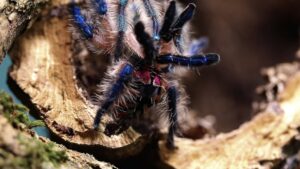
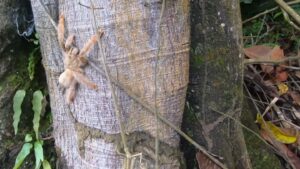
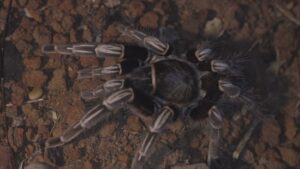
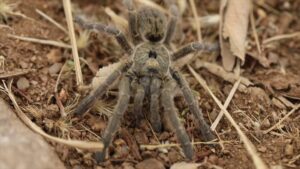
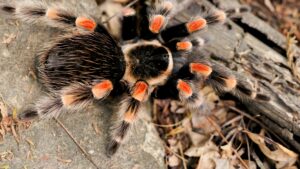
Lasiocyano sazimai is a blue-haired tarantula from the highlands of Bahia and Minas Gerais in Brazil. Until 2023 it was Pterinopelma sazimai, and the old name is still on many labels and price lists. Hobbyists often call it the Brazilian blue.
Why the name changed
A short explainer on why the blue tarantula was renamed from Pterinopelma sazimai to Lasiocyano sazimai.

In 2023 Galleti-Lima, Hamilton, Borges and Guadanucci published a phylogenomic study of the lasiodoriform tarantulas, and their results showed that sazimai did not sit with the other Pterinopelma species, so the authors gave it a genus of its own, Lasiocyano. Roots meaning hairy and blue make up the name, after the blue iridescent hairs of the type species, and no other species belongs to the genus. A second Pterinopelma species, felipeleitei, went into another new genus, Parvicarina, in the same study.
Bertani, Nagahama and Fukushima described the species in 2011, and the World Spider Catalog accepts Lasiocyano sazimai. A 2026 morphometric study in the Journal of Morphology treats Lasiocyano and Lasiodora as sister lineages and reports that measurements and shape could not reliably separate L. sazimai from Lasiodora species; the blue-purplish setae of Lasiocyano stayed informative (Marquezin-Gomes et al. 2026).
What it looks like
Both sexes are covered in blue or purple iridescent hairs on the carapace, chelicerae and legs. In the female, the carapace, labium and sternum are black. Short black hairs and long golden ones cover the legs, with pale rings near the ends of the femora, patellae and tibiae, and the abdomen is black with long red hairs on top. The male first described in 2011 belongs to a different species, and Bertani and Leal described the true male in 2016.

Where it lives
The species is known from the highlands of the Espinhaço range in Bahia and Minas Gerais; the holotype was collected at 1,262 metres above sea level. Two national parks, Chapada Diamantina in Bahia and Serra do Cipó in Minas Gerais, supplied the type series. Campo rupestre is where the animals live, a rocky highland habitat above 900 metres with outcrops and thin soil. Juveniles were found under rocks by day at about 1,300 metres, and the holotype female was crossing a trail at four in the afternoon.
Ivan Sazima, the Brazilian zoologist who collected the first specimens in the 1970s and 1980s, is honoured in the species name. For many years those were the only animals known.
More tarantulas of the subfamily are in the Theraphosinae gallery. The Brazilian blue and the other Brazilian trade names are sorted in Brazilian tarantulas and their trade names.
Sources
- Bertani, R., Nagahama, R. H. & Fukushima, C. S. (2011). Revalidation of Pterinopelma Pocock 1901 with description of a new species and the female of Pterinopelma vitiosum. Zootaxa 2814: 1-18.
- Bertani, R. & Leal, F. (2016). A new species of Pterinopelma from the highlands of Minas Gerais, Brazil, and description of the male of P. sazimai. Zoologia 33(2): e20150190.
- Galleti-Lima, A., Hamilton, C. A., Borges, L. M. & Guadanucci, J. P. L. (2023). Phylogenomics of Lasiodoriforms: reclassification of the South American genus Vitalius and allied genera. Frontiers in Ecology and Evolution 11: 1177627.
- Marquezin-Gomes, A. G., Galleti-Lima, A., Morales, M. J. A. & Guadanucci, J. P. L. (2026). Testing the limits of morphology: a comprehensive morphometric study of the sister lineages Lasiocyano Galleti-Lima, Hamilton, Borges and Guadanucci, 2023 and Lasiodora C. L. Koch, 1850 (Theraphosidae, Mygalomorphae). Journal of Morphology 287(4): e70123.
- World Spider Catalog (2026). Lasiocyano sazimai, accessed 1 October 2026.