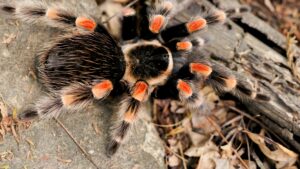
The source page identifies the pictured tarantula as Lasiodorides polycuspulatus but gives no sex, life stage, molt date, or individual growth record. The old page made general claims about slow growth and post-molt color. Those claims are not converted into a history for this image.

What is established
The World Spider Catalog accepts Lasiodorides polycuspulatus Schmidt and Bischoff, 1997, records it from Peru, and lists it as the type species of Lasiodorides. The catalog does not include Ecuador in the accepted distribution. [1]
Sherwood and colleagues redescribed and redefined Lasiodorides in 2021. Their revision treated Lasiodorides rolinae as a junior synonym of L. polycuspulatus. [1][2] These taxonomic sources support the name and diagnosis. They do not support the old page’s calm-temperament claim, eight-centimeter carapace, or numerical enclosure recipe.
What a future record would need
A dated series with molt intervals, photographs under the same light, feeding notes, and sexing evidence could test the old page’s growth and color claims. Until such records exist, they should not be attached to the pictured animal. The informal name “Peruvian Blonde” can help readers recognize hobby usage, but it is not part of the scientific diagnosis.
Our unidentified tarantula record from Peru shows the problem from the opposite direction: there is a photograph and country-level provenance, but not enough evidence for a genus or species name. The Antikuna cimrmani field account is a separate Peruvian record from a different genus and does not help identify the image on this page.
References
- World Spider Catalog: Lasiodorides polycuspulatus.
- Sherwood, D. et al. (2021). Stabilizing a chaotic taxonomy: redescription and redefinition of Lasiodorides and Thrixopelma.