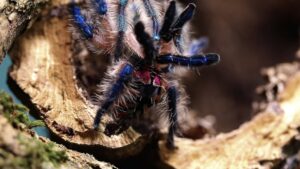
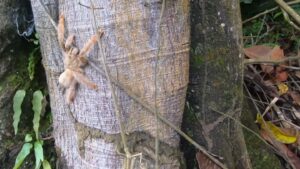
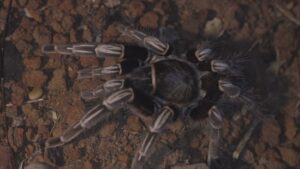
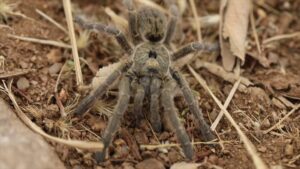
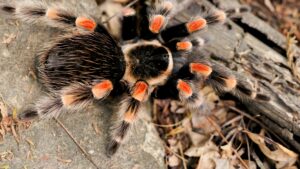
Brachypelma boehmei, the Mexican fireleg tarantula, is a burrowing tarantula with orange legs. It lives in one small part of western Guerrero, Mexico, and the IUCN lists it as Endangered. In the film we note that almost none have been filmed in their natural habitat, so we went to Guerrero to find one.
Field documentary from Guerrero
Field footage from Guerrero, Mexico: the search for Brachypelma boehmei in dry forest, a tour of its habitat, and the release of the animal back into the wild at the end.
- 0:12 Finding Bonnetina hijmenseni
- 3:17 Entering the habitat of the Mexican fireleg tarantula
- 3:48 The scientific history of B. boehmei
- 4:22 The search begins in the heat
- 6:12 The habitat
- 12:15 A tour of the habitat, with the Mexican red knee tarantula for comparison
- 17:27 Release back into the wild
The film also shows Bonnetina hijmenseni, a species described in 2017. Ortiz and Francke note that it is bred in the European pet trade and sold there as Bonnetina rudloffi, a name they treat as a nomen dubium because the original description cannot be tied to any known animal.
What it looks like
The carapace and legs of both sexes are orange, which separates B. boehmei from every other Brachypelma. In live males the carapace is persimmon orange with a paler border. The femora are black, each patella carries a persimmon flame-shaped patch, the tibiae and metatarsi are persimmon, and the tarsi are dark brown. Some females have black patches around the eyes.

Where it lives
The species is found only in a small coastal region of the Sierra Madre del Sur, east of the Balsas River basin in western Guerrero. The Balsas forms its western edge, and the high Sierra Madre del Sur separates it from Brachypelma auratum further inland. Mendoza and Francke record it from a single municipality. The conservation profile written for the IUCN assessment gives an extent of occurrence of about 396 square kilometres, at 100 to 320 metres above sea level.

It lives in subtropical dry forest and thorn forest in the foothills and lowlands near the Pacific coast. It prefers shady, forested ground, and healthy populations are not found outside that habitat. The burrows sit under large angular rocks and tree roots among thorny brush. The spider either modifies an existing cavity or digs its own, and the burrows mostly have no silk around the entrance, so an occupied burrow gives no sign that anyone is home. The spider inside still feels a visitor coming, through vibration picked up by the hairs on its legs.
The spiders are nocturnal and wait near the burrow entrance from dusk. Prey remains found in burrows have been mostly beetles and millipedes. One female was found sharing her burrow with a 30 centimetre Balsas ground snake. Mature males wander in the open to look for females from August to January, mostly at night, in cooler daylight hours and on overcast days.
Why it is Endangered
The IUCN lists B. boehmei as Endangered. The whole genus is on CITES Appendix II, which regulates international trade. The conservation assessment names these threats:
- Urban and agricultural expansion shrinks the dry forest. The species seems to depend on well-preserved forest and does not adapt well to disturbed ground.
- Males are run over while crossing the coastal Pacific highway during the mating season.
- New roads give smugglers access to wild populations.
- Illegal collection for the pet trade, including wild-caught gravid females.
- Hurricanes have devastated some subpopulations, according to local information.
Between 2006 and 2016, 7,810 to 10,021 live B. boehmei were reported in international trade, none of them declared wild-caught. Captive breeding is carried out in Mexican wildlife management units, but the assessment concludes that legal supply is too low to meet demand and that illegal collection is increasing.
Names and relatives
Schmidt and Klaas described Brachypelma boehmei in 1993. The holotype female and a paratype male were collected by K. Böhme and are kept in the Senckenberg Museum in Frankfurt; no locality was recorded with them. In the 2020 revision by Mendoza and Francke, Brachypelma was split in two. B. boehmei stays in the red-knee group together with B. smithi, B. hamorii, B. baumgarteni, B. auratum, B. albiceps, B. emilia and B. klaasi. Seven other species moved to a new genus, Tliltocatl. Common names include Mexican fireleg and Mexican rustleg.
For the other Mexican red-knee species see Mexican red knee tarantula: smithi vs hamorii. More Brachypelma and its relatives are in the Theraphosinae gallery.
Sources
- Mendoza, J. I. & Francke, O. F. (2020). Systematic revision of Mexican threatened tarantulas Brachypelma (Araneae: Theraphosidae: Theraphosinae), with a description of a new genus, and implications on the conservation. Zoological Journal of the Linnean Society 188(1): 82-147.
- Fukushima, C. S., Mendoza, J. I., West, R. C., Longhorn, S. J., Rivera, E., Cooper, E. W. T., Hénaut, Y., Henriques, S. & Cardoso, P. (2019). Species conservation profiles of tarantula spiders (Araneae, Theraphosidae) listed on CITES. Biodiversity Data Journal 7: e39342.
- Ortiz, D. & Francke, O. F. (2017). Reconciling morphological and molecular systematics in tarantulas: revision of the Mexican endemic genus Bonnetina. Zoological Journal of the Linnean Society 180: 819-886.
- Schmidt, G. & Klaas, P. (1993). Eine neue Brachypelma-Spezies aus Mexiko (Araneida: Theraphosidae: Theraphosinae) (original description of Brachypelma boehmei). Arachnologischer Anzeiger 4: 7-9, 11-13.
- World Spider Catalog (2026). Brachypelma boehmei, accessed 1 October 2026.