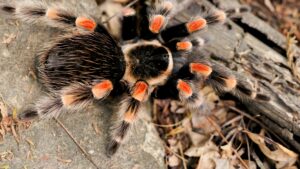
Nhandu tripepii (Dresco, 1984) is a large, hairy, brown tarantula from the eastern Amazon in northern Brazil, sold in the hobby as the Brazilian giant blonde or strawberry blonde tarantula. Its accepted name is Nhandu tripepii. A second name from 1998, Nhandu vulpinus, describes the same species and is now a junior synonym. [1][2]

| Accepted name | Nhandu tripepii (Dresco, 1984) [1] |
|---|---|
| Original name | Eurypelma tripepii Dresco, 1984 [1] |
| Synonym | Nhandu vulpinus, first described as Vitalius vulpinus Schmidt, 1998; the male was described by Schmidt & Samm, 1998 [1][2] |
| Genus and family | Nhandu Lucas, 1983, Theraphosidae [1] |
| Hobby names | Brazilian giant blonde, strawberry blonde |
| Distribution | Brazil [1]. Published records: the states of Pará and Maranhão [3] |
| Colour | Brown, with long reddish hairs [3] |
| Measured size | Female 81.0 mm, male 50.9 mm total length (single animals, not maxima) [3] |
What is the Brazilian giant blonde tarantula?
It is the hobby name for Nhandu tripepii. The scientific name is the more precise reference, because trade names are used loosely and the species has carried several names. Dresco described it as Eurypelma tripepii. Raven later moved it to Hapalopus, and Nagahama, Fukushima and Bertani placed it in Nhandu in 2009. [1][2]
Is Nhandu vulpinus the same species as Nhandu tripepii?
Yes. Nagahama, Fukushima and Bertani examined the holotype of Eurypelma tripepii, a male from the state of Pará. Its palpal bulb has the same general shape and keel positions as that of N. vulpinus, metatarsus I folds against the tibial apophysis in the same way, the colour patterns agree, and the known range of N. vulpinus fits the type locality of N. tripepii. [2] Sherwood and colleagues also treat N. vulpinus as a junior synonym of the valid N. tripepii. [4]
The older name is still searched for. Vulpinus means fox-like, and the dense reddish hair does fit.
What does Nhandu tripepii look like?
Bertani’s 2001 revision describes the species under the name N. vulpinus. In both sexes the carapace and legs are brown and covered in long reddish hairs, with darker femora. The legs carry large whitish bands that are hardly distinct, not clear rings, and females have more very long curly hairs on the carapace and its border than males do. [3]
Females of Nhandu chromatus differ from those of N. tripepii by striping on the legs, which N. chromatus has and N. tripepii lacks, and by legs that are densely hirsute in N. tripepii but not in N. chromatus. [4]
How big does Nhandu tripepii get?
Bertani measured a female with a total length of 81.0 mm and a carapace 26.5 mm long, and a male with a total length of 50.9 mm and a carapace 23.2 mm long. The female is the larger animal, but the male has the longer legs: leg IV from femur to tarsus adds up to 87.4 mm in the male and 71.8 mm in the female. [3] These are single measured animals, not recorded maxima, and none of the figures is a leg span.
In my own collection, a captive N. tripepii female is my biggest tarantula. She is bigger than my very old Lasiodora klugi, and the fuzzy coat makes her look larger still.
Where does Nhandu tripepii live?
The World Spider Catalog gives Brazil. The holotype came from the state of Pará, and Bertani’s records, filed under the name N. vulpinus, come from Pará and from Maranhão, in Amazon forest from the north-east of Pará to the north-west of Maranhão. Nagahama and colleagues describe this area as restricted. [1][2][3]
Around Belém it lives in lowland Amazon forest with high humidity and high rainfall all year round, and it shares that forest with other big tarantulas, Acanthoscurria geniculata and Theraphosa blondi. I cover its habitat and the drier-habitat N. chromatus in our film on both species, starting at 7:46. For the same Brazilian setting from the taxonomy side, see our Acanthoscurria geniculata article, and for the relative from the dry Caatinga and Cerrado, Nhandu chromatus, restored to Nhandu in 2026. The Brazilian giant blonde and the other Brazilian trade names are sorted in Brazilian tarantulas and their trade names.
How do I keep Nhandu tripepii in captivity?
This is how I keep mine in Switzerland, as shown in the film from 7:46. It is one keeper’s experience with captive animals, not a care sheet and not a statement about wild animals.
Climate charts for the Belém region show about 30 to 36 degrees Celsius depending on the month. In a burrow it is cooler, probably around 23 to 24 degrees, so the outside figures are no guide for an enclosure. Compared with N. chromatus, N. tripepii wants it more humid.
My female has a strong feeding response. You can tickle her out of her burrow and offer a small cockroach, and in my experience they take whatever prey you give them. They are hungry most of the time, so do not overfeed them. Like N. chromatus, she is defensive, and the genus has urticating hairs that irritate mammals, so keep them away from your face and eyes. The film talks about the hairs at 7:06.
Frequently asked questions
What is a strawberry blonde tarantula?
Strawberry blonde is another hobby name for Nhandu tripepii, next to Brazilian giant blonde.
Is Nhandu tripepii the same as Nhandu vulpinus?
Yes. Nhandu vulpinus is a junior synonym of Nhandu tripepii (Dresco, 1984), according to Nagahama and colleagues, and Sherwood and colleagues follow that treatment. [2][4]
References
- World Spider Catalog: Nhandu tripepii.
- Nagahama, R. H., Fukushima, C. S. and Bertani, R. (2009). Nhandu tripepii is a senior synonym of Nhandu vulpinus. Zoologia 26: 578-580.
- Bertani, R. (2001). Revision, cladistic analysis, and zoogeography of Vitalius, Nhandu, and Proshapalopus; with notes on other theraphosine genera (Araneae, Theraphosidae). Arquivos de Zoologia 36(3): 265-356.
- Sherwood, D., Gabriel, R., Peñaherrera-R., P., Brescovit, A. D. and Lucas, S. M. (2026). Redescription of Nhandu chromatus Schmidt, 2004 stat. rest. and revalidation of Nhandu sylviae Sherwood, Gabriel & Brescovit, 2023 stat. rev. (Araneae: Theraphosidae). Arachnology 20(4): 519-526.