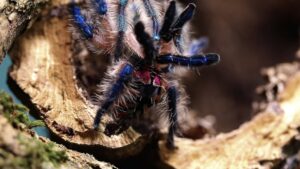
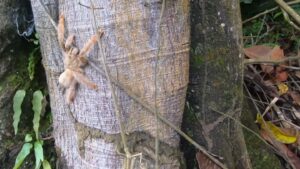
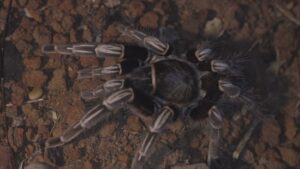
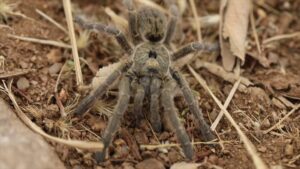
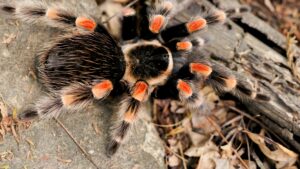
Old World tarantulas live in Africa, Asia and Australia, with a few species in southern Europe.5 New World tarantulas live in the Americas. The difference you can check on the animal is the urticating hairs: many New World tarantulas carry them on the abdomen, and no Old World tarantula has been found with them.2,4 The bite is the other half of the question. The literature says Old World tarantulas are more reactive and their bites can be more severe,1 and in my own films some of them are and some are not.
What do Old World and New World tarantulas mean?
Both terms only say where a tarantula lives. Tarantulas, the family Theraphosidae, occur on every continent except Antarctica, and the World Spider Catalog lists 1,209 species in 192 genera.5 Most of them live in the Neotropics.1 Of the 12 or 13 subfamilies most authors recognise, five occur in the New World, and one of them, Theraphosinae, holds about half of all tarantula species.1 Poecilotheriinae from India and Sri Lanka, Harpactirinae and Stromatopelminae from Africa, and Ornithoctoninae from Southeast Asia and China are Old World subfamilies.2
In the 2019 phylogenomic study, nearly all New World tarantulas fall into one branch of the tree. The Old World subfamilies sit on other branches, in regional pairs: Harpactirinae with Stromatopelminae in Africa, Ornithoctoninae with Poecilotheriinae in Asia.2 So the New World is close to one lineage, and the Old World is several. That is one reason I distrust any rule that is meant to cover every Old World species.
| New World | Old World | |
|---|---|---|
| Where | The Americas | Africa, Asia, Australia, a few species in southern Europe5 |
| Subfamilies | Five of the 12 or 13, among them Theraphosinae, Aviculariinae and Psalmopoeinae1 | The others, for example Poecilotheriinae, Harpactirinae, Stromatopelminae, Ornithoctoninae2 |
| Urticating hairs | Present in Theraphosinae, Aviculariinae and in Ephebopus; absent in the rest1,3 | None found2,4 |
| Bites in the literature | Usually like a wasp sting1 | More reactive; bites can be more severe; painful muscle cramps of about a month reported for Pterinochilus, Poecilotheria and Hysterocrates1 |
Individual animals do not read the literature.
Which tarantulas have urticating hairs?
Urticating hairs are barbed, microscopic hairs that a tarantula flicks off its abdomen or presses onto a threat.2 They occur in the New World subfamilies Theraphosinae and Aviculariinae, and in one genus of the Psalmopoeinae, Ephebopus, which carries them on the palps instead of the abdomen.1,3 The hairs are found only in New World tarantulas and are absent in the Old World subfamilies.4
New World does not mean hairs, though. Psalmopoeus, Tapinauchenius and Pseudoclamoris in the Psalmopoeinae, the Schismatothelinae and the Ischnocolinae have no abdominal hairs.1,2 Ephebopus is the only genus of its subfamily with hairs, and they sit on the pedipalps, so an adult at the entrance of its burrow can flick them at an intruder it is looking at. I explain it in our film about the 2019 phylogenomic paper (from 2:18), and it also shows my photograph of a small Theraphosinae from the Ecuadorian highlands caught in the middle of flicking hairs. The Schismatothelinae are dwarf tarantulas without urticating hairs, and like most Psalmopoeinae they strike a pose when disturbed (8:12).
At the other end is Hapalopus. It is skittish and fast, and it carries urticating hairs. A typical defence is raising the abdomen into the air, and I show it at 3:42 in the film.

The seven hair types, how they are released and what they do to skin are on Urticating hairs, so I do not repeat them here. For irritation and first aid, see Are tarantulas poisonous? The Ephebopus genus has its own page, Ephebopus: skeleton tarantulas.
Do Old World tarantulas bite harder or have stronger venom?
Not by a rule I can give you. Pérez-Miles writes that the great majority of tarantula species are not poisonous spiders, that the bite can hurt because of the large chelicerae, and that the effect is usually similar to a wasp sting.1 Most tarantulas are not aggressive and try to escape rather than bite. Old World tarantulas, he adds, are not so quiet, are more reactive than their New World relatives, and their bites can be more severe. For Pterinochilus, Poecilotheria and Hysterocrates he reports painful muscle cramps that can last about a month.1
The 2019 phylogenomic paper takes the same line. A small fraction of species seem capable of medically significant bites, the literature only treats Poecilotheria as potentially dangerous, and bites from other African and Asian tarantulas have been reported anecdotally as relatively severe and painful.2 The authors also point out that every species with reliably reported medically significant bites and potent venom lacks urticating hairs. They suggest, as a scenario they can imagine and not a result, that cheap hairs may have let New World tarantulas lose costly venom components.2
Our page Are tarantulas poisonous? has the bite evidence in detail, including the Poecilotheria cases and a 2025 case report of weeks of muscle cramping after a bite from a New World species, Grammostola rosea. So the continent is a hint and not a prediction for an individual bite. Tarantulas are venomous, but not to the point of killing a person, and the exceptions in venom potency belong to Old World tarantulas such as the arboreal ornamentals of India and Sri Lanka. I say it at 10:33 in the Yucatan film.
What I see in the field and in my collection
This is a handful of animals from my own films, not a survey. I give the film and the time so you can check each one.
Old World, in my collection
In 2020 I compared the two African tree tarantulas I keep, Heteroscodra maculata and Stromatopelma calceatum. I have never seen either in the wild (2:56). They are extremely fast, much quicker than Poecilotheria, and much more defensive: disturb them a little, even with a breath of air, and they go into defence mode (5:18). They are not beginner species. Every tarantula can bite and has venom, and the difference is how docile or how defensive it is.

In the 2021 feeding film I tickle an undescribed Vietnamese species, which I call Haplopelma sp. “Bach Ma” in the film, out of its burrow with a wooden stick. It is quick and quite defensive (3:10). A dark-form Pterinochilus murinus takes the same stick, and that is a feeding response and not a defence reaction. This technique takes years of handling, and a beginner should start with tarantulas that can be fed without it.
Harpactira pulchripes is the other way round. In my opinion it is not that defensive (4:30, 2020 overview film). Defensive behaviour and bite are two different questions, though. The Baxter text quoted on our bite page describes bites of Harpactira as extremely painful.
Old World, in the field
In Namibia we turned rocks in the heat and found nothing under them that day. A Ceratogyrus sanderi came out of its burrow after we poured water down it. It moved slowly, we had to take it out with a small stick, and it was not aggressive or defensive at all (5:47). In the Malaysian highlands we got a Coremiocnemis hoggi out of its burrow, and once it was out it showed no aggression at all (8:15). Both are single animals on a single day.

New World, in the field
On a roadside embankment in Costa Rica in 2019 we found a Sericopelma. She was not happy to see us and went into threat posture straight away, so we stopped disturbing her (3:20 to 3:52).

Put together, these animals do not sort by continent. A fast, defensive Stromatopelma and a defensive Vietnamese Haplopelma sit on one side, a calm Ceratogyrus and Coremiocnemis on the other, and a New World Sericopelma shows threat posture within seconds.
Old World and New World tarantulas I have filmed
These are the pages on this site where I follow one genus or species in detail.
Old World
- Poecilotheria subfusca, the ivory ornamental of Sri Lanka, in the wild
- Heteroscodra maculata, the Togo starburst tarantula
- Pelinobius muticus, the king baboon spider
- Harpactira pulchripes and the Ceratogyrus horned baboon tarantulas
- Hysterocrates elephantiasis from Congo
- Omothymus, Melopoeus lividus, Melopoeus minax and Ornithoctonus aureotibialis from Southeast Asia
- Wild tarantulas of Malaysia and Thailand, with Coremiocnemis hoggi
New World
- Tarantulas of Mexico in the wild, with Tliltocatl epicureanus and Brachypelma baumgarteni
- Costa Rica tarantulas in the wild and Sericopelma in Panama
- Ephebopus, the genus with hairs on the palps
- Psalmopoeus cambridgei and Psalmopoeus emeraldus, two Psalmopoeinae without abdominal hairs
- Caribena versicolor, an Aviculariinae pinktoe
- Typhochlaena, Antikuna and Xenesthis
- The tarantula gallery, sorted by subfamily
Is an Old World tarantula a bad first tarantula?
I do not give a rule by continent. Stromatopelma and Heteroscodra are not for beginners. Tickling an animal out of its burrow takes years of handling, and a beginner should start with species that can be fed without it. The bite evidence on Are tarantulas poisonous? is a reason to look up the genus before you buy, from whichever side of the world it comes.
Short answers
What is the main difference between Old World and New World tarantulas? Where they live, and the urticating hairs. Many New World tarantulas have them, and no Old World tarantula has been found with them.2,4
Do Old World tarantulas have urticating hairs? No. The hairs are known only from New World tarantulas.2,4 More on them is in Urticating hairs: how New World tarantulas defend themselves.
Do all New World tarantulas have urticating hairs? No. Psalmopoeus, Tapinauchenius, Pseudoclamoris, the Schismatothelinae and the Ischnocolinae have none on the abdomen, and Ephebopus carries them on the palps.1
Are all Old World tarantulas aggressive? No. The literature calls them more reactive than New World tarantulas.1 In my films a Ceratogyrus and a Coremiocnemis were calm, and a Stromatopelma and a Vietnamese Haplopelma were not.
Is an Old World tarantula bite worse? It can be. Pérez-Miles reports painful muscle cramps of about a month for Pterinochilus, Poecilotheria and Hysterocrates.1 The details are on Are tarantulas poisonous?
References
- Pérez-Miles, F. (2020). Introduction to the Theraphosidae. In: Pérez-Miles, F. (ed.), New World Tarantulas, Zoological Monographs 6. Springer, Cham, pp. 1-23 (pp. 1-3, 7, 9-11, 16-17, 19). doi:10.1007/978-3-030-48644-0_1
- Foley, S., Lüddecke, T., Cheng, D.-Q., Krehenwinkel, H., Künzel, S., Longhorn, S. J., Wendt, I., von Wirth, V., Tänzler, R., Vences, M. & Piel, W. H. (2019). Tarantula phylogenomics: a robust phylogeny of deep theraphosid clades inferred from transcriptome data sheds light on the prickly issue of urticating setae evolution. Molecular Phylogenetics and Evolution 140: 106573 (pp. 1-2, 6-10). doi:10.1016/j.ympev.2019.106573
- Kaderka, R., Bulantová, J., Heneberg, P. & Řezáč, M. (2019). Urticating setae of tarantulas (Araneae: Theraphosidae): morphology, revision of typology and terminology and implications for taxonomy. PLOS ONE 14(11): e0224384 (p. 1). doi:10.1371/journal.pone.0224384
- Perafán, C. & Pérez-Miles, F. (2010). Euathlus latithorax (Strand, 1908) is a synonym of E. vulpinus (Karsch, 1880) (Araneae, Theraphosidae, Theraphosinae). Bulletin of the British Arachnological Society 15(2): 49-51 (p. 49).
- World Spider Catalog. Natural History Museum Bern. Family list (Theraphosidae: 192 genera, 1,209 species) and genus pages for Ischnocolus, Coremiocnemis and Selenocosmia. Accessed 2 October 2026.
Explore this site
For the family as a whole, see the Theraphosidae overview. Where tarantulas live, from burrows to trees, is in Where do tarantulas live?