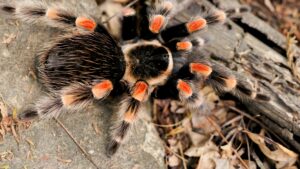
Pamphobeteus ornatus Pocock, 1903 is a large burrowing tarantula from Colombia, called the Colombian pinkbloom in the hobby and in the title of our film. Valid in the World Spider Catalog, it is one of 25 species of Pamphobeteus and is recorded from Colombia only.1 Below you find our field film of it, shot on a roadside embankment in southern Colombia, plus what the original description and the recent revisions say about the name.
Field footage from Colombia, filmed in December 2017 with a friend who knew the site. The location stays undisclosed.
What the film shows
From 1:36 the film switches to field footage from our first trip to Colombia in December 2017. Chris, a friend from Germany who had been to the country several times, came along. Having found a colony earlier, he showed it to us, and no searching was needed on our side. In the film we call that a pure gift.

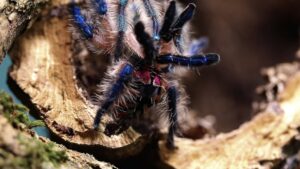
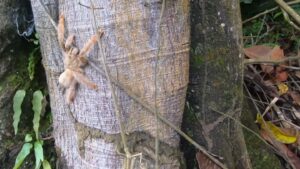
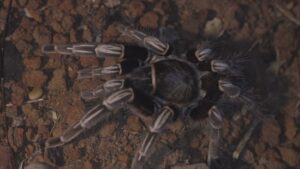
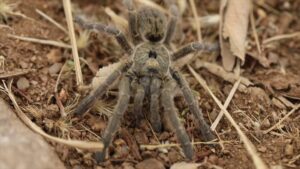
Walking along the roadside embankment, we checked it for burrow entrances. Five or ten minutes in, the first females showed up (at 3:36 in the film). Several animals followed, adult females and mature males, with males that differ completely from the females in colour. On screen are a brown spider with pink marks on the carapace and a dark one with violet-purple legs.
Coaxing the spiders out of their holes worked easily by day. Hungry animals fit the start of the rainy season in southern Colombia in December, when crickets and roaches become more active and food is plentiful. Night searches in Colombia are not fun.
Burrows, soil and temperature
The spiders use rodent burrows and dig their own as well. Twenty to thirty centimetres into the embankment, a burrow ends in a slightly wider chamber where the spider rests (at 5:35 in the film). Rain fell often and humidity was very high, yet the soil grew drier the deeper we went into the embankment, with only the top layer soaked.
Outside in the shade we measured 27 to 28 degrees Celsius. In direct sun, at a burrow entrance for instance, readings can pass 32 or 33 degrees. Inside the burrow, 22 to 23 degrees (at 6:45). One embankment on one trip does not make a range for the species. For comparison, the Ecuadorian P. skis lives under fallen logs, in cracks in the ground and in burrows probably dug by small mammals or large insects, with depths of 30 to 50 centimetres.4
The name and the pink bloom
Reginald Pocock described P. ornatus in 1903 from a single male from the Río Dagua in Colombia.2 Closely related to P. nigricolor and P. insignis, in his words, but with “a pinky-red bloom on the upperside”. His key to the males of the genus repeats the point as a “rosy-pink bloom” on the dorsal surface.2 Further characters were a more arcuate first protarsus, a shorter and more curved spine on the palpal organ, and a pad of feathery bristles on the palp trochanter.2
Today the holotype male sits in the Natural History Museum, London. Sherwood and colleagues redescribed it in 2022, measuring a total length of 61 millimetres including the chelicerae and describing the specimen as brown in alcohol.3 Their 2023 key separates P. ornatus by a short embolus that curves slightly in its apical third.4
Females and the Panama record
Less settled than the male is the female. Schmidt (2007) is credited with describing it in the World Spider Catalog, but Sherwood et al. (2022) call that identification dubious: a single illustration of the spermathecae, no text, no locality for the specimen.3 Panamanian records of the species they treat as erroneous.3 On that reading, the species rests on its type male and the female still lacks a reliable description. Our own part was small, as we say in the film: no research on the site, and the spiders a gift from Chris (at 7:55).
Range
Colombia is the only country the World Spider Catalog gives.1 Sherwood et al. (2022) place the species in the Chocó-Darién moist forests ecoregion.3 Where our colony lives stays unpublished, because poaching continues in Colombia, and the people meant to protect the habitat lack the resources to pay for that protection in the first place (at 5:11 in the film).
Diet
To our knowledge, no wild diet record for P. ornatus has been published, and the film shows no prey capture. The closest record belongs to another member of the genus: in Ecuador, an adult male of P. jamacoaque was seen preying on a juvenile snake, though the species mainly eats insects.4 What Do Tarantulas Eat? collects that record and others.
Related pages
Why colour alone does not name a tarantula is the subject of our page on the purple tarantula question, built around a nocturnal Xenesthis encounter in Colombia. A second Colombian film, a defensive Megaphobema robustum, is on its own page. Photographs of related genera are in the Theraphosinae gallery.
References
- World Spider Catalog (2026). Pamphobeteus ornatus Pocock, 1903; species list of Pamphobeteus Pocock, 1901. Natural History Museum Bern. Accessed 1 October 2026.
- Pocock, R. I. (1903). On some genera and species of South-American Aviculariidae. Annals and Magazine of Natural History (7) 11(61): 81-115 (P. ornatus p. 92). doi:10.1080/00222930308678729
- Sherwood, D., Gabriel, R., Brescovit, A. D. & Lucas, S. M. (2022). On the species of Pamphobeteus Pocock, 1901 deposited in the Natural History Museum, London, with redescriptions of type material, the first record of P. grandis Bertani, Fukushima & Silva, 2008 from Peru, and the description of four new species. Arachnology 19(3): 650-674 (pp. 651, 666-667, 671). doi:10.13156/arac.2022.19.3.650
- Sherwood, D., Gabriel, R., Peñaherrera-R., P., León-E., R. J., Cisneros-Heredia, D. F., Brescovit, A. D. & Lucas, S. M. (2023). Pamphobeteus Pocock, 1901: redescriptions, new species and records, description of a missing sex, with taxonomic notes and changes in Megaphobema Pocock, 1901 (Araneae: Theraphosidae). Arachnology 19(6): 894-930 (pp. 896, 903, 910-911). doi:10.13156/arac.2023.19.6.894
Explore this site
For the wider picture, see the Theraphosidae overview and the Tarantula Gallery.