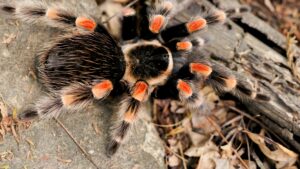
Pelinobius muticus is the king baboon spider, an East African tarantula that reaches Kenya and Tanzania.[1] Hobbyists also call it the king baboon tarantula. It is the only species in its genus, and for most of the twentieth century it was filed under another name, Citharischius crawshayi.[1][2] Our film below shows the spider and explains why it hisses before it bites.
Which names does the king baboon spider go by?
- Pelinobius muticus Karsch, 1885: the accepted name in the World Spider Catalog.[1]
- King baboon spider, king baboon tarantula: the common names. Neither is a scientific name.
- Citharischius crawshayi Pocock, 1900: the old name. Pocock described the genus and the species from a female collected in Kenya.[2] Old pet-trade labels and older books still use it.
The change came in 2010. Richard Gallon examined the type material and found that Citharischius had been named for the same animal that Karsch described in 1885, so the older genus name Pelinobius takes priority.[2] Three more names that had been placed in Phoneyusa (gregorii, bettoni and rufa) went into the same synonymy.[1][2] Before that, Raven had treated Pelinobius as a junior synonym of Phoneyusa, which Gallon reversed.[2] One accepted species is left in the genus today.[1]
What does Pelinobius muticus look like?

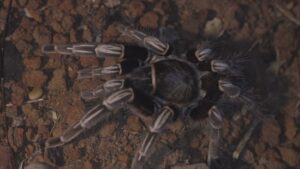
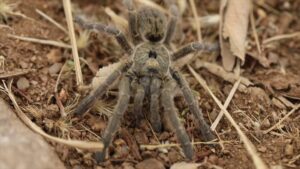
The hind legs give it away. Gallon singles out the female’s stout, velvety hind legs with turned-in tarsi as the feature that separates it from every other African theraphosid, and says the turned-in tarsi are not marked in immatures.[2] In the film we say the same thing in plainer words: leg four is massive, and up close the foot looks like a dog’s paw. We also say it grows nearly as large as the Goliath birdeater, though the film gives no measurement. The types are reddish-brown, and the labium (the plate behind the mouthparts) is long and sub-conical, which Gallon gives as further distinction from all other Eumenophorinae.[2]

Where does it live?
The World Spider Catalog gives Kenya and Tanzania.[1] Karsch’s male holotype came from Tanzania, and the other name-bearing specimens in Gallon’s synonymy came from Kenya.[2] The film opens by asking whether the species comes from Tanzania. This page says nothing more precise than the two countries.
Why does the king baboon tarantula hiss?
The spider rubs bristles together, and Gallon’s diagnosis lists stridulatory setae on the coxae and trochanters, between the palp and leg I and between legs I and II, and uses them to separate Pelinobius from other African subfamilies and from Mascaraneus.[2] In the film we point to the hiss coming from between the first two pairs of legs. Other tarantulas have the organs in different places: on the chelicerae and the palp, for instance. We also explain that the structures differ in shape from group to group. Poecilotheria has thorn-like ones, and Harpactira has a velcro-like surface, which changes the sound. Tarantulas have no ears; they pick up sound and vibration through hairs on their legs, more on that in how tarantulas sense the world.
As a warning, the hiss comes first. In the film we say that the spider can defend itself with a bite, that it has venom and that the venom is not mild for mammals, humans included. The hiss gives a predator a reason to leave it alone first. For the wider picture on tarantula venom and defence, see our page on whether tarantulas are poisonous.
Our film: the king baboon tarantula that makes sound
Our science update on Pelinobius muticus is on YouTube: Tarantulas Makes Sound! King Baboon Tarantula Painful Venom.[3] The same film is embedded on our page on whether tarantulas are poisonous, and the timestamps below open it at the matching point on YouTube.
- 0:00: we introduce the species, its old name Citharischius crawshayi and its massive hind legs.
- 0:42: the defence sequence: the bite is a real possibility, and the hiss comes before it.
- 1:21: we ask which other tarantulas stridulate, and which genera cannot.
- 2:43: we walk through two published experiments in which researchers stopped spiders from stridulating.
- 4:50: the different types of stridulation organ across tarantulas, and the position of this species’ organs between legs I and II.
Where does it sit among the African baboon spiders?
Pelinobius belongs to the subfamily Eumenophorinae, a group Gallon places it in and that the 2018 phylogeny of Lüddecke and colleagues lists for western and eastern Africa, Madagascar, Yemen and the Indian Ocean islands.[2][4] It is a different group from the Harpactirinae, the central and southern African subfamily that holds Harpactira and Ceratogyrus.[2][4] “Baboon spider” therefore covers animals from two different subfamilies. For a close relative in the same subfamily, see our page on Monocentropus balfouri. For the other African baboon spiders, see Ceratogyrus, the horned baboon tarantulas, Harpactira pulchripes and our Theraphosidae overview. All the Eumenophorinae we cover sit on the Eumenophorinae gallery page.
References
- World Spider Catalog (2026), Pelinobius Karsch, 1885 and Pelinobius muticus Karsch, 1885. Natural History Museum Bern.
- Gallon, R. C. (2010). On some Southern African Harpactirinae, with notes on the eumenophorines Pelinobius muticus Karsch, 1885 and Monocentropella Strand, 1907 (Araneae, Theraphosidae). Bulletin of the British Arachnological Society 15(2): 29–48.
- birdspidersCH (2021). Tarantulas Makes Sound! King Baboon Tarantula Painful Venom. YouTube.
- Lüddecke, T., Krehenwinkel, H., Canning, G., Glaw, F., Longhorne, S. J., Tänzler, R., Wendt, I. & Vences, M. (2018). Discovering the silk road: nuclear and mitochondrial sequence data resolve the phylogenetic relationships among theraphosid spider subfamilies. Molecular Phylogenetics and Evolution 119: 63–70 (Table 1).
Related Images: