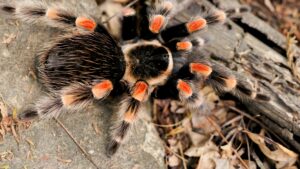
Tarantulas in Peru live from the lowland jungle to high Andean slopes. The altitude record for the whole family has been set twice in the Peruvian highlands, at 4,524 metres in 2018 and at 4,689 metres in 2021.[2][3] This page gathers nine of our field films from Peru about the highland genera Hapalotremus, Antikuna and Bistriopelma, and adds one older film on a Peruvian tarantula whose name has since changed. For wild burrows in general, see what wild burrows show.
Which tarantulas live in the Peruvian highlands?
Three genera run through our highland films. Country records and authorities follow the World Spider Catalog.[1]
- Hapalotremus Simon, 1903 has 15 species: ten recorded from Peru, three from Bolivia and two from Argentina.[1] Species range between about 1,300 and 4,500 metres, and the Argentine H. martinorum has its own article, finding Hapalotremus martinorum in Argentina.
- Antikuna Kaderka, Ferretti, West, Lüddecke & Hüsser, 2021 has seven species, all recorded from Peru, at altitudes between 3,836 and 4,689 metres.[1][3]
- Bistriopelma Kaderka, 2015 has six species, all recorded from Peru. Kaderka described the genus in 2015 with two species.[1][4]
How the three genera differ
When Antikuna was described in 2021, two features set it apart from its neighbours. Antikuna has one patch of urticating hairs on the abdomen, while Bistriopelma has two lateral patches.[3] Female Antikuna have spermathecae in two parts, while female Hapalotremus have a single oval receptacle.[3][6] In the field we only have the animal’s looks, and a feature such as a swollen tibia sometimes shows up only later, in the photographs.
What the highlands look like
In the first film the spiders sit under rocks about fifty times their own size. At the first site the morning air was 8 to 10 degrees Celsius, and under the rocks it was still 11 to 12 degrees. Low shrubs and Peruvian feather grass break the wind. The papers describe a similar pattern: Hapalotremus are found under rocks or among fallen logs, where they make short burrows.[2] Antikuna shelter in burrows or old rodent tunnels beneath angular rocks, with several life stages under one rock.[3] At one Antikuna site the authors also note grazing sheep and farm plots.[3]
My part in the papers
I am the third author of the 2021 Antikuna paper, which also credits me with the distribution map.[3] The World Spider Catalog lists Antikuna cimrmani and Antikuna cyanofemur as Kaderka, Ferretti & Hüsser, 2021, so I am a co-author of both.[1] Hapalotremus martinorum is a different case. Cavallo & Ferretti described it in 2015 from northern Argentina, and the name honours Martin Gamache and me, both of whom took part in the discovery.[7] On that name I am the honouree, not the author.
Nine episodes, six embedded here
All the films below except the last show wild animals in the field in Peru; the last, the 2019 cobalt red rump film, is about a captive animal. Three of them are embedded on the pages linked beneath their summaries. We filmed these episodes on trips to Peru in 2021 and 2023. The first five came out between January and July 2022 and the last four in late 2024, and they run here in that order.
Days one and two: Hapalotremus at 4,000 metres
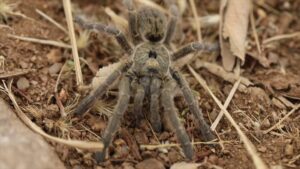
We flew to Lima, then on to Cusco, and drove up the first hill we could find. The first tarantula of the trip sat under a big rock beside Peruvian feather grass, and although the locality made Hapalotremus major and H. kaderkai both possible candidates, we could not say which species it was. The next morning, at about 4,200 metres, we found an adult and a juvenile Hapalotremus under a huge rock. We were not sure of the species when we filmed it, and we took nothing but photographs; the film closes on the thought that we may have been the first to see a new species in the wild.

Day three: down the slope east of Cusco
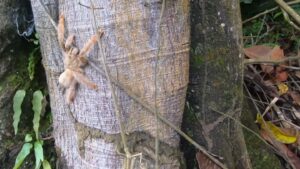
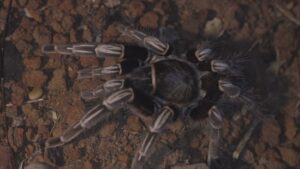
On the third day we descend into lower country east of Cusco, an area known for its tarantula fauna, and look for a black tarantula with red hairs on the abdomen. Along the way the film explains how highland tarantulas live, and it ends with the plan to climb back into the high Andes.

From the lowland jungle to the highlands and back
This episode follows the trip from the lowland jungle up into the highlands and down again. Chapters stop at juvenile colouration and close on remarkable colouration. Throughout, the focus is Hapalotremus and its close relatives from the Peruvian highlands, a group that had been well studied in the five years before the film. Watch it on our Hapalotremus martinorum page.
Four species without a name
In one episode we show four different tarantulas, none of which had a scientific name when the film was made. Each was undescribed and new to science. Finding them took weeks and months of preparation. Filming them in their native habitat is our way to raise awareness of animals that are mostly misunderstood.
A new genus on video
These small tarantulas from the Andes live under the protection of dull brown grass and ancient rocks. We documented a new species and a new genus, the first time such animals were filmed. Watch it on our Antikuna cimrmani page.
3,000 to 4,000 metres: Antikuna and Hapalotremus
At 3,000 to 4,000 metres we look under rocks for Antikuna and Hapalotremus, visit the type site of Antikuna cernickai, and find at least six animals there. Each rock shelters its own small microclimate. Farming and environmental degradation in the same landscape get their own share of the film.

Antikuna cyanofemur and an undescribed relative in one valley
Field footage from Peru: a search on the dry side of a valley, with a juvenile and an adult female that are both purple with red hairs. The film shows two kinds of Antikuna: A. cyanofemur and a dark blue-violet species that science has not yet described. Dry and moist habitats of one valley are set against each other.

Blue and red at altitude (short)
A short clip on the highland Antikuna of Peru: juveniles in every stage, from freshly hatched nymphs on, and why taking them from the wild would be a loss.
Antikuna cyanofemur and its highland relatives
This film introduces Antikuna, a genus named from the Quechua word for the Andes, through A. cyanofemur. We show its urticating hairs and its shallow burrows under rocks in snowfall, with adult females, juveniles and freshly hatched spiderlings. Highland tarantulas like Antikuna, we say plainly, are unsuited for captivity. Watch it on our page about wild burrows.
How the names have moved
Peruvian tarantula names have changed quickly, with new genera in 2015, 2021 and 2025. One of our older films carries a label the catalogue no longer uses.
- 2015: Bistriopelma was described with two species.[4]
- 2018: a revision of Hapalotremus described seven new species, counted ten valid species and reported the 4,524 metre record.[2]
- 2021: Antikuna was described with seven species and set a new record of 4,689 metres.[3] Four more Hapalotremus species from Peru and Bolivia followed the same year.[5]
- 2025: Hapalotremus munaycha from central Peru brought the genus to 15 species.[6] In the same year Thrixopelma cyaneolum moved to the new genus Ewok.[8]
Thrixopelma cyaneolum is now Ewok cyaneolus
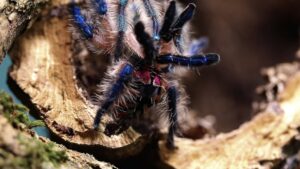
In 2019 we published a film about keeping a captive cobalt red rump tarantula from Peru under the name Thrixopelma cyaneolum. The World Spider Catalog now lists it as Ewok cyaneolus, and Thrixopelma keeps species such as T. ockerti and T. choquequirao from Peru.[1][8]
More on Peruvian and Andean tarantulas
The field article on Antikuna cimrmani describes the tunnels and the crowded patch of rocks in detail. The Chilean side of the Andes is on Chilean tarantulas in the wild, and where do tarantulas live puts both in a world context. For the family as a whole, see the Theraphosidae overview.
References
- World Spider Catalog (2026), genus pages for Hapalotremus, Antikuna, Bistriopelma, Thrixopelma and Ewok. Natural History Museum Bern.
- Ferretti, N., Cavallo, P., Chaparro, J. C., Ríos-Tamayo, D., Seimon, T. A. & West, R. (2018). The Neotropical genus Hapalotremus Simon, 1903 (Araneae: Theraphosidae), with the description of seven new species and the highest altitude record for the family. Journal of Natural History 52(29–30): 1927–1984. doi:10.1080/00222933.2018.1506521
- Kaderka, R., Ferretti, N., Hüsser, M., Lüddecke, T. & West, R. (2021). Antikuna, a new genus with seven new species from Peru (Araneae: Theraphosidae: Theraphosinae) and the highest altitude record for the family. Journal of Natural History 55(21–22): 1335–1402. doi:10.1080/00222933.2021.1936680
- Kaderka, R. (2015). Bistriopelma, a new genus with two new species from Peru (Araneae: Theraphosidae: Theraphosinae). Revista peruana de biología 22(3): 275–288. doi:10.15381/rpb.v22i3.11432
- Sherwood, D., Ferretti, N. E., Gabriel, R. & West, R. C. (2021). Redescription of the theraphosine Hapalotremus albipes Simon, 1903 and description of four new species of Hapalotremus Simon, 1903 from Peru and Bolivia (Araneae: Theraphosidae). Arachnology 18(9): 965–989.
- Ferretti, N., Chaparro, J. C., Ochoa, J. A. & West, R. (2025). Phylogeny of the high-altitude tarantulas Hapalotremus Simon, 1903 with the description of a new species. Insect Systematics & Evolution 56(1): 90–110. doi:10.1163/1876312x-bja10068
- Cavallo, P. & Ferretti, N. E. (2015). The first Hapalotremus from Argentina: description and natural history of Hapalotremus martinorum sp. nov. Journal of Natural History 49(15–16): 873–887. doi:10.1080/00222933.2014.953226
- Sherwood, D., Gabriel, R., Peñaherrera-R., P., León-E., R. J., Rollard, C., Leguin, E.-A., Brescovit, A. D. & Lucas, S. M. (2025). On the identity of some taxa in the tarantula tribe Hapalopini, with two synonymies, and description of four new genera and three new species (Araneae: Theraphosidae). ZooNova 46: 1–23.