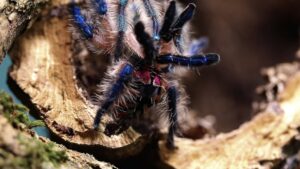
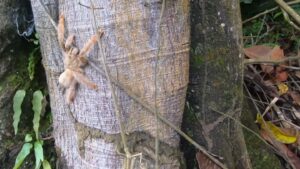
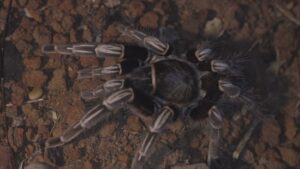
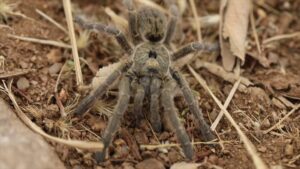
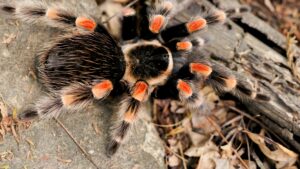
Phrixotrichus is a small genus of big, hairy tarantulas from southern South America. The name is a tongue-breaker, and the genus has a history to match: it was named in 1889, folded into Euathlus in the 1990s and revalidated in 2014. The World Spider Catalog now lists four species, three of them in Chile. In 2018 we went looking for them in the cool forests of southern Chile and made three films, all below.
What defines Phrixotrichus?
Two separate patches of urticating hairs on the sides of the abdomen define the genus. Euathlus, its sister genus, has a single patch.[2] In the second film you can see the two dark dots on the abdomen of spiderlings. The 2024 review of Chilean tarantulas describes the genus as medium-sized, 5 to 6 cm in body length, with a black carapace covered in pink, whitish or yellowish hairs, black legs with long yellowish or orange hairs, and a small tuft of reddish hairs at the base of the abdomen.[6] In the second film we put the leg span of a male at 18 to 20 centimetres, far more than a male Grammostola.
Whether two patches of hair justify a genus of their own, or whether these spiders will end up back in Euathlus, is an open question, as we say in that film.
How did the genus get resurrected in 2014?
- 1880 and 1889: Karsch described Orthothrichus vulpinus. The name Orthothrichus was already taken by a beetle, so Simon replaced it with Phrixotrichus in 1889.[1]
- 1996: Schmidt moved the species into Euathlus, where it stayed as Euathlus vulpinus until 2014.[1]
- 2010: Perafán and Pérez-Miles showed that Ashantia latithorax Strand, 1908 is a junior synonym of vulpinus. Its type locality was given as Ghana, which they judged wrong, because the spider carries urticating hairs and those occur only in New World tarantulas.[3]
- 2014: the same authors revalidated Phrixotrichus as the sister genus of Euathlus, and described P. jara in the same paper.[2]
- 2022: the subspecies P. vulpinus ater Donoso, 1957 became a nomen dubium. The type is lost and the museum specimens filed under it turned out to be Euathlus truculentus.[4] We mention in the first film that nobody has seen this subspecies since it was described.
Which species are in Phrixotrichus?
- Phrixotrichus vulpinus (Karsch, 1880): Chile and Argentina. In Chile it is the southernmost tarantula, recorded in the Los Ríos region and probably also in Los Lagos. Ferretti’s 2015 paper gave the first record for Argentina. Hobbyists know it as the Chilean ocelot tarantula.[1][5][6][7]
- Phrixotrichus scrofa (Molina, 1782): Chile and Argentina. In Chile the 2024 review places it only in the coastal forests of the Biobío region. Adults wander the forest floor and climb tree trunks.[1][6]
- Phrixotrichus jara Perafán & Pérez-Miles, 2014: Chile, endemic. It was described from a single male and the 2024 review still knows it only from its type locality.[1][6]
- Phrixotrichus pucara Ferretti, 2015: Argentina. Ferretti described it from a male from Neuquén province.[1][7]
Chile’s environment ministry classes P. vulpinus and P. scrofa as Endangered, and the 2024 review notes that P. vulpinus is included in the 2015 Hunting Law.[6]
Where do these tarantulas live?
The climate of their Chilean range is rainy, with rain through the year. In many places the native forest has been replaced by farmland and plantations. Winter snow keeps P. vulpinus shut in for several months, and the genus is often seen climbing tree trunks.[6]

In our films the setting is the south of Chile, in and around pine forest. The first episode opens on a cool autumn day, with 12 to 13 degrees Celsius in the daytime and about 5 at night. In the second film we found the spiders in the open. Females sat beside silk retreats built into a tuft of grass and into a roadside bank, in the early afternoon and in full sun, with no log or rock over them. We say that we only found these tarantulas outside their retreats, and that a retreat with the egg sac built in was something we had otherwise seen only from Avicularia in South America.
Three films from southern Chile

Why This Red Tarantula is so Special!
Field footage from southern Chile, 2018. This is the first of two parts, and we have not found the spider yet. We introduce the genus and the cool pine forest we are searching, then go through its history: the move into Euathlus, the revalidation in 2014 and the lost subspecies, from 3:53 in the film. The episode ends at a bank with a burrow and what looks like a freshly hatched egg sac, at 5:22, which tells us we are on the right track.
Why Tarantulas Are Lovely Creatures | Phrixotrichus vulpinus
Field footage from southern Chile, 2018. Here the search pays off. We find an adult male at 1:31 and talk about its size and its docility, then adult females at open retreats, a silk retreat full of recently hatched spiderlings and a female in threat posture, fangs spread. Between these scenes we talk through the taxonomy of the genus. Then we put a male and a female together, the male starts drumming (from 13:30), and the pair mates. We end the episode with every life stage on film.
Harvestman & Tarantulas! Sympatric Tarantula Species in Chile
Field footage from a national park in southern Chile, about 1,000 metres above sea level, 2018. We find an adult male Euathlus crossing the road and a juvenile under a rock, then a Phrixotrichus in the same park (from 2:22). Two tarantulas from two genera share the area, and we guess that one lives under stones while the other digs burrows. A spiny, colourful harvestman turns up on the way, and the episode closes on an old adult male Phrixotrichus (at 9:04).
Which species are in our films?
The films call the animals Phrixotrichus vulpinus, and in the second one we call the first adult male “vulpinus or jara”. P. jara is known from a single male, so a description of its female may settle which name fits. Until then we keep the films at genus level: Phrixotrichus from southern Chile.
What happened when friends tried to keep them
In the second film we call P. vulpinus extremely docile, and a great tarantula for the hobby on paper. We also say that, as far as we know, nobody has bred it successfully. Two reports from friends give the picture. One friend, a dealer in Canada, imported quite a few in the past, and none lived for long. Another, in Switzerland, mated an adult pair, but both died a few months later. As we put it in the film, nobody really knows what the species needs to survive, and the best thing is probably to leave them in the forest.
More on Chilean tarantulas
The rest of the series is on the hub page, tarantulas of Chile in the wild. The small red and black tarantula from the same country has its own page, Homoeomma chilense. The Chilean species most people know is the rose hair: rose hair tarantula, what Grammostola rosea means.
References
- World Spider Catalog (2026), genus page Phrixotrichus. Natural History Museum Bern.
- Perafán, C. & Pérez-Miles, F. (2014). The Andean tarantulas Euathlus Ausserer, 1875, Paraphysa Simon, 1892 and Phrixotrichus Simon, 1889 (Araneae: Theraphosidae): phylogenetic analysis, genera redefinition and new species descriptions. Journal of Natural History 48(39–40): 2389–2418. doi:10.1080/00222933.2014.902142
- Perafán, C. & Pérez-Miles, F. (2010). Euathlus latithorax (Strand, 1908) is a synonym of E. vulpinus (Karsch, 1880) (Araneae, Theraphosidae, Theraphosinae). Bulletin of the British Arachnological Society 15(2): 49–51.
- Aguilera, M. A., Montenegro, R. & Casanueva, M. E. (2022). Revised taxonomic placement and distribution update of Grammostola Simon, 1892, Phrixotrichus Simon, 1889 and Thrixopelma Schmidt, 1994 species, a chaotic history of Chilean tarantulas (Araneae, Theraphosidae). Revista Ibérica de Aracnología 40: 63–71.
- iNaturalist taxon page, Phrixotrichus vulpinus (common name: Chilean Ocelot Tarantula).
- Montenegro V., R. & Aguilera, M. A. (2024). Tarántulas chilenas de la subfamilia Theraphosinae (Mygalomorphae: Theraphosidae): una revisión a nivel de género. Revista Chilena de Entomología 50(2): 329–352. doi:10.35249/rche.50.2.24.16
- Ferretti, N. (2015). A new species of Phrixotrichus (Araneae, Theraphosidae) from southwestern Argentina and new distributional data for P. vulpinus. Iheringia, Série Zoologia 105(2): 252–256. doi:10.1590/1678-476620151052252256