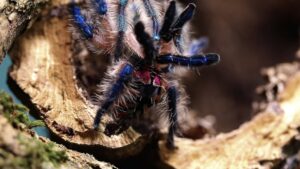
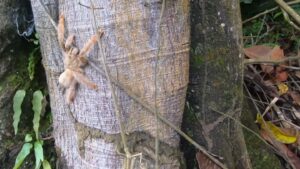
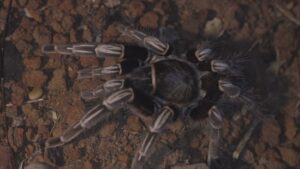
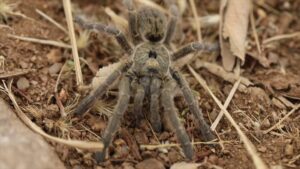
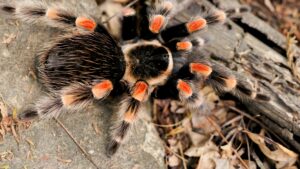
Poecilotheria subfusca Pocock, 1895 is a small, dark ornamental tarantula that lives in the trees of Sri Lanka. Hobbyists often call it the Ivory Ornamental. The World Spider Catalog lists it as a valid species with a distribution of Sri Lanka only.1 This page follows one field film of it from Sri Lanka’s central highlands and adds the naming history behind it.
Field footage from Sri Lanka: a search for Poecilotheria subfusca in a highland park, ending with an adult male, sub-adults and a freshly moulted adult female.
What the film shows
The search starts at around 1,900 metres above sea level, in air of 20 to 23 degrees in the sun (0:07). The spiders also occur in the rainforest nearby, but much of that forest is a protected zone that cannot be entered without permission, so the search goes to a public park with many trees.

At 1:42 the first animal appears, an adult male. He is brown with a few yellow stripes on the legs, quite unlike the pale-looking females. Earlier in the day other spiders had been located, but they could not be coaxed out of their holes. The second spider sits in a cypress tree (5:26). Cypresses are not native to Sri Lanka, yet the spiders use them, apparently because of the many holes in the trunks. Sub-adult males lack the vivid colours they will show after maturity.
Inside a hole about 20 centimetres deep in a trunk, a thermometer reads 17.2 degrees. The last animal is a freshly moulted adult female with a pink-purple sheen on the femora and yellow lines across the legs (9:25). In total, six spiders were found in the park and three were coaxed out of shallow holes. It was our first adult female seen in the wild.
The Sri Lankan highlands and more of the ivory ornamental start at 2:49 in Top 3 Most Endangered Old World Tarantulas (field footage).
Highland and lowland: one name, two spiders in the hobby
In the hobby the name P. subfusca is used for two kinds of spider, a small “highland” form and a larger “lowland” form, and some keepers call the lowland one P. bara (film, 2:52). The film argues that these are different animals living in different habitats, and asks whether the highland spider in the film really is the species Pocock described. That is a field observation and an open question, not a taxonomic ruling. Gabriel, Gallon and Smith (2013) examined the holotype of P. bara and listed a captive-bred lowland-form female among their P. subfusca material.5 In the World Spider Catalog there is one accepted P. subfusca.1
According to Smith (2006), P. subfusca is one of two montane species of the genus, from the central highlands of Sri Lanka, grouped with the Indian P. rufilata.4
Name, authority and synonyms
Reginald Pocock described the species in 1895 from male and female specimens.1,2 He noted that the British Museum held thirteen specimens from Ceylon and that it seemed the commonest of the genus.2 Four years on, he separated it from P. fasciata by the underside of the legs: the femora are banded black and yellow in P. fasciata, but a uniform chocolate-brown in P. subfusca.3
Two later names now sit under P. subfusca. P. bara Chamberlin, 1917 was placed in synonymy by Kirk in 1996. P. uniformis Strand, 1913 was added by Gabriel, Gallon and Smith in 2013 after they examined the type specimens and found the same abdominal pattern and palp tubercles as in P. subfusca.5 The World Spider Catalog lists both names under the species.1
Identification
In Pocock’s key, P. subfusca stands apart from the other early species by femora that are brown or black beneath and not striped, fine whitish lines radiating from the fovea on the carapace, and a tubercle on the palp coxa lying in the middle of the line of keys.2 Smith (2006) adds that the two montane species carry two to five tubercles on the maxilla, set midway along the stridulating organ.4 In older females the dark side stripes on the abdomen fade and the central folium shrinks with age.5

Range and trade
The World Spider Catalog gives Sri Lanka as the only country of record and notes that trade is restricted by CITES.1

Venom
Published venom and bite research on Poecilotheria covers several species: a mouse toxicity study of nine Poecilotheria species,6 a series of 17 bite patients in Sri Lanka,7 and single case reports such as a bite by P. tigrinawesseli.8 The Sri Lankan series identifies the spiders only as Poecilotheria species, so it says nothing specific about P. subfusca. The symptoms, the research and the sources are covered in Are Tarantulas Poisonous?
Related species
Photographs of the other Poecilotheria species are in the Poecilotheriinae gallery, with the list of accepted species and their countries. A species page for the Indian P. formosa is in preparation.
References
- World Spider Catalog (2026). Poecilotheria subfusca Pocock, 1895. Natural History Museum Bern. Accessed 1 October 2026.
- Pocock, R. I. (1895). On a new and natural grouping of some of the Oriental genera of Mygalomorphae, with descriptions of new genera and species. Annals and Magazine of Natural History (6) 15(86): 165-184, pl. 10 (Poecilotheria synopsis p. 171). doi:10.1080/00222939508677863
- Pocock, R. I. (1899). The genus Poecilotheria: its habits, history and species. Annals and Magazine of Natural History (7) 3(13): 82-96, pl. 7 (p. 87). doi:10.1080/00222939908678082
- Smith, A. M. (2006). A new species of Poecilotheria from northern peninsular India (Araneae, Mygalomorphae, Theraphosidae) with notes on its distribution and conservation status. Journal of the British Tarantula Society 21(3): 83-94 (p. 85).
- Gabriel, R., Gallon, R. & Smith, A. (2013). The revised taxonomical status of some Poecilotheria species Simon 1885 (Araneae: Theraphosidae). Journal of the British Tarantula Society 28(3): 103-110 (pp. 103, 106-108).
- Andreev-Andrievskiy, A., Popova, A., Lagereva, E., Osipov, D., Berkut, A., Grishin, E. & Vassilevski, A. (2017). Pharmacological analysis of Poecilotheria spider venoms in mice provides clues for human treatment. Toxicon 138: 59-67. doi:10.1016/j.toxicon.2017.08.013
- Rathnayaka, R. M. M. K. N. & Ranathunga, P. E. A. N. (2025). Clinico-epidemiology of tarantula (Poecilotheria spp.) bites in Sri Lanka. Clinical Toxicology 63: 112-114. doi:10.1080/15563650.2024.2446555
- Alsultan, R., Brody, J., Hurst, N., Welch, S. & Shirazi, M. (2023). Wessel’s tiger ornamental tarantula bite envenomation: a case report and venom analysis. Toxicon 223: 107013. doi:10.1016/j.toxicon.2022.107013
Explore this site
For the wider picture, see the Theraphosidae overview and the Tarantula Gallery.