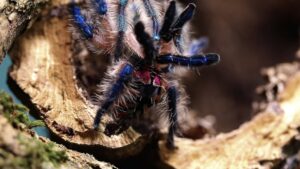
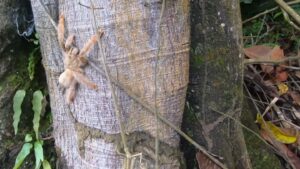
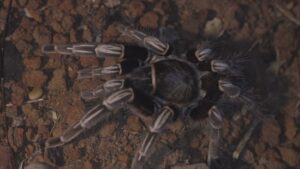
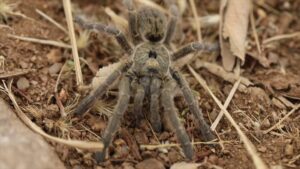
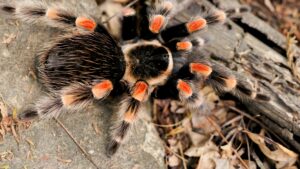
Psalmopoeus emeraldus Pocock, 1903 is an arboreal tarantula from Colombia whose name rests on a single dried museum specimen. The World Spider Catalog accepts the name and gives Colombia as the only country.1 In our film from Colombia we photograph a living adult female and say it looks very similar to P. pulcher from Panama, the hobby’s “Panama blonde” (1:53). Below you find what the film shows, what the papers say about both names, and a third species, P. drolshageni, described in 2025 from Costa Rica.

What the film shows
The spider was a gift. A friend gave us the record, and we could photograph this one animal. It had been through a lot. Several legs were missing, and the specimen had “quite some fights in the past” (at 1:46 in the film). It was an adult female, and we were delighted to see her. For the friend it was a first Psalmopoeus.
Arboreal tarantulas are hard to find. Psalmopoeus webs a lot, so the silk should at least be easy to spot, but most of the time you cannot tickle the spider out. Later in the film we searched the trees of a village garden for more of them and found no sign of any (at 7:11). More on silk and tree retreats is on our page Do Tarantulas Make Webs?, and our Trinidad Chevron Tarantula page covers the type species of the genus in the field.
A name that rests on a dried specimen
Reginald Pocock described P. emeraldus in 1903 from the emerald mines of Boyacá, Colombia, which is why the species carries that name (at 3:19 in the film). His animal was a dry specimen of 28 millimetres, “a tolerably uniform deep olive-brown above, sooty black below”, and its stridulating bristles were not set apart from the oral fringe.2 Our animal was not at the exact type locality but in close range of it.
The type has not aged well. Gabriel and Sherwood (2019) found the holotype badly fragmented, with an emptied abdomen and the sex organs missing, so they could not confirm it was a female at all. It might be a subadult male.3 Because the specimen has no distinctive features, they listed P. emeraldus as a species inquirenda, a name of doubtful identity.3 A publication that treats the species as inquirenda appeared as we returned from the trip (at 2:33 in the film).
Since then Cifuentes and Bertani (2022) have kept the name. They treat P. emeraldus as valid until more specimens appear, citing an immature spider in a Colombian university collection from the neighbouring department of Santander with the same stridulatory organ, and note that no mature specimens are available.4 Mature animals from the type locality region, they write, may confirm whether the species is valid.4 More specimens would let us help the researcher working on the question.
The Panama blonde, Psalmopoeus pulcher
Alexander Petrunkevitch described P. pulcher in 1925 from a male from the Panama Canal Zone.1,4 The hobby name “Panama blonde” fits its colour. Gabriel and Sherwood (2018) separate the species from congeners living alongside it by its overall beige or blonde pubescence, and describe adult females with an almost entirely beige abdomen, black hairs only towards the rear and a stripe down the middle.5 Adult males are grizzled grey-beige.5 They also describe the species as extremely opportunistic and arboreal, with specimens collected in and around houses.5

That description fits the pale abdomen on screen, but a colour match proves little. Cifuentes and Bertani (2022) tell P. pulcher females apart by the abdominal pattern and by the shape of the spermathecae, the internal sperm-storage organs.4 The emeraldus holotype has neither an abdomen to check nor spermathecae to compare.3 The published description of the type gives no character that would separate the two.
One more fact changes the picture. In the film pulcher is the species from Panama (3:06), and the first description is indeed from Panama. But the World Spider Catalog now lists Panama and Colombia for the species, and Cifuentes and Bertani examined P. pulcher specimens from five Colombian departments, among them a female from Boyacá, the department of the emeraldus type locality.1,4 A blonde Psalmopoeus in Colombia is therefore not automatically a new find. It could be P. pulcher, it could be P. emeraldus, or the two names could turn out to belong to one species.
In that last case the older name wins. P. emeraldus dates from 1903 and P. pulcher from 1925, 22 years later: if the two were ever combined, pulcher would fall. Cifuentes and Bertani also suspect that P. pulcher may be a junior synonym of P. plantaris Pocock, 1903, whose type is a dry, possibly female, specimen from Cauca, Colombia; they keep plantaris valid until more material from Cauca turns up.4 Until then, I keep calling the spider P. emeraldus, because it is not a pulcher from Panama (at 4:34).
Three species side by side
| Species | Described | World Spider Catalog range | Type material |
|---|---|---|---|
| P. emeraldus | Pocock, 1903 | Colombia | One dry holotype in London, supposedly a female1,3 |
| P. pulcher | Petrunkevitch, 1925 | Panama, Colombia | Male holotype, Panama Canal Zone, in New York1,4 |
| P. drolshageni | Sherwood and colleagues, 2025 | Costa Rica | Male holotype and paratypes, Costa Rica, in San Francisco1,6 |
Psalmopoeus drolshageni and a genus that keeps splitting
The third name shows how much is moving in this genus. P. drolshageni was described in 2025 from spiders collected in the northern Caribbean lowlands of Costa Rica, the same animals that Cifuentes and Bertani had published as P. reduncus.6 It is named for Bastian Drolshagen of Karlsruhe, honoured for his work on mygalomorph taxonomy.6 So far it is known only from its type locality.6 Costa Rica’s other tarantulas are collected on our hub page Costa Rica Tarantulas in the Wild.
The same paper reinstated four species that Cifuentes and Bertani had folded into others, and the authors urge a phylogenomic study because Psalmopoeus, as it stands, might hold several distinct lineages.6 Cifuentes and Bertani counted 14 species in 2022.4 The World Spider Catalog now lists 20, among them P. pristirana from the Chocó region of Ecuador, described by Dupérré and Tapia in 2024.1,7
What makes a Psalmopoeus
The genus is defined by a sound-making organ. On the front face of the maxilla, the mouthpart next to the leg base, Psalmopoeus carries elongate bristles called lyra that rise from dark circular bases and are rubbed against the chelicera.3 Dupérré and Tapia (2024) describe them as thick bristles in a single row.7 At species level the organ is a poor guide. Gabriel and Sherwood found that the number of lyra varies between individuals and even between the left and right maxilla of one spider, so counts alone cannot name a species.3 That is one reason a damaged, dried type like the emeraldus holotype is so hard to place.
More from Colombia
Other Colombian tarantulas from our films have pages of their own: the burrowing Pamphobeteus ornatus and the dwarf Cyriocosmus leetzi. Photographs of related arboreal species are in the Psalmopoeinae gallery.
References
- World Spider Catalog (2026). Psalmopoeus emeraldus Pocock, 1903; P. pulcher Petrunkevitch, 1925; P. drolshageni Sherwood et al., 2025; species list of Psalmopoeus Pocock, 1895. Natural History Museum Bern. Accessed 1 October 2026.
- Pocock, R. I. (1903). On some genera and species of South-American Aviculariidae. Annals and Magazine of Natural History (7) 11(61): 81-115 (P. emeraldus p. 84). doi:10.1080/00222930308678729
- Gabriel, R. & Sherwood, D. (2019). The revised taxonomic placement of the three species of Psalmopoeus Pocock, 1895 described by R. I. Pocock in 1903 (Araneae: Theraphosidae). Arachnology 18(1): 40-46 (pp. 40-44). doi:10.13156/arac.2018.18.1.40
- Cifuentes, Y. & Bertani, R. (2022). Taxonomic revision and cladistic analysis of the tarantula genera Tapinauchenius Ausserer, 1871, Psalmopoeus Pocock, 1895, and Amazonius n. gen. (Theraphosidae, Psalmopoeinae). Zootaxa 5101(1): 1-123 (pp. 7, 81-83). doi:10.11646/zootaxa.5101.1.1
- Gabriel, R. & Sherwood, D. (2018). Re-description of the male of Psalmopoeus pulcher Petrunkevitch, 1925 with the first description of the female (Araneae: Theraphosidae). Journal of the British Tarantula Society 33(1): 8-18 (pp. 11-13).
- Peñaherrera-R., P., León-E., R. J., Guerrero-Campoverde, A., Falcón-Reibán, J. M., Fajardo-Torres, J. D., Picón-Rentería, P., Gabriel, R., Sherwood, D. & Cisneros-Heredia, D. F. (2025). Novel insights on Psalmopoeinae Samm & Schmidt, 2010 (Araneae: Theraphosidae): new species, taxonomic restorations, and reversal of four erroneous synonymies. Arachnology 20(3): 491-508 (pp. 491, 496-497, 506). doi:10.13156/arac.2024.20.3.18
- Dupérré, N. & Tapia, E. (2024). Description of a new Psalmopoeus Pocock, 1895 species (Araneae, Theraphosidae, Psalmopoeinae) from the Chocó region of Ecuador. Zootaxa 5437(4): 495-509 (pp. 495-496). doi:10.11646/zootaxa.5437.4.3
Explore this site
For the wider picture, see the Theraphosidae overview and the Tarantula Gallery.