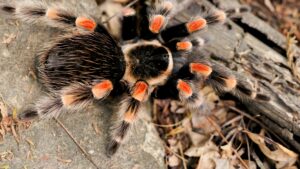
If you arrived looking for a pumpkin patch tarantula, this Colombian field record is relevant, with one important limit. Within hobby use, pumpkin patch is a trade term, not a scientific name. For this page, the photographed tarantula is held at Hapalopus sp. because the photograph does not show the reproductive structures used to identify Hapalopus guerreroi.

What pumpkin patch means in the hobby
Within hobby use, the expression helps people find a familiar group of animals. It is commonly applied to Hapalopus sp. Colombia “large” and Hapalopus sp. Colombia “small”. Those are hobby forms rather than described species, and neither label supplies a scientific name.
That distinction matters because a trade label may group animals that look familiar without recording the characters a taxonomist needs. It cannot identify the photographed spider as either hobby form or as H. guerreroi. Here, sp. records the supported genus while leaving the species open.
What the Colombian revision found
In their 2024 revision, Sherwood and colleagues redefined Hapalopus from examined material and included eight species in the genus. The paper describes three new Colombian species: H. guerreroi Benavides, Osorio, Sherwood, Gabriel, Peñaherrera-R., Hörweg, Brescovit & Lucas, 2024; H. platnicki Sherwood, Gabriel, Osorio, Benavides, Peñaherrera-R., Hörweg, Brescovit & Lucas, 2024; and H. vangoghi Osorio, Benavides, Sherwood, Gabriel, Peñaherrera-R., Hörweg, Brescovit & Lucas, 2024.1
The authors did not define the genus by colour alone. Their diagnosis combines the spotted or lined abdominal pattern with structures such as palpal-bulb keels, the cymbial apophysis, and one or two metatarsal pits. For females, the shape of the spermathecal receptacle also matters. That combination explains why the same genus can contain several patterned Colombian species that require closer examination to separate.
Among the new species, male H. platnicki has two prolateral accessory inferior keels and two metatarsal pits, while male H. guerreroi has one of each and triangular margins on its dorso-lateral abdominal lines. H. vangoghi was described from female material, whose circular spermathecal receptacle differs from the T-shaped one of H. guerreroi.1
H. guerreroi was described from a holotype male, CAUA_Ara0105, and a paratype female, CAUA_Ara0106, collected at Plan Bonito near Riohacha, La Guajira. The paper places both type specimens in the Colección de Artrópodos de la Universidad del Atlántico, Barranquilla. Its World Spider Catalog entry accepts the name, places Hapalopus in Theraphosidae, and gives Colombia as the distribution summary.12
How Hapalopus guerreroi is separated
For an adult male, the 2024 diagnosis names two apical keels on the palpal bulb, one metatarsal pit, no prolateral superior keel, a weakly developed keelar apophysis on the subapical keel, and one prolateral accessory inferior keel. It also notes triangular edges on the dorso-lateral abdominal lines. The female is distinguished by a T-shaped spermathecal receptacle and those triangular dorso-lateral lines.
The authors describe the preserved holotype male as light brown on the carapace with black setae, two yellow dorso-medial abdominal spots, a nearly continuous lateral line of fused spots, and yellow spots on the ventral surface. Yet the revision also cautions that spot colour varies before and after moulting, so yellow, orange, or red spots do not carry taxonomic value by themselves. Pattern can be part of a diagnosis, but it is read alongside the structures above.1
This photograph cannot test a female’s spermathecal receptacle or an adult male’s palpal bulb, and the source record does not provide the other diagnostic examination used in the paper. The photographed animal therefore remains Hapalopus sp. The open label is specific about what this record supports without assigning a hobby form or a species name.
Our Colombian field footage
Field footage from Colombia, 2019: in the film we search a roadside embankment and find a yellow-and-black Hapalopus, then two more tarantula species on the same day.
Nor does the catalogue establish that the animal in the video and the spider in the photograph are the same individual, the same species, or either hobby form. The field record provides Colombian context and footage; the revision supplies the characters against which a species claim would have to be tested.
A short clip of a dwarf Hapalopus species on the forest floor in Colombia.
Field photographs from the triseriatus complex
The photographs below come from our own Colombian field work. On the ground, the photographer places these animals in the Hapalopus triseriatus complex. Sherwood and colleagues recognise H. triseriatus as one of eight species in the genus, but it is a Venezuelan species from the Cordillera de Mérida, and they treat the Venezuelan species as disjunct from the Colombian taxa of their revision.1 That is a field assessment by the person who found them, not an examined identification, so the animals stay Hapalopus sp. here. What the pictures do show is why a single trade phrase sits awkwardly over this genus: several similar, strongly patterned Colombian spiders answer to pumpkin patch, and telling them apart needs the characters described in the revision rather than the pattern a camera records.


What would move the identification forward
A stronger record would retain the observation date, a suitably broad locality, life stage if known, and additional views without revealing a sensitive site. A mature specimen, retained molt, or specialist examination could make comparison with the published characters possible. Until then, this remains a documented Colombian Hapalopus encounter rather than a confirmed record of H. guerreroi.
Related Colombian field records
The linked Pseudhapalopus sp. “Yellow Blue” field record also keeps an informal name in quotation marks rather than presenting it as a species identification. It belongs here as Colombian field context, not as evidence that either animal is a pumpkin patch tarantula.
By contrast, the Aguapanela arvi field story near Medellin has a named species because its genus and species had already been described when we filmed it in Colombia. Both records remain useful when the label tells the reader whether the evidence reaches species level.
Notes from the field, by email
I send a short tarantula briefing by email, with field notes from our trips written for the newsletter when I have them, and once a month a roundup of new posts. It is free, and you can unsubscribe at any time.
Later, if you want to support the fieldwork and the films, I am also on Patreon.
References
- Sherwood, D., Gabriel, R., Osorio, L. M., Benavides, L. R., Peñaherrera-R., P., Hörweg, C., Brescovit, A. D. & Lucas, S. M. (2024). Spot the difference: on the genus Hapalopus in Colombia and a new related genus from Brazil and Bolivia. ZooNova 32: 1-44.
- World Spider Catalog: Hapalopus guerreroi.