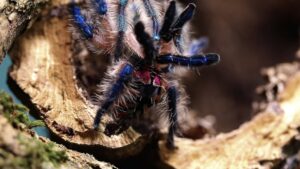
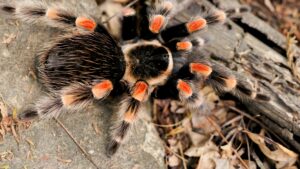
This is how we set up our own tarantula enclosures, told through three of our films from 2018 to 2020 and a tank tour from the end of 2019. This is how I keep them, and it is not a care sheet for every species. The films cover glass enclosures, a room of planted tanks, and how I keep mould (mold in US spelling) out of a tank.
Why we use glass enclosures
In Tarantula Glass Enclosures Are Actually Better (Here’s Why) (2020) I go through pros and cons while standing in front of my shelf of glass tanks. My first pro is the look: “You can’t really beat a nice glass enclosure” (at 0:14 in the film). Light is the second: much more of it passes through glass than through a plastic top. Third, a glass front is nearly escape-proof: the front opening is usually guillotine-like and a tarantula cannot lift it.
Durability is my fourth point. Glass cleans easily, and some of my glass enclosures have been in use for over 10 years and still look clean. The cons are weight, especially for big tanks made bioactive, so the shelf has to be built well, and breakage: glass breaks more easily than a plastic top, which matters with cats or small children around. Ventilation is the last con. Glass tanks usually come with it fixed, and one built for a terrestrial or fossorial species can seldom be used for an arboreal one (at 6:28).

In my opinion glass is the best design and style, and the more eco-friendly material than plastic made from oil. I invite viewers to debate that one. In Switzerland, glass enclosures are far cheaper than acrylic ones.
Glass is not my only material. I keep many tarantulas in plastic enclosures, especially young ones, and I use glass only for adults: “You need the right enclosure for the right spider and age of the spider.” Some breeding projects do better in plastic.
A room of planted tanks
We filmed the room in late 2019, while it was still being finished. In I Spent 3 Weeks Building 30 Bioactive Tarantula Enclosures I walk along the shelves. On the left, small glass tanks of 20 by 40 by 20 centimetres have been planted for several weeks, with plants covering almost the whole back wall. Leaf litter goes into every tank, because I like the look and because it helps “for the moisture in general and the micro climate”.
The sizes tell you what each shelf is for. Tanks of 30 by 40 by 40 centimetres on top are meant for the big arboreal species, and the large 60 by 40 by 40 tanks below hold a mix of plants, including a Monstera minima. Plants are quite affordable in Switzerland. Most tanks in this film were empty or still being decorated, and some were meant for other animals, such as a cockroach breeding tank and two snakes. I close by asking viewers which species I should add to the collection I am building.

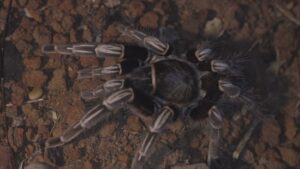
A month later, in our tank tour from Christmas Day 2019 (Huge Pet Tarantula & Bioactive Tank Tour!), the same kind of tank holds animals. Here an adult female Lasiodora klugi lives in a 60 by 40 by 40 centimetre tank with about 30 centimetres of substrate. She has plenty of soil to burrow in, but prefers to sit on the surface (at 1:20). On the ventilation of my tanks: looking from an angle you do not see any ventilation, “so that’s what I prefer”. You can watch the full tour on our Ewok tarantula page.

I keep the drainage layer out of my bioactive tanks. In 15 years I never had problems keeping tarantulas in bioactive enclosures without one, and the big tanks in the background of our Heteroscodra and Stromatopelma film have none (at 4:44). You can watch that film on our Do Tarantulas Make Webs? page.
How we keep mould out of an enclosure
The mould film dates from 2018. It opens with a plain claim: “Actually, it is very simple to not have any mold in your enclosure.” There are two main causes: too little ventilation and the wrong substrate.
Look at plastic boxes with only a top vent: with nothing on the bottom part of the enclosure, air cannot circulate. What I want is cross ventilation: an opening just above the substrate layer and another at the very top, so that fresh air comes in low, warms, rises and leaves through the lid (at 2:00). Top ventilation alone is not enough for a big tank.
A common belief is that high humidity is only possible with few ventilation holes. That is not right. A tank at “let’s say 80-90%” without circulation has air of very bad quality; a tank with good cross ventilation can reach the same humidity if you moisten it more or use live plants. Live plants are the “secret tip” I use myself.
My second tip is the substrate. Many tanks online use only coco fibre with plastic plants and a hide. “It is not bad, but it is not the ideal setting,” and to avoid mould you should change the substrate. Different species need different substrates and moisture. I want a living substrate that mimics the microclimate, not pure coco fibre without anything else.
Springtails are the “little helpers”. Porcelain woodlice, Trichorhina tomentosa, appear in an on-screen inset. Both clean up the bits of cricket or cockroach the tarantula does not eat and that you miss when cleaning, and they also eat fungi and mould (at 6:56). My reasoning against a sterile tank is that oven-baked soil is not sterile, and prey you add later brings bacteria and mould back with nothing in the soil to eat them. A closing on-screen card sums it up: use good ventilation together with living helpers that feed on bacteria and mould.
My example is a small container holding a Harpactira I got at a show. Its ventilation holes sit at the bottom just above the soil, and on the opposite side higher up, and I added helpers too. For what captive tarantulas eat, see What Do Tarantulas Eat?
Why arboreal and fossorial set-ups look different
In our own shelves the difference follows the animals. The upper shelf of the tank tour holds the big arboreal species, with smaller tanks fitted out for arboreal animals beside them (at 5:16). In the room tour the 30 by 40 by 40 centimetre tanks on top are for the big arboreal species. My remark about glass ventilation follows the same logic: a tank for a fossorial or terrestrial species rarely suits an arboreal one.

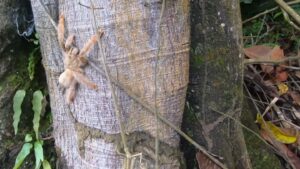
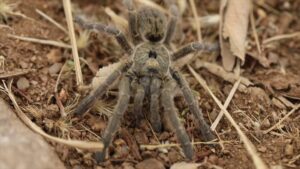
Wild animals explain it. Arboreal tarantulas use vertical surfaces, and our pink toe page (cross ventilation for Avicularia) shows how they build silk retreats on trunks and in leaves instead of burrows. Burrowers make a different home. Do Tarantulas Make Webs? covers the silk in both places, from burrow linings to tree retreats. Fossorial tarantulas: what wild burrows show adds that “fossorial” is a habit, not a fixed group, and that one burrow on film does not tell you what a captive enclosure will show. Where Do Tarantulas Live? puts both lifestyles on the map.
What this page gives you is our setup: glass for adults, plastic for young animals, cross ventilation at the substrate and the lid, live plants, a living substrate with springtails, and tanks sized and fitted to the species. None of these films gives a temperature or humidity setting to copy, so this page gives none. All of it comes from films made between 2018 and 2020.