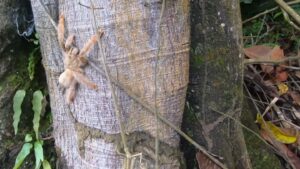
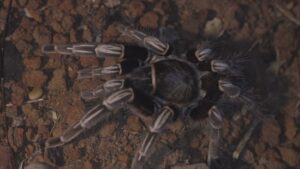
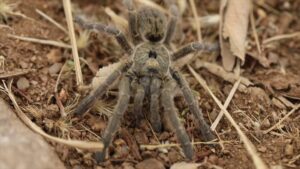
The tarantula “migration” seen in Colorado, Texas, California and other US states is mature male tarantulas of the genus Aphonopelma walking in search of females. It is not a seasonal trip to a destination. After years of growing up in a burrow, a male makes his final molt, leaves, and spends the rest of his short life looking for female burrows, in many species from late summer into autumn.[1][2] Males usually die after that first reproductive season.[3] The females stay home.
We have not filmed this in the United States, so there is no US migration footage on this page. What we can offer is the published field work on the American species and our own films of the same behavior in Mexican tarantulas, linked below.
What is actually happening?
Adult female tarantulas stay inside their retreats most of the time and usually do not move far from the entrance.[3] Males do the traveling. Andrew Smith, summarizing W. J. Baerg’s long study of an Arkansas colony, describes it like this: with the final molt “the males leave the safety of the burrow and become itinerant wanderers, cruising the hillsides of the colony in search of female burrows.”[1] Males of this kind are leggier and darker than the burrow-bound females.[1]
Smith himself uses the phrase “migratory pattern of behaviour” for it, and the English word has stuck. It describes the sight well, because a lot of males cross roads and hillsides at once, but the biology is different from a bird or butterfly migration. Nobody travels to a winter site and back. Baerg noticed that the movement of males often seemed to run in one direction, and that a male turned aside would quickly redirect himself. Smith reads that as evidence that females give off a chemical signal the males can follow.[1] That is a hypothesis, and the one telemetry study of wandering males does not clearly support it: in Texas, the overall movement of radio-tracked A. hentzi males was in all directions, randomness could not be excluded, and significant directedness was found in only three individuals.[7]
Pérez-Miles makes the same general point for tarantulas as a family: most are nocturnal sit-and-wait predators, but in the reproductive period wandering males can be seen by day searching for females.[3] Our page on how tarantulas mate and breed covers what happens when a male finds a burrow.
When does the tarantula migration happen?
There is no single date, because the “migration” is several species with their own breeding seasons. The revision of the US genus by Hamilton, Hendrixson and Bond (2016) gives the season for most species, and the pattern for the states people search for most looks like this.[2]
| State | Species (Hamilton et al. 2016) | When mature males leave their burrows |
|---|---|---|
| Colorado | Aphonopelma hentzi, east of the Rocky Mountains. A. marxi in the south-west of the state. | A. hentzi: depending on the locality, a spring and summer season (April to August) and a fall season (September to October), sometimes at the same place. A. marxi: fall, generally September to November. |
| Texas | Several species. A. hentzi is the most widely distributed in the US, and A. armada has a wide distribution across the state. | A. armada: evenings and early mornings from late spring to early summer. A. hentzi as above. |
| Texas, Rio Grande counties | A. moderatum and A. anax | A. moderatum: spring (March to June), shortly before sunset and on overcast afternoons. A. anax: April to July, with males seen in large numbers at night along roads after heavy rain. |
| California | A. iodius, A. eutylenum, A. johnnycashi, A. steindachneri and others, depending on the region | A. iodius: late summer to early fall, generally August to November. A. eutylenum and A. johnnycashi: fall, generally September to November. A. steindachneri: summer, July to August. |
| Arizona (for comparison) | A. chalcodes, among others | Summer, generally July to September. |
So the “autumn migration” that gets the headlines is real for some species and some places, and it is not the whole story. For A. hentzi, Hamilton and colleagues put the fall season at September and October. Their key to the male Aphonopelma of Colorado, Kansas, Oklahoma, Missouri, Arkansas and Louisiana lists only two species for Colorado: A. hentzi on the plains and the black A. marxi in the south-west.[2] Several older names you may meet, including A. coloradanum and A. wichitanum, are now synonyms of A. hentzi, and the World Spider Catalog lists A. hentzi (Girard, 1852) and A. marxi (Simon, 1891) as accepted species.[2][6]
Smith’s Arkansas colony shows two waves within one species. The main wave of males appeared from August to November, with a much smaller number in spring. Baerg thought the spring males were simply animals that had survived the winter. Smith disagreed and suggested that two waves are a back-up for the colony: if an early, hard winter ruins the autumn mating, the spring males still get egg sacs made by July or August.[1] For A. hentzi in Oklahoma, Smith reports that males molt out in two waves, the first in June and July and a smaller one in September.[1]
Day or night?
It depends on the species and the weather. Smith found A. hentzi males in Oklahoma crossing roads at night, with movement peaking from about nine in the evening, and sometimes by day when the sky was heavily overcast.[1] Prentice found males of the Arizona species A. paloma wandering by day in the late fall breeding season, especially from late morning to early afternoon, and no active males after dark; Hamilton and colleagues put that season at November and December.[4][2] That difference is one reason a single “best time to see them” does not exist.
Temperature matters too. Prentice lured Mojave Desert tarantulas out of their burrows at night temperatures as low as 7 °C, and concluded that the threshold for feeding is lower than the one required for males to start wandering and courting.[5]

How far do they walk?
Radio telemetry gives a measured answer for one species. Janowski-Bell and Horner followed 11 radio-tagged male A. hentzi on a ranch in Wilbarger County, Texas, in 1994 and 1995. Individual males moved up to 1,300 metres, over up to 18 days, while searching for mates, and their daily rates in the study’s table ranged from about 18 to 95 metres. The authors call it the first study to document male tarantula movement extensively.[7] Smith, citing Baerg, says large numbers of males may cross highways, towns and hillsides while seeking out far-flung parts of a colony, and suggests this movement spreads genes between colonies.[1] He adds that it must also bring neighboring colonies into contact and lead to hybridization, which he suggests may account for the large number of closely related species in North America. That count has since come down: Hamilton and colleagues evaluated all 55 nominal US species in 2016 and recognized 29; one more, A. jacobii, was described in 2024.[2][8]
How long do the males live afterwards?
A male Aphonopelma spends years growing up and weeks to months as an adult. Baerg’s laboratory males, collected as juveniles from an Arkansas colony, matured in 10 to 13 years.[1] Pérez-Miles gives up to 10 years to adulthood for A. hentzi in arid regions, against 3 to 6 years for most tarantulas in humid tropical and temperate climates.[3]
After the final molt the clock is short. One of Baerg’s laboratory males matured in August 1936 and died in August 1937.[1] Prentice, writing about the Mojave Desert species, calls it the general rule among males of most Aphonopelma species that even captive males rarely last through the year in which they matured.[5] In the field, Smith describes the end of the season as slow: as the cold weather settles in, surviving males grow feeble, stop feeding and drinking, and are eventually taken by ants.[1] Pérez-Miles states the general rule for the family, that males usually die after their first reproductive season, while females live much longer.[3] The numbers by species are on our page on how long tarantulas live.
The same behavior in Mexican tarantulas
We have filmed wandering males in Mexico, in the genus Brachypelma, not Aphonopelma. In our film The Mexican Red Knee Tarantula You’ve Never Seen Before (3:32) we say that in that part of Mexico males of one species wander at night, while on the west coast other Brachypelma species wander by day, mostly in the morning and evening. At 14:39 the film says the males emerge every September through January, and at 16:02 that on one coastal highway hundreds of males get killed by cars every mating season. Another of our Mexico films, Millions Own This Tarantula, describes the breeding season of the Brachypelma genus as running from August through January, with males wandering in the morning and evening (14:11). More of our Mexican footage is collected on Tarantulas of Mexico in the wild.
Seeing wandering tarantulas respectfully
The males you see are on the last stretch of their lives. A few simple habits are enough.
- Watch from a distance and leave the spider where it is. A male that is picked up, turned around or taken home is a male that does not find a female.
- If you drive roads in the plains or foothills in the evening, slow down. Our Mexico film shows what traffic does to them.
- Share the state and the season, not the roadside. This page names no viewing spots on purpose: we would rather not send crowds to the places where many males walk.
More on where tarantulas live and how they are classified is on our Theraphosidae overview.
References
- Smith, A. M. (1995). Tarantulas of the USA and Mexico (Theraphosid Spiders of the New World, vol. 2). Fitzgerald Publishing, London. The Arkansas colony chapter, summarizing the field and laboratory work of W. J. Baerg (1928, 1958), and Smith’s own A. hentzi field notes from Oklahoma.
- Hamilton, C. A., Hendrixson, B. E. & Bond, J. E. (2016). Taxonomic revision of the tarantula genus Aphonopelma Pocock, 1901 (Araneae, Mygalomorphae, Theraphosidae) within the United States. ZooKeys 560: 1-340. doi:10.3897/zookeys.560.6264 (open access).
- Pérez-Miles, F. (2020). Introduction to the Theraphosidae. In: Pérez-Miles, F. (ed.), New World Tarantulas, Zoological Monographs 6, Springer, pp. 1-23. doi:10.1007/978-3-030-48644-0_1
- Prentice, T. R. (1992). A new species of North American tarantula, Aphonopelma paloma (Araneae, Mygalomorphae, Theraphosidae). The Journal of Arachnology 20: 189-199. Cited as 1993 in Hamilton et al. (2016).
- Prentice, T. R. (1997). Theraphosidae of the Mojave Desert west and north of the Colorado River (Araneae, Mygalomorphae, Theraphosidae). The Journal of Arachnology 25: 137-176.
- World Spider Catalog (2026). Natural History Museum Bern. wsc.nmbe.ch
- Janowski-Bell, M. E. & Horner, N. V. (1999). Movement of the male brown tarantula, Aphonopelma hentzi (Araneae, Theraphosidae), using radio telemetry. The Journal of Arachnology 27: 503–512 (open access, americanarachnology.org).
- Hamilton, C. A., Hendrixson, B. E. & Silvestre Bringas, K. (2024). Discovery of a new tarantula species from the Madrean Sky Islands and the first documented instance of syntopy between two montane endemics (Araneae, Theraphosidae, Aphonopelma): a case of prior mistaken identity. ZooKeys 1210: 61–98. doi:10.3897/zookeys.1210.125318 (open access).