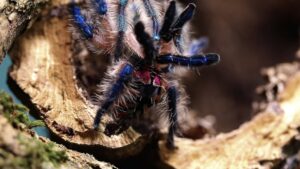
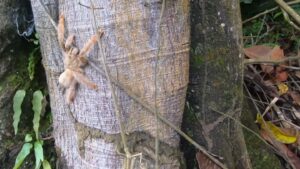
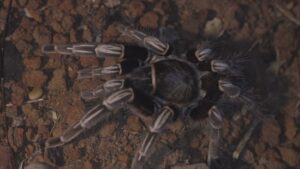
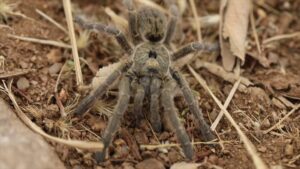
Yes. Some tarantulas live where snow falls, and a few live higher than any other tarantula on record. In our Chile films we found them under rocks between patches of snow at about 1,100 to 1,200 metres. Both highest published records come from Peru: Hapalotremus vilcanota at 4,524 metres (2018) and Antikuna valladaresi at 4,689 metres (2021).1,2 This page collects what those papers say about cold habitats and what we saw and measured ourselves.
Tarantulas in snow: our Chile films
The snow footage is from our 2018 Chile trip. In Tarantula under Ice & Snow? we start in the Andes in autumn, about two months before the usual start of winter, and 30 to 50 centimetres of snow has just fallen (at 2:00 in the film). We were at about 1,200 metres, and the temperature had dropped by about 20 degrees Celsius, with a lot of rain, before it started to snow. Snow hides the rocks, so searching was hard; we drove down to about 1,100 metres, where the forest floor had less snow than the open ground. It is a Euathlus; I cannot say which species.

What we found tells you how the animals use the cold ground. Two moults of adult females on the rocks were proof for me that tarantulas live there, and scorpions, centipedes and ants were also out even though it was cold. With the sun out the thermometer read about 5 to 6 degrees Celsius, and the day before had been below zero. Directly under a rock beside snow sat a small juvenile, with no silk or webbing at all. For me it was the first time I had found tarantulas in a snowy place (at 5:12).

Finding the adults was hard. After hours of turning rocks we had found three moults of adult females, an old egg sac and two spiderlings, but no adult; later the count was four freshly hatched egg sacs and at least nine moults under rocks, with silk lines but no spider. The big burrows and moults were all empty, and I do not know where the large females were. By the end of the film it is 16 to 17 degrees and the snow is retreating.
Do tarantulas hibernate?
Not in the juvenile I found in that film. The animals were not hibernating. Snow was coming, but they were still active and waited under the rock for prey (at 8:40). One animal in autumn is a single observation, not a rule for tarantulas in general. Work on the Peruvian highland genus Hapalotremus (2018) adds a winter record of its own: a female of H. vilcanota was found with 27 early-instar young in the same burrow on 4 July, in the dry, cold season.1 The authors suggest from collection dates that males mature at the start of the rainy summer, that females make their egg sac at the start of the dry winter, and that cold-habitat females may produce fewer, larger eggs.1 They present this as a likely scenario, not a measured one.
Euathlus condorito: a tarantula of the ski slopes
Our short film This Tarantula Enjoys The Snow in Nature was shot at a ski area in the central Andes at about 2,400 metres. The target species was Euathlus condorito, described by Perafán and Pérez-Miles in 2014 from the same altitude; the holotype is a male collected at 2,400 metres in the Santiago region of Chile in December 2005.3 In the film we show the animals under rocks in shallow cave systems, we found females with offspring, and the population looks fairly stable to me (at 0:58). They spend the winter blanketed by snow for months (at 1:21). I did not film that in winter.

In the earlier film Tarantulas Above The Clouds we see the same species at the same altitude, with the temperature check. It feels cold up there. At the end the external sensor in the habitat reads 16 to 17 degrees Celsius. I assume the temperature inside the burrows is about the same, and I think the rocks store heat from the sun. During a night of 12 hours without sun, and in winter with snow everywhere, it surely gets much colder and probably below zero (at 10:25). A soil logger run for one year at 2,400 metres in the central Chilean Andes, where E. condorito was studied, recorded minima of about minus 6 degrees Celsius in autumn and a stable 0 degrees under winter snow. In the laboratory the species proved freeze-avoidant: it supercooled at minus 3.0 ± 1.3 degrees Celsius and none survived freezing.5 I did not measure inside a burrow.
More about the other Chilean species is on Chilean Tarantulas in the Wild, which also hosts our film on a Chilean Euathlus in a dry habitat that looks like southern Europe to me. In that area winter temperatures are about 8 degrees Celsius, with about 180 millimetres of rain over the winter months (at 5:18).
Under the rock: temperatures we measured
Every rock here is a small climate zone. Below are the temperature readings I give in our field films, side by side. Each is a single reading from one day, not a record of a season.
| Film and place | Altitude | Outside | Under rock or in burrow |
|---|---|---|---|
| Peru highlands, morning (2:57) | highlands, about 4,000 m in the film’s opening | 8 to 10 °C in the morning | 11 to 12 °C under rocks |
| Chile, Grammostola burrow (3:44) | about 2,050 m | 17 °C | 20.3 °C inside the burrow |
| Chile, E. condorito habitat (10:25) | about 2,400 m | 16 to 17 °C (sensor in habitat) | assumed similar, not measured |
| Chile, snow film (3:19) | about 1,100 to 1,200 m | 5 to 6 °C in the sun, below zero the day before | not measured |
In the Peru film I show what I think protects the animals. Sparse low shrubs and Peruvian feathergrass, Jarava ichu (formerly Stipa ichu), cover the ground and insulate the soil where the tarantula lives (at 7:50). The spiders sit under rocks about 50 times their own size, which gives them good insulation in the cold, and the grass breaks the wind, which can cut temperatures sharply. Rocks and grass together keep the temperature more or less constant over the year (at 8:41). On the rocks the papers agree: H. vilcanota was found in burrows under big rocks, and the Antikuna females described below lived under angular rocks lying on the ground.1,2
The Chile temperatures also show one more thing: the Grammostola burrow in our film was warmer inside than outside (3:44). You can watch that film on our page about the rose hair tarantula. For what wild burrows look like across the family, see Fossorial tarantulas: what wild burrows show and Where Do Tarantulas Live?
The altitude records
Two papers set the published records. In 2018 Ferretti and colleagues revised Hapalotremus and described H. vilcanota from a female holotype collected at 4,524 metres in the Cordillera Vilcanota, southern Peru, on 4 July 2006, giving it as the highest altitude record for a theraphosid.1 In 2021 I described the genus Antikuna with Kaderka, Ferretti, Lüddecke and West, and the type data for A. valladaresi give 4,689 metres, reported as a new highest altitude record for the family.2 Both are published records, not a claim that nothing lives higher. A 2023 paper by Kaderka and colleagues still names Antikuna as holding the record for Theraphosidae, gives Hapalotremus as occurring up to about 4,600 metres and a third genus, Urupelma, at 4,450 metres.4

For context, the 2018 paper lists other high tarantulas: Haplocosmia himalayana at about 2,100 metres, Aguapanela arvi up to 2,400, Cyriocosmus up to 3,000, Euathlus up to 3,200 and Bistriopelma up to 4,398 metres.1 At the H. vilcanota site the authors describe a dry, cold season from April to September, atmospheric pressure of 50 to 60 percent of that at sea level, and glaciers ending at about 4,700 to 5,000 metres. Specimens lived in burrows under big rocks.1
The Antikuna paper gives more detail on the coldest sites. At the A. valladaresi locality the authors call the habitat semi-arid tundra slopes of the Andean Puna, with a coldest-month average of 4 degrees Celsius and summer months averaging 18; several females carried egg sacs about 10 millimetres across, at no particular time of year.2 Females, subadults and juveniles lived in self-made retreats 20 to 25 centimetres long directly under angular rocks; some burrows angled down into the soil and ended in a blind chamber, with a light silk lining inside and no apparent silk at the entrance.2 The habitat photograph in the paper is captioned as showing usual low temperatures and rainfall or snowfall.2 For A. cyanofemur, the field day was cloudy with temperatures up to 10.5 degrees and snow showers until 11 a.m.2 The authors describe the Andean Puna as having a snow line at about 5,000 metres and temperatures between 0 and 17 degrees, and say the genus lives on grassland between the timber line and the permanent snow fields.2 They also write that mountain ridges and zones too cold or too arid are barriers that isolate tarantula populations.2 The details for each species are on our Antikuna page and the high-altitude genus is covered on Hapalotremus: the high-Andes tarantulas.
Snow is not limited to the highest sites. Lower down, a Hapalotremus species from the Yungas of northwestern Argentina lives at about 1,300 to 2,000 metres in a climate with winter snowfalls, where temperatures as low as minus 10 degrees Celsius are common.1 The 2023 authors note that adapting to low ambient temperature is difficult for ectothermic tarantulas. Their phylogeny suggests that the tribe Hapalopini moved into the mountains at least three times independently, in Antikuna, Hapalotremus and Urupelma, or once, with later returns to lower ground in the other lineages.4
Our films from the high Andes
We went to Peru to find out what the limit for tarantulas is: how cold they can survive and how high they can live. The film We Found A New Tarantula Species Above The Clouds opens with that question (at 1:19). Both our Peru highland tarantulas page and the Hapalotremus page host the film. Cusco sits at over 3,500 metres, and the first long hike brought headaches. On the second day we stood at about 4,200 metres and turned rocks, then found two Hapalotremus, an adult and a juvenile under huge rocks (at 5:38).
In How This Team Found Four New World Tarantula Species in 10 Minutes I find a small adult female about two centimetres long under rocks at around 4,200 metres in the grassland. It is most likely a dwarf Hapalotremus (at 5:05). We took temperature measurements on the surface and underneath the rocks, but the values are not in the film. You can find it on the Peru highland tarantulas page.
For Antikuna cyanofemur, the type-site hike started with a drive to about 4,400 metres (at 2:20), and at the type site snow blankets the landscape outside while the animals live in their shelters, with adult females and juveniles of every stage (at 6:20). More is on the Antikuna page.

Short answers
Do tarantulas live in snow? Some do. In Chile we filmed a Euathlus juvenile under a rock next to snow in Chile, and the highland Hapalotremus and Antikuna live where snow showers fall and the snow line is above them.
Which tarantula lives highest? Antikuna valladaresi at 4,689 metres (2021) and Hapalotremus vilcanota at 4,524 metres (2018) are the published records.
Do tarantulas hibernate? In our snow film the juvenile stayed active at 5 to 6 degrees; one burrow with a female and 27 young was recorded in a Peruvian winter. Neither is a general answer for all tarantulas.
References
- Ferretti, N., Cavallo, P., Chaparro, J. C., Ríos-Tamayo, D., Seimon, T. A. & West, R. (2018). The Neotropical genus Hapalotremus Simon, 1903 (Araneae: Theraphosidae), with the description of seven new species and the highest altitude record for the family. Journal of Natural History 52(29-30): 1927-1984 (pp. 1927, 1935, 1967, 1975, 1977, 1980-1981). doi:10.1080/00222933.2018.1506521
- Kaderka, R., Ferretti, N., Hüsser, M., Lüddecke, T. & West, R. (2021). Antikuna, a new genus with seven new species from Peru (Araneae: Theraphosidae: Theraphosinae) and the highest altitude record for the family. Journal of Natural History 55(21-22): 1335-1402 (pp. 1335, 1338-1339, 1349, 1370, 1373, 1381, 1386, 1401). doi:10.1080/00222933.2021.1936680
- Perafán, C. & Pérez-Miles, F. (2014). The Andean tarantulas Euathlus Ausserer, 1875, Paraphysa Simon, 1892 and Phrixotrichus Simon, 1889 (Araneae: Theraphosidae): phylogenetic analysis, genera redefinition and new species descriptions. Journal of Natural History 48(39-40): 2389-2418 (p. 2404). doi:10.1080/00222933.2014.902142
- Kaderka, R., Lüddecke, T., Řezáč, M. & Řezáčová, V. (2023). Revision of the Peruvian tarantula Homoeomma peruvianum (Chamberlin, 1916): description of a new genus with eleven new species and insights to the evolution of montane tarantulas (Araneae: Theraphosidae: Theraphosinae). Journal of Natural History 57(41-44): 1710-1824 (p. 1723). doi:10.1080/00222933.2023.2265621
- Cubillos, F. A., Cáceres, M., Villablanca, A., Villarreal, P., Baeza, M., Cabrera, R., Graether, S. P. & Veloso, C. (2018). Cold tolerance mechanisms of two arthropods from the Andean Range of Central Chile: Agathemera crassa (Insecta: Agathemeridae) and Euathlus condorito (Arachnida: Theraphosidae). Journal of Thermal Biology 74: 133–139. doi:10.1016/j.jtherbio.2018.03.018
Explore this site
For the wider picture, see the Theraphosidae overview and the Tarantula Gallery.