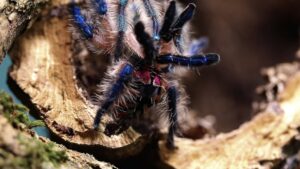
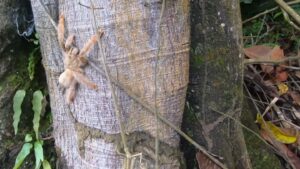
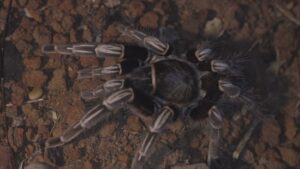
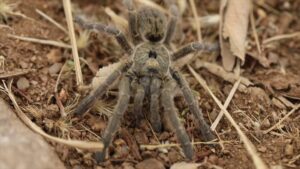
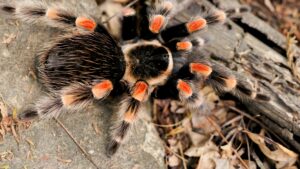
“Thai black tarantula” is a trade name, not a scientific one, and it points mainly at Melopoeus minax (Thorell, 1897), a black burrowing tarantula from Myanmar and Thailand. Keepers and dealers also use it for Ornithoctonus aureotibialis von Wirth & Striffler, 2005, a dark tarantula from Thailand with a gold-orange fringe on its front legs. The two belong to different genera. This page sets out what each name means, how M. minax got its current genus, and how to tell the two apart.[1][2]
Which species does “Thai black” mean?
- Melopoeus minax (Thorell, 1897): the species the name most often means. In our film we describe it as completely black and quite big.[1]
- Ornithoctonus aureotibialis von Wirth & Striffler, 2005: also sold and discussed as a Thai black, which is why searches for the name land on both. We know it as the Thai golden fringe tarantula.[2]
Related species that are not Thai blacks: the cobalt blue tarantula, Melopoeus lividus, is blue and black and lives in the same part of the world, and Chilobrachys species share the same forests.
Naming history of Melopoeus minax
- Melopoeus minax Thorell, 1897: described from a single female; the holotype is in the Museo Civico di Storia Naturale “Giacomo Doria” in Genoa.[1][3]
- Ornithoctonus minax: the name under which the male was described in 1935.[1]
- Haplopelma minax: after Raven (1985) treated Melopoeus as a junior synonym of Haplopelma, the species was listed there. This is the name in most hobby literature and the one Smith (1996) used when he redescribed the male.[1][4]
- Cyriopagopus minax: Smith & Jacobi (2015) moved it again, folding Haplopelma and Melopoeus into Cyriopagopus.[1]
- Melopoeus minax again, 2026: Smith, Daniel and Vignaud found that the type of Cyriopagopus paganus, the type species of that genus, is lost, so they treated Cyriopagopus as a nomen dubium and restored Melopoeus and Haplopelma as separate genera. They returned seven species to Melopoeus, among them minax. The World Spider Catalog follows this and lists Melopoeus minax as accepted, distribution Myanmar and Thailand.[1][5]
- “Haplopelma vonwirthi” Schmidt, 2005: an unavailable name (nomen nudum). Von Wirth and Striffler considered it most probably a synonym of H. minax, though they could not check the type material.[2] Schmidt then republished the description in the same year with a type depository, and the World Spider Catalog now accepts Melopoeus vonwirthi (Schmidt, 2005) as a valid species; Smith, Daniel and Vignaud (2026) list it among the species of Melopoeus.[1][5][6]
Old labels therefore read Haplopelma minax or Cyriopagopus minax, and all of them mean the same spider. In the film I say Melopoeus is the more precise name for it, and the 2026 paper has since gone the same way.
Names of Ornithoctonus aureotibialis
It was sold for years as Haplopelma sp. “aureopilosum”. Schmidt & Samm (2005) published “Haplopelma chrysothrix”, which is a nomen nudum because no type depository was named. Von Wirth & Striffler described the species validly in the same year, in Ornithoctonus. Our page on the Thai golden fringe tarantula covers the names, size, range and our 2018 field film in full.[2]
How to tell them apart
The quickest mark is the fringe. Von Wirth and Striffler separate O. aureotibialis from every other Ornithoctonus by orange to golden hairs on the outer side of the patella and tibia of legs I and II.[2] Melopoeus minax has no such fringe. Smith describes the male of M. minax as deep chocolate brown with fawn-brown hairs and faint white bands on the leg joints.[4] The spider at the top of this page is O. aureotibialis: blackish legs, with gold-brown on the abdomen when seen from above.
Other differences need a microscope. Von Wirth and Striffler define Ornithoctonus against the Haplopelma minax group by the number of spines on the fourth metatarsus and the palpal coxa, by a notch in the male palpal bulb and by a notch in the female spermathecae.[2] Adult males of O. aureotibialis are pale beige on top with black femora, palps and tarsi, which differs from Smith’s description of the male M. minax.[2][4] For a spider with no locality data, the safe wording is “Thai black” for the trade name and the species name only where the fringe, the male or a specialist confirms it.
What we filmed
We went to a national park in north-western Thailand to find minax in Chilobrachys and Haplopelma minax on the same day?!, which is also on our Malaysia and Thailand page. Phil Samadi of World of Spiders gave me the locality information. We spent two days there and found about 40 Chilobrachys, but no minax. Some of the footage in the film was shared by Phil Samadi.
The golden fringe tarantula we did find. Thai Golden Fringe Tarantula in the wild | Ornithoctonus aureotibialis follows the search in southern Thailand in the rainy season, and its closing segment at 08:14 in Malaysian Earth Tiger: The Tarantula Renamed 3 Times (Omothymus) AND Electric Blue Tarantula Bonus shows another one. Both films are on the golden fringe page. For the wider family, see our Theraphosidae overview.
References
- World Spider Catalog (2026), Melopoeus minax Thorell, 1897 and genus page Melopoeus Pocock, 1895. Natural History Museum Bern. Accessed 1 October 2026.
- von Wirth, V. & Striffler, B. F. (2005). Neue Erkenntnisse zur Vogelspinnen-Unterfamilie Ornithoctoninae, mit Beschreibung von Ornithoctonus aureotibialis sp. n. und Haplopelma longipes sp. n. (Araneae, Theraphosidae). Arthropoda 13(2): 2-27.
- Thorell, T. (1897). Viaggio di Leonardo Fea in Birmania e regioni vicine. LXXIII. Secondo saggio sui Ragni birmani. I. Parallelodontes. Tubitelariae. Annali del Museo Civico di Storia Naturale di Genova 37: 161-267 (Melopoeus minax, p. 182).
- Smith, A. M. (1996). A new species of Haplopelma (Araneae: Theraphosidae), with notes on two close relatives. Mygalomorph 1: 21-32.
- Smith, A. M., Daniel, B. A. & Vignaud, B. (2026). Nomenclatural notes on the Ornithoctoninae genera Cyriopagopus Simon 1887, Haplopelma Simon 1892 and Melopoeus Pocock 1895 (Araneae: Theraphosidae) with the intention of restoring the genera Haplopelma and Melopoeus. Journal of the British Tarantula Society 40(3): 15-28.
- Schmidt, G. (2005). Neupublikation einiger von mir in “Arachnol. Mag.” und “Tarantulas of the World” zwischen 2000 und 2005 veröffentlichten Arbeiten. Tarantulas of the World 110 (Sonderheft): 3-49.
Related Images:

![Cyriopagopus cf doriae (Thorell, 1890)], female, Brunei, Sabah, Sarawak - Borneo](https://birdspiders.ch/wp-content/gallery/theraphosidae/Cyriopagopus-cf-doriae-Thorell-1890-female-Brunei-Sabah-Sarawak-Borneo.jpg?t=1673691486 "Cyriopagopus cf doriae (Thorell, 1890)], female, Brunei, Sabah, Sarawak - Borneo")